
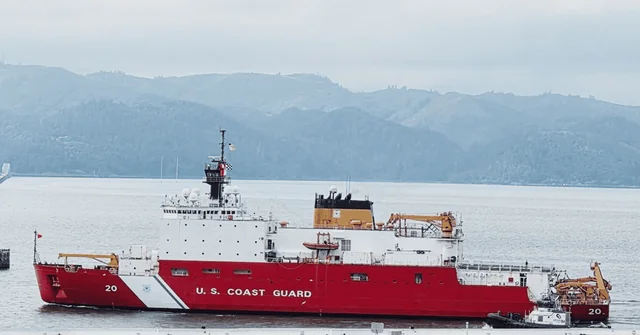
The U.S. Coast Guard icebreaker Healy experienced a major mechanical issue during sea trials off the coast of Washington. It was towed back to Seattle on July 13 for an investigation and extensive repairs, according to information from the Coast Guard shared with gCaptain.
Fortunately, there were no injuries reported from the incident, which happened while the 420-foot icebreaker was operating northwest of Port Angeles. Tugboats returned the vessel safely to Seattle, where it will be thoroughly examined and repaired.
“The crew of Coast Guard Cutter Healy acted quickly and effectively during this incident,” said Admiral Kevin E. Lunday, the Coast Guard’s commandant.
“While the Coast Guard continues its missions in the Arctic, this incident highlights the urgent need for President Trump’s plan to quickly expand and modernize the icebreaker fleet. The United States has important security, economic, and strategic interests in the Arctic. We need a strong icebreaking fleet operated by the Coast Guard to ensure access year-round, which helps protect our northern border in Alaska and the maritime routes in the Arctic,” Lunday added.
A publicly accessible webcam captured video of the Foss Maritime tug Marshall Foss towing Healy towards Seattle on July 13. Automatic Identification System (AIS) data confirmed that the icebreaker was being towed after operating off the coast of Washington.
The AIS data indicated that Healy had been conducting high-speed sea trials recently, reaching speeds over 20 knots before suddenly reducing speed to about 2 knots and stopping completely. The vessel was then assisted by Marshall Foss near Air Station Port Angeles before being towed back to Seattle.
A source familiar with the situation told gCaptain that the mechanical issue involved a crankcase explosion in one of the engines during the sea trials that followed its recent maintenance period. Although there were no injuries, the affected engine room was shut down, and the tugboat was sent as a precaution, according to the source.
The Coast Guard has not disclosed further details about the mechanical issue or the damage it caused.
Experts in marine engineering noted that the effects of a crankcase explosion can vary widely. Damages can range from minor problems that require little attention to severe engine failures necessitating extensive repairs.
Healy uses four medium-speed Sulzer 12ZAV40S diesel generators split between two engine rooms that are separated by a fire-resistant wall. This design, based on Finnish icebreakers, offers some redundancy because each engine room can work independently.
In modern marine diesel engines, crankcase relief valves help release pressure during an internal explosion, mitigating damage in many cases. A minor incident might only require inspection and cleaning of the engine room and replacement of any damaged parts.
However, more severe explosions can crack engine frames, damage crankshafts, or cause secondary fires, which may require extensive repairs or engine replacement. Currently, the extent of the damage on Healy remains uncertain.
Marine engineers emphasized that even serious crankcase explosions are usually repairable and do not necessarily mean the loss of a vessel. Since Healy has four diesel generators across two engine rooms, an incident in one room wouldn’t necessarily leave the ship beyond repair. Nevertheless, the Coast Guard would likely halt operations until the issue is identified and fixed.
This incident is the latest engineering challenge for the Coast Guard’s largest and most capable scientific research icebreaker.
Healy previously faced a propulsion motor fire while working in the Arctic in 2020, which led to the cancellation of its annual Arctic deployment. The vessel later underwent significant repairs, including replacing its starboard propulsion motor before returning to active duty. Healy also had another fire in August 2024, which cut its Arctic patrol short.
Commissioned in 1999, the 420-foot Healy is the main high-latitude research icebreaker in the U.S., supporting scientific missions, Arctic awareness, and national security operations. Its role has become increasingly vital due to melting sea ice that raises commercial and strategic interest in the Arctic.
Extended repairs could impact the Coast Guard’s Arctic operations at a time when it struggles with a lack of operational icebreaking capacity. Besides Healy, the Coast Guard only operates two other ocean-going icebreakers: the aging heavy icebreaker Polar Star and the newly commissioned Storis. Last year, Healy returned to Seattle after a 129-day Arctic patrol that highlighted growing strategic competition in the region, where it monitored several Chinese research vessels operating in U.S. waters.
This incident comes as the Coast Guard's troubled Polar Security Cutter program is delayed further, with a new government report predicting the first heavy icebreaker will be delivered in March 2033, nearly a decade later than planned. The Polar Security Cutter is set to replace the aging Polar Star, which has been in service since 1976 and has undergone multiple life-extension efforts.
On a positive note, the Coast Guard has made better progress on its Arctic Security Cutter program. Currently, plans include building the first four medium icebreakers in Finland, with production later moving to U.S. shipyards. The first cutter is expected to be delivered by the end of 2028.
The Coast Guard said Healy will undergo a thorough investigation of the mechanical issue before significant repairs begin, but no timeline has been given for when the vessel will return to service.