
By Forrest Crellin, Aleksandar Vasovic and Luiza Ilie
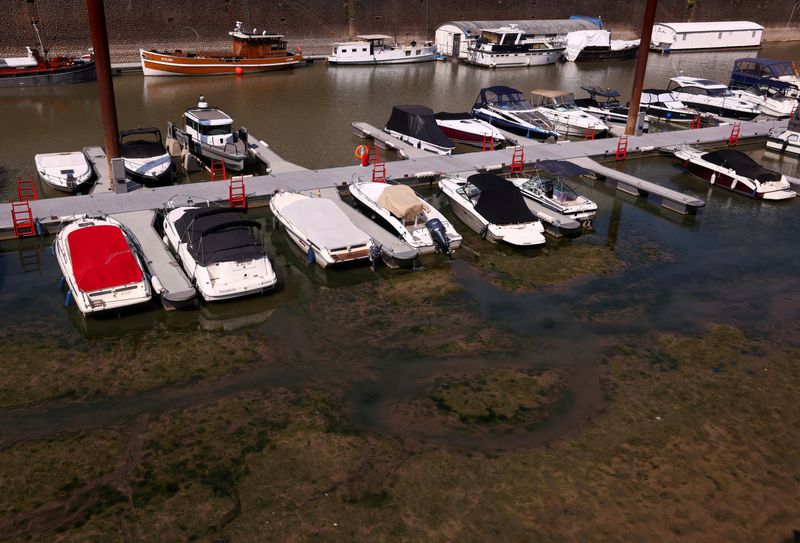
PARIS/BELGRADE/BUCHAREST, July 31 (Reuters) – Europe is facing record low water levels in its major rivers, impacting the transport of goods, reducing electricity production, and diminishing company profits. This situation has raised concerns about the economic consequences of extreme heat and irregular rainfall.
As Europe warms faster than any other continent and endures record-breaking heatwaves, the ongoing drought highlights the urgent need to rethink business operations.
From the busy port of Rotterdam to hydropower stations in Serbia, waterways are becoming less dependable for transporting essential goods like grains and oil, or for generating electricity at a time when many people need to cool their homes.
“This is not just affecting one area, but is impacting the entire European landscape,” stated Alessandro Armenia, a power analyst at commodities data and analytics firm Kpler.
“With the current situation, we could either face blackouts or need to invest significantly more in energy solutions.”
HYDROPOWER AND NUCLEAR OUTPUT CUT
In Hungary, nuclear power production has decreased, and in Serbia, hydropower output is down due to the extremely low water levels in the Danube River, which runs through major cities like Vienna, Budapest, and Belgrade on its way to the Black Sea.
Hungary’s Paks nuclear power plant, providing nearly half of the country’s electricity, will shut down on Monday and may remain closed for weeks, as the river, which supplies cooling water, is expected to stay too low for safe operation.
In Serbia, the Djerdap 1 hydropower plant's output has dropped to 20% of its capacity, according to production director Davor Maljokovic. The shipping channel beside the plant has shrunk, revealing sandbanks and gravel bars.
The water shortage has also affected cooling systems at Serbia's Kostolac coal-fired power plants, leading to reduced output, as reported by Serbia’s state power utility EPS.
Both Serbia and Hungary plan to import electricity to compensate for the reduction in local production, which can be expensive when demand is high on the spot market.
Romania’s state nuclear power company, Nuclearelectrica, had to shut down one of its two reactors earlier this week for similar reasons, with the second reactor likely to follow soon, risking a fifth of the nation's electricity supply.
France is also facing a decrease in nuclear power generation due to low water levels and rising river temperatures.
WATER LEVELS ALSO DISRUPT TRANSPORT
Energy production isn’t the only area affected.
Cezar Gheorghe from Romanian grain market consultancy AGRIColumn mentioned that farmers along the Danube are struggling to ship their crops due to low water levels blocking several river ports.
“Only the ports closer to the Black Sea are still operational. Barges can’t navigate through other ports,” Gheorghe stated.
“Buyers might offer farmers lower prices and switch to trucking their goods, although there might also be a shortage of trucks.”
Simultaneously, cargo volumes moving to and from Rotterdam – Europe’s largest sea port – have declined slightly each week since July began and are now about 10% below normal, according to a port spokesperson.
Chemical and oil tankers, along with dry bulk carriers, are particularly affected due to their heavier draft, which requires deeper water.
DROUGHT REDUCES COMPANY EARNINGS
In addition to the natural destruction from wildfires and heatwaves causing numerous excess deaths, companies are feeling the financial strain from climate changes.
Austrian company Verbund, which produced around 85% of its electricity from hydropower last year, announced that drought conditions reduced earnings by about €370 million in the first half of the year compared to normal conditions.
French state utility EDF stated that its earnings for 2026 are expected to drop by 10% due to low market prices and decreased power output from heatwaves.
In Italy, the Po River basin is facing severe water shortages, threatening rice crops and drinking water supplies across northern regions.
Renato Mazzoncini, CEO of regional utility A2A, indicated that hydropower production this year could fall to 3.9 TWh compared to a historical average of 4.1 TWh.
“Some of our reservoirs are under pressure,” he remarked. “We might need to start doing a rain dance.”