
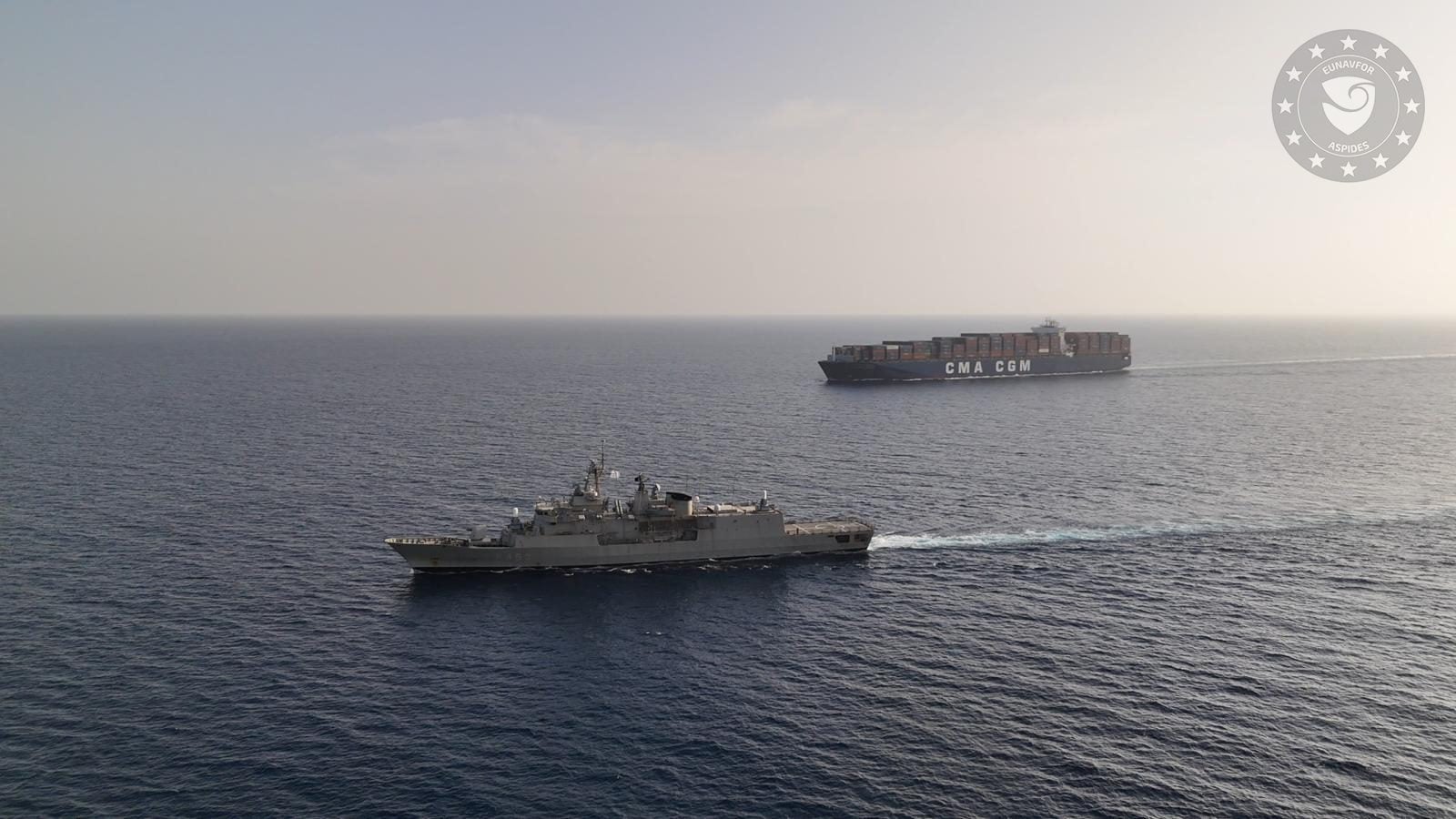
By Paul Morgan (gCaptain) - The idea of a multinational mission to protect commercial shipping in the Strait of Hormuz has gained importance after European leaders met in Paris today. This comes even as Iran and the U.S. have declared the waterway "open" following a ceasefire related to Lebanon.
Chaired by Emmanuel Macron and Keir Starmer, the meeting included representatives from around 40 countries. This shows that Europe is gearing up for a maritime stabilization operation after conflicts. Leaders or their senior representatives from Germany, Italy, and various other nations from Europe, Asia, and the Middle East were expected to take part, some virtually.
For shipping markets, the symbolism of this meeting holds great significance. It is even more important for governments. As countries begin to hold meetings about restoring freedom of navigation, the focus is shifting from political statements to actual planning. There are already differing claims about whether this freedom has been restored.
Iran's Foreign Minister, Seyed Abbas Araghchi, stated that the strait is "completely open" for all commercial vessels during the ceasefire, with transits following a "coordinated route" along Iran's coast. U.S. President Donald Trump supported this, saying the waterway is "completely open and ready for business," but noted that the U.S. naval blockade would still be in effect regarding Iran.
For industry players, these declarations raise many questions. The reopening seems conditional, linked to the ceasefire and routing guidance from Iran, leading to uncertainty about whether vessels need to coordinate their movements or seek permission to pass through.
The Strait of Hormuz is one of the world's most crucial maritime chokepoints, responsible for about 20% of global oil and significant liquefied natural gas transport under normal trading conditions. Any long-term disruption can quickly impact tanker rates, fuel prices, inflation, insurance costs, and supply chains.
In this context, German Chancellor Friedrich Merz has indicated that Germany is ready, with conditions, to help secure maritime traffic through Hormuz. Merz mentioned that Germany would support such efforts if there is a ceasefire, a mandate from the international community, ideally from the United Nations, and approval from the German parliament.
This stance reflects both the constraints of German law and a broader European desire to avoid direct combat while still protecting global trade routes. There is a need to reconcile the official reopening with on-the-ground realities.
The Paris summit seems focused on making this distinction clear. According to Reuters, the mission being discussed is framed as multilateral and defensive, aimed at ensuring safe passage rather than engaging in offensive military actions.
This wording is critical for the maritime industry. Defensive operations could involve mine-clearing, surveillance, traffic management, intelligence sharing, and escort services for merchant vessels. These tasks are specialized but crucial for commercial viability, especially if the strait's reopening is restricted by routing controls and ongoing security threats.
French Defence Minister Catherine Vautrin mentioned that several European countries have the necessary capabilities for mine clearance in Hormuz. She highlighted nations like Belgium, the Netherlands, and France, noting they could provide "fully supported escort services" for ships passing through the strait.
This operational detail is significant. If the waterway is mined, poses risks from drifting hazards, or remains uncertain despite reopening claims, minehunters and hydrographic assets may be more essential in the early stages than frigates. Restoring a sea route involves instilling confidence in commercial operators, charterers, and insurers.
Reports from German sources suggest Berlin might offer mine-countermeasure or reconnaissance vessels, while deploying frigates is considered less likely. Germany has not confirmed its contribution yet, but this aligns with the capabilities of the German Navy and Europe’s maritime strengths.
For shipowners and operators, confidence is key. A nominal reopening of Hormuz—especially one that requires a coordinated route amid an active U.S. blockade—has little value if underwriters deem the route too dangerous, crews hesitate to sail, or charterers fear delays and contractual issues. A successful coalition would need to provide more than just a naval presence. Clear routing advice, shared intelligence, quick response capabilities, and visible progress in mine clearance would be essential.
The political landscape remains complex. Significantly, the United States, Israel, and Iran are not major participants in the current European-led discussions. Future coordination with Washington and Tehran may still be required, but the summit's immediate goal is to unify non-belligerent nations around a stabilization plan.
This reflects a practical reality. Shipping lanes are effectively reopened when neutral parties can ensure safe commercial passage, especially when main actors announce the route is open while also enforcing measures that complicate transit.
Historically, Europe set up the European Maritime Awareness in the Strait of Hormuz initiative, which focused on surveillance and reassurance. A new mission would likely be larger, more robust, and more focused on mine warfare and escorted transit if risks remain even after the reopening.
Markets are already paying attention. Energy traders and freight desks reacted positively to signs of diplomatic efforts and reopening discussions, with broader investor confidence boosted by hopes for de-escalation in the region.
For the maritime sector, the Paris summit sends a strong message: Europe is not just talking about the strategic importance of Hormuz anymore; it is starting to plan how to make any reopening a reality.
Whether this plan leads to a functioning naval coalition will depend on the durability of the ceasefire, legal frameworks, and political commitment. For tanker owners, LNG carriers, insurers, and commodity traders, one thing is already clear.
The Strait of Hormuz may be declared open, but making it truly safe, predictable, and operational requires careful planning, protection, and trust.