
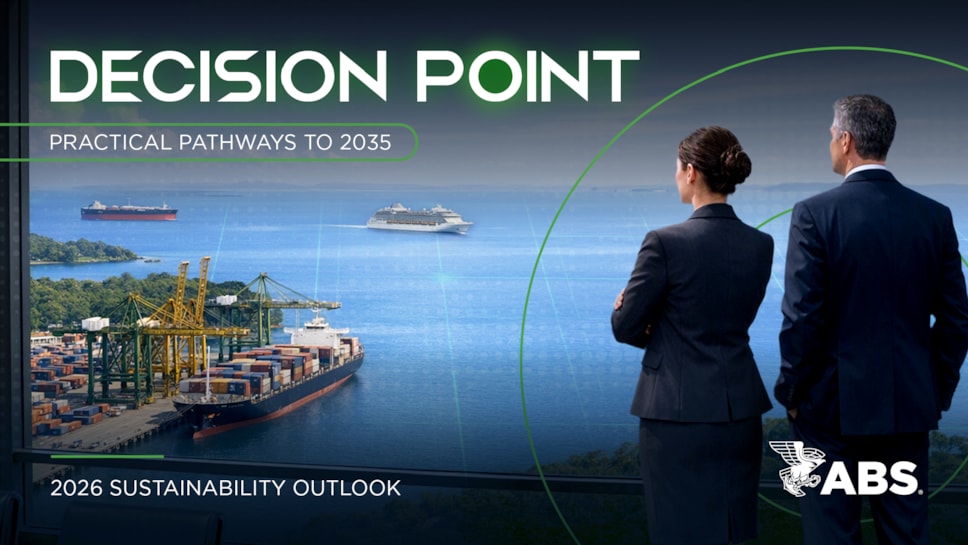
The annual ABS report provides a strategic guide for shipowners dealing with fragmented regulations, rising carbon costs, and changing fuel options.
According to the 2026 ABS Outlook, the main challenge for shipping organizations is to effectively navigate decarbonization while staying competitive, maintaining asset value, and ensuring access to capital.
Titled Decision Point: Practical Pathways to 2035, this report explores the decisions shipowners must make regarding strategy, operations, and investments as regulations evolve, carbon costs rise, and alternative fuels and technologies emerge.
“The industry has entered a new phase. For many years, the conversation focused on finding the best future fuel. Now, the challenge is broader. Shipping companies are investing in assets that will be in use until the 2040s and must navigate regulatory uncertainty, changing market demands, and evolving technologies. Achieving success will require practical decisions that generate value across various future scenarios,” stated John McDonald, ABS Chairman and CEO.
The report emphasizes that there is no single best path for the industry; rather, the best strategy will depend on factors like how vessels trade, their operational profiles, regional factors, fuel availability, and commercial needs.
Key findings from the report include:
- Trade patterns are more important than ship type. Fuel and investment strategies should be based on real operational realities and trading patterns, not just the type of vessel.
- Regulatory fragmentation is a significant market feature. Shipowners encounter overlapping regional and international regulations that affect their investment and operational choices.
- Carbon costs are becoming a significant operating expense. As carbon pricing becomes more established, fuel efficiency and emissions performance are crucial for profitability and asset value.
- Energy efficiency is the most immediate opportunity. Existing technologies and operational measures can provide noticeable improvements while lowering carbon-related costs.
- Digitalization and AI are becoming strategic advantages. Data-driven decision-making is enhancing performance optimization, risk management, and capital planning.
- Execution capacity may pose challenges. Availability of shipyards, workforce capabilities, engineering resources, and infrastructure readiness will increasingly influence the speed of decarbonization strategies.
The report also presents six strategic questions that shipping leadership teams should currently address, including fleet investment priorities, exposure to carbon costs, fuel flexibility, digital readiness, and execution capabilities within the organization.
According to ABS, the organizations most likely to succeed by 2035 will not just be those that make the boldest fuel choices, but those that enhance efficiency, maintain options, boost digital capabilities, and align investments with the realities of how their vessels operate.
“The next decade will be shaped more by execution than by predictions,” said Rostom Merzouki, ABS Vice President, Global Sustainability. “The industry has many potential paths to take. The current challenge is to turn these paths into viable actions on a large scale.”
You can download the full report here.