
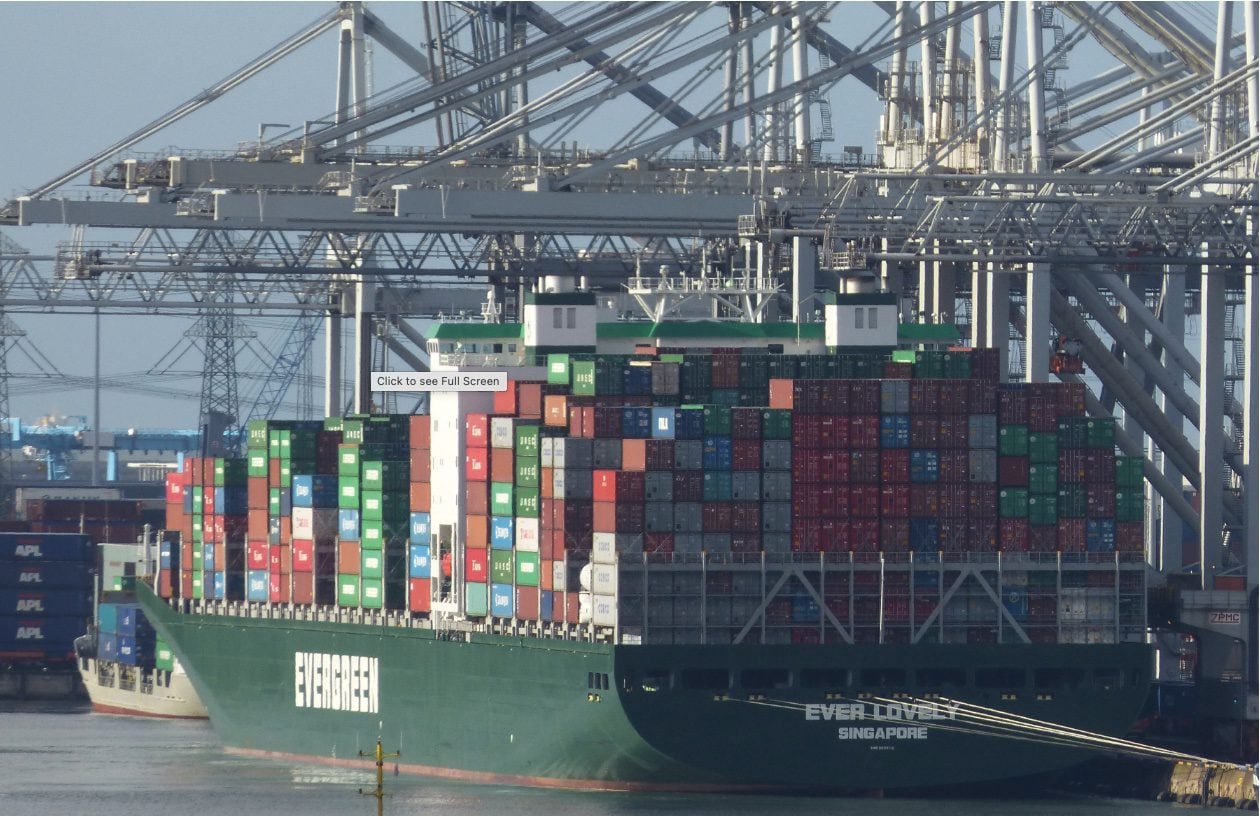
On June 25, 2026, at 1410 UTC, the containership Ever Lovely, registered in Singapore and operated by Taiwan’s Evergreen Marine Corporation, was hit on its starboard side by an unidentified object while leaving the Strait of Hormuz near the Omani coast, about 7.5 nautical miles southeast of Dahit, Oman.
The United Kingdom Maritime Trade Operations (UKMTO) confirmed the incident in Warning 074-26, noting that while the bridge was damaged, there were no injuries and no environmental harm. The captain reported the ship was safe, and Ever Lovely continued its journey. Shortly after, the U.S. government linked the attack to a drone operated by Iran’s Islamic Revolutionary Guard Corps Navy (IRGC-N), although Iran has not officially taken responsibility for the strike.
The freshly established Persian Gulf Strait Authority in Tehran made it clear that this attack had political motives. They posted on social media that any vessel using non-designated routes “would not be guaranteed safe passage” and the consequences of such actions would fall upon the vessel's owner, operator, and captain. Their message was clear.
The southern route, promoted by the International Maritime Organization (IMO) and Oman as a safe passage, is not recognized by Iran.
The incident's timing was also significant as June 25 is the IMO’s Day of the Seafarer. Just two days earlier, the IMO Secretary-General Arsenio Dominguez had unveiled a plan for evacuating vessels from the Strait of Hormuz, developed in cooperation with Oman and the U.S., to assist the many ships and seafarers trapped in the Gulf since Iran had effectively closed the strait on March 4 after U.S. and Israeli actions in the area.
This evacuation plan outlined two potential escape routes: one through Iranian waters and another through Omani waters. Dominguez had stressed the importance of ensuring safety for ships on the evacuation list, prompting him to pause the plan after the attack.
Since the conflict began, 14 seafarers have lost their lives in the strait. It is ironic that a ship was struck on a day meant to honor the contributions and vulnerabilities of those at sea.
It’s essential to clarify what happened. Ever Lovely was not part of the IMO evacuation framework and was making an independent transit with guidance from Oman, consistent with the southern route. Earlier that same morning, the IRGC warned vessels over VHF Channel 16 that transit without their permission or proper identification would be at the vessel's own risk.
According to maritime intelligence firm Windward, the IRGC claimed via their Telegram channel that three tankers using the southern route were ordered to turn back, and five vessels were observed changing course. The Togo-registered tanker Blue Star 1 turned back during transit, and at least two Panama-flagged ships were redirected by the IRGC.
Amid these tensions, Ever Lovely was struck, the evacuation plan was suspended, and any sense of security created by a record number of crossings the day before quickly disappeared.
The geopolitical implications of this incident extend beyond the immediate consequences. The U.S.-Iran Memorandum of Understanding (MOU) signed in June sought to establish a 60-day negotiation process to resolve the conflict and reopen the strait. It included agreements to lift the naval blockade of Iranian ports and for Iran to allow free passage in Hormuz without charges. However, it left unresolved the crucial issue of who controls traffic through the strait and under what conditions.
On June 25, the IRGC reaffirmed its stance that no transit arrangement would be accepted without Iranian approval, while the U.S. maintained the exact opposite view, stating no nation has the right to charge for an international waterway. A Gulf Cooperation Council (GCC) ministerial statement that day rejected any fees or unilateral control over the strait. This contradiction within the MOU has caused real repercussions.
The maritime industry faces serious implications from this incident. Before the conflict, the Strait of Hormuz handled about 20% of global oil and liquefied natural gas trade. With war-risk insurance costs already rising, these costs have dramatically increased since the attack.
Han Shen Lin, China Director at The Asia Group, noted that companies are more concerned about insurability than cargo safety, as war-risk premiums have escalated significantly since February. For a Very Large Crude Carrier (VLCC), this could mean an increase in expenses by hundreds of thousands of dollars for each transit.
The Persian Gulf Strait Authority's warning after the attack indicated that vessels on unauthorized routes risk losing insurance coverage, complicating commercial operations in Hormuz.
This incident also highlights a fundamental flaw in the two-corridor evacuation strategy. The southern Omani route is legally protected under the UN Convention on the Law of the Sea as a passageway for all ships. An IRGC strike in these waters indicates a serious violation of international law, yet enforcement mechanisms for such laws are lacking in real-time scenarios.
The situation in the strait since March has emphasized the disconnect between international maritime law and the on-ground reality, with the incident involving Ever Lovely being the most striking example to date. The standard traffic lanes remain closed due to threats from Iranian mines, which have yet to be cleared, presenting additional significant challenges.
Industry reactions have been measured rather than frantic, reflecting a recalibration of expectations since the beginning of the conflict. Aristidis Alafouzos, CEO of Okeanis Eco Tankers, mentioned that he does not expect major disruptions to crude oil transit trends, although Saudi Arabia's redirection of exports away from the Gulf signifies ongoing instability.
Halvor Ellefsen of Fearnleys Shipbrokers described current traffic as minimal, mainly focused on clearing existing inventories rather than new loadings. Oil prices fluctuated following the attack, with Brent crude initially rising before stabilizing as markets gauged the implications of the escalation.
This incident ultimately reveals the gap between political statements and operational realities in the strait. The MOU seemed to foster cautious hope, yet the IRGC operates under a distinct set of rules, complicating adherence to any diplomatic agreements. Ongoing frictions between the IRGC and the Iranian government have hindered a clear understanding of military control in the strait.
For shipowners and other stakeholders, the attack on Ever Lovely underscores that the southern route is not safe, and the strait cannot be considered a regular commercial travel route. Every transit comes with elevated risks, and any ship proceeding without a firm grasp of both the IMO’s evacuation framework and the PGSA’s requirements is navigating precariously in contested waters.
The industry now closely monitors whether the evacuation plan will be reinstated, how the U.S. and Oman will respond to this act of aggression, and whether the 60-day MOU process can establish rules that the IRGC will honor. For the thousands of seafarers stranded in the Gulf, these questions are pressing and far from abstract.