
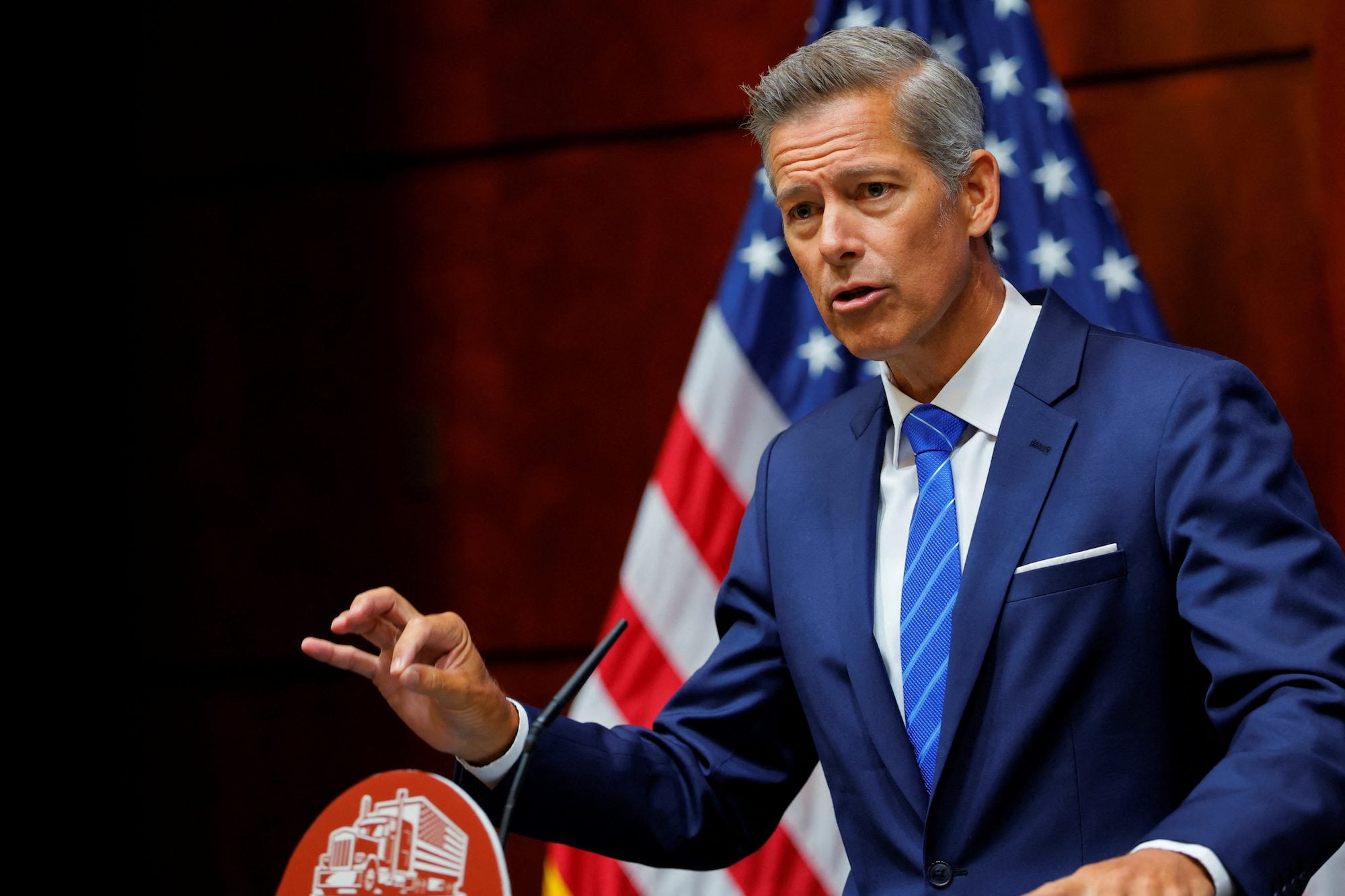
He wasn’t just sightseeing. He was helping America understand itself.
Why a Road Trip?
Some criticized the trip as a pointless vanity project, calling it a family vacation disguised as a policy tour. They suggested that a cabinet secretary was playing tourist while pressing issues in Washington went unaddressed.
However, they missed the bigger picture.
The controversy masked a straightforward yet intriguing question: Why did the Secretary of Transportation dedicate months to filming across the country?
President Donald Trump may have touched on the answer when he jokingly asked the Duffy family in the Oval Office if everyone truly wanted to go along. “This isn’t just Mom and Dad saying get in the car, are you?” This question elicited laughter as it resonated with many families. Road trips evoke a mix of excitement and fatigue—endless hours in the car, rest stops, and kids persistently asking if they’ve arrived, even when everyone knows the answer.
Yet, each generation continues to pile into cars. Road trips are about more than just traveling; they’re about exploring.
In America, the journey can feel as significant as the destination. The vast country is dotted with mountains, rivers, farms, industrial cities, ports, and small towns. While these places appear as mere dots on a map, the experience of driving through them transforms those dots into real life.
This may explain why the idea of a road trip remains appealing. We learn about America through movement, experiencing it firsthand. We can’t let ourselves get so tied up in Washington, D.C., that we forget how connected we are across thousands of communities, rivers, railways, roads, and city skylines.
It’s noteworthy that the nation’s top transportation official chose to spend valuable time encouraging Americans to explore their country, even with his busy schedule. The more I pondered this, the clearer it became that Sean Duffy’s Great American Road Trip was not simply about leisure or nostalgia.
It was about helping Americans reconnect with their country, highlighting how he perceives transportation, and why understanding the nation is vital. In this sense, the road trip could end up being one of the most telling actions of his tenure.
Transportation Connects Us
Most people think about transportation only when they face delays, like canceled flights or closed bridges. Usually, transportation intrudes into daily life as a nuisance. But its main purpose is not to disrupt; it’s to connect.
Generally, it quietly operates in the background, linking workers with jobs, manufacturers with suppliers, farmers with markets, energy producers with consumers, and communities with opportunities.
We often overlook this, as we’re not meant to notice it when it functions smoothly.
When shelves are stocked, lights turn on, packages arrive, planes land, and life continues, it’s because transportation forms the foundation beneath our movement. Movement is how such a large and diverse nation like the United States comes to terms with its identity. This perspective sheds light on why the idea of a road trip was important to Duffy.
The Real World Shows Up
The Great American Road Trip is especially intriguing today as many Americans increasingly view the world through screens. Information is instant, commerce is online, and relationships thrive on digital platforms.
Much of contemporary life can seem disconnected from the physical world. Yet, many factors determining national prosperity, security, and opportunities are still anchored in tangible locations. While the digital realm has changed how Americans communicate, work, and share information, it hasn’t replaced the physical landscape beneath it.
Transportation plays a unique role because it allows our 50-state nation to function as something larger than just individual communities.
Duffy seems to recognize that we must see America to truly know it, and this realization is more important than it might seem. National ambitions still rely on real-world conditions that cannot be grasped through a screen.
What Secretary Duffy Appears to See
Duffy seems to view transportation as the underlying support for national power and prosperity. In this context, it’s not just about managing roads, ports, airports, and freight systems, but about the network enabling economic growth, energy security, competitiveness, and resilience.
This perspective shapes a governing style focused on scale, urgency, and direct actions. It’s not that Duffy thinks transportation is important—most transportation leaders do. The difference lies in his belief that transportation challenges can limit broader national objectives. Instead of viewing these challenges as fixed hurdles, he has pushed for structural changes and enhanced institutional capabilities to address the significant issues he sees facing the country.
The aviation sector, especially the air traffic control (ATC) system, illustrates this focus. For many years, policymakers have navigated increasing ATC infrastructure and workforce issues while demand kept rising. Duffy’s approach has been distinctive. He prioritized ATC modernization, bringing the topic directly to Congress and the President to secure major investments to upgrade essential infrastructure.
This proactive instinct is also evident in trucking, where the Department has cracked down on fraudulent Commercial Driver’s License schools and raised standards for commercial drivers. Instead of accepting decreasing standards, it moved to reset expectations and restore confidence in the system that ensures freight mobility. Duffy’s announcement of the Supply Chain Sovereignty Initiative in June supports this strategy, emphasizing the modernization of how supply chain capacity is understood and managed.
A similar pattern can be seen in maritime matters. The U.S. Merchant Marine Academy at Kings Point needs over $1 billion for campus revitalization after years of neglect. When Duffy took office, he departed from decades of slow maintenance by prioritizing the Academy and committing to a comprehensive revitalization plan through a 10-year agreement with the U.S. Army Corps of Engineers.
Secretary Sean Duffy has stated, “The American people deserve an efficient, safe, and pro-growth transportation system.” Critics may argue that narratives, policies, and resources by themselves won’t guarantee results, but they do illustrate priorities. The real question is whether this approach leads to actual change in the physical world. His record suggests it will, particularly in regions whose economic importance is often overlooked.
More Than Coordinates
Duffy’s personal involvement in the Great Lakes likely reflects his understanding that some places matter more than their geographic coordinates suggest—not from sentiment alone, but because of their production and role in the broader American economy. For much of the twentieth century, the Midwest grasped this instinct intuitively.
Steel mills, ports, railroads, highways, waterways, power generation, and skilled workforces functioned as interconnected assets. Together, they formed a cohesive industrial economy that produced not just goods but also sparks of livelihood.
The American dream was not just an idea in Northwest Indiana, near Detroit, or along the Ohio River to Pittsburgh. It evolved through networks linking those communities with the rest of America.
My maternal grandfather worked for fifty years welding freight cars in Northwest Indiana, while my paternal grandfather built his life at U.S. Steel. My parents and relatives found work in factories, all connected to the broader Great Lakes industrial economy. Steel and manufacturing became a way of life. That’s what network effects feel like from within. Observing the changes in those networks over the years has made this moment feel more than just policy; it feels like recognition.
As a former U.S. Congressman from Wisconsin, Duffy came to the Department of Transportation with a wealth of Great Lakes experience. One of his first actions as Secretary was to expand the U.S. Marine Highway Program and strengthen the M-90 corridor across the Great Lakes. In making this decision, he emphasized that maritime strength depends on not just oceans but also inland waterways, rivers, and ports that facilitate American products throughout the country.
Duffy's focus on the Great Lakes aligns with a broader pattern. He seems to see transportation not as a set of isolated projects, but as a system shaped by geography, industry, and competitive advantages. Some locations are significant because of what they connect, while others are vital due to their production. The most crucial often embody both qualities.
The Comparative Advantage of Place
Take Burns Harbor, for example. Located at the junction of Great Lakes shipping, Class I railroads, interstate highways, and steel production, this Indiana port connects transportation networks deeply embedded within the American interior. Mariners transport cargo across the Great Lakes, dock workers prepare freight for regional manufacturers, steelworkers process raw materials coming by rail and water, and rail teams distribute goods across a national network reaching both coasts.
On June 19, Secretary Sean P. Duffy made history as the first sitting U.S. Secretary of Transportation to visit Burns Harbor, stating, “The Great Lakes and Inland Waterways are vital arteries for America’s freight network.” Burns Harbor functions as a multimodal hub linking steel production, rail logistics, and Great Lakes shipping.
Duffy’s focus supports bipartisan congressional initiatives led by Senator Todd Young (R-IN) along with Tammy Baldwin (D-WI) and Gary Peters (D-MI). Together, they aim to secure a fair share of federal funding for Great Lakes ports and protections for the lakes. These efforts collectively underscore the region’s significant role in national freight and industrial systems.
Under Duffy's leadership, the Department of Transportation has emphasized port modernization and strengthening multimodal freight corridors as part of a broader strategy to improve system capacity and resilience while collaborating with national, state, and local agencies.
Secretary Sean Duffy has said, “To love America is to see America.” He realizes Americans connect with themselves not through policies, plans, or programs, but through their communities. On the open road. In the people, industries, and landscapes that define this country.
If transportation shapes how communities, industries, and regions work together, then helping Americans grasp those relationships is part of the Secretary’s responsibility. What better way to symbolize that than a road trip across America right in time for the nation’s 250th anniversary?
Not just as transportation policy. But as transportation leadership.