
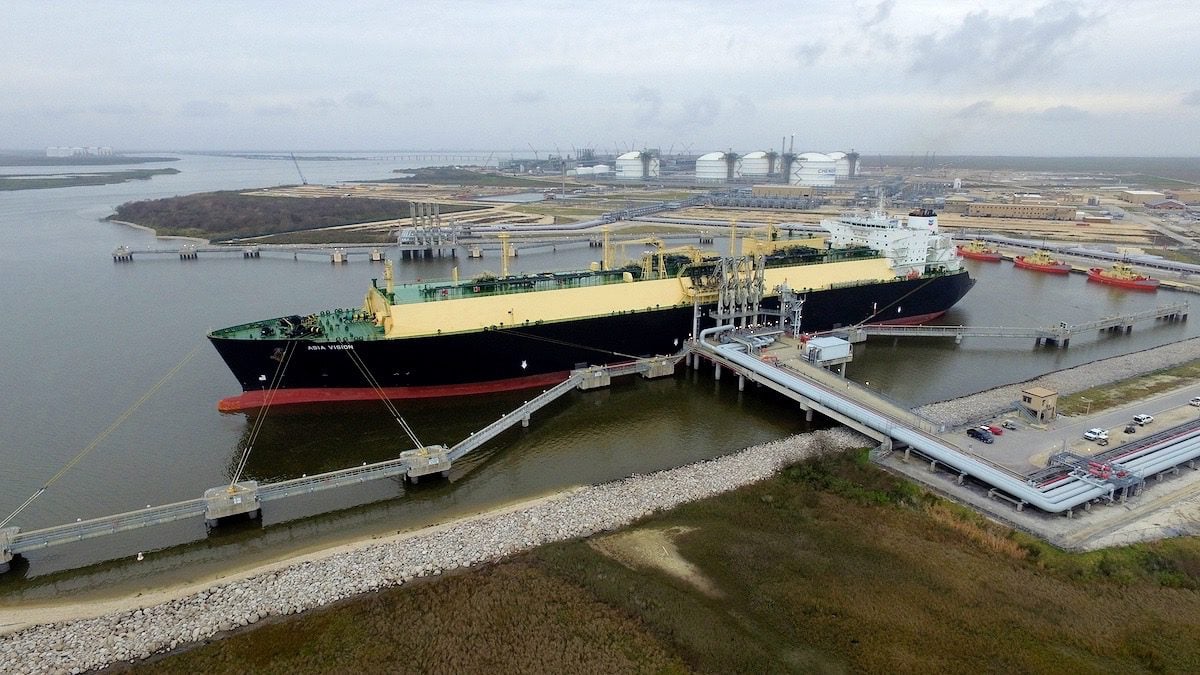
U.S. Secretary of Energy Chris Wright signed an export authorization yesterday, allowing for a 12% increase in exports at Cheniere Energy's Corpus Christi liquefied natural gas (LNG) terminal. This move highlights America's strong position in the global LNG market as the industry celebrates ten years of remarkable growth.
The new authorization allows an extra export of up to 0.47 billion cubic feet per day of U.S. natural gas as LNG to countries that do not have Free Trade Agreements with the U.S. This is part of the Corpus Christi Stage 3 Project, specifically from Trains 8 and 9. With this approval, the total export capacity of Corpus Christi LNG now stands at 4.45 billion cubic feet per day, making it the second largest LNG export project in the United States.
During his visit to the terminal, Secretary Wright stated, “In the last ten years, American innovation and leadership transformed the United States into the world’s largest exporter of LNG. This order further strengthens America’s LNG export capacity, promoting peace abroad and prosperity for Americans at home. I am proud to be here today in Corpus Christi, alongside the American workers who are driving our energy dominance.”
This expansion coincides with the ten-year anniversary of the LNG carrier Asia Vision leaving Louisiana's Sabine Pass Terminal in February 2016, marking the first U.S. LNG cargo from the lower 48 states, which amounted to 3.3 billion cubic feet bound for Brazil.
The growth in this sector has been remarkable. U.S. LNG exports increased from just 0.5 billion cubic feet per day in 2016 to an expected 15.0 billion cubic feet per day by 2025. The Energy Information Administration predicts that by 2027, exports will surpass 18.1 billion cubic feet per day, equivalent to around 136 million metric tons per year.
Last year, the U.S. became the first country to export over 100 million metric tons of LNG in a single year. Preliminary data indicates that the total for 2025 reached 111 million metric tons, which is nearly 20 million metric tons more than Qatar.
Kyle Haustveit, Assistant Secretary of the Hydrocarbons and Geothermal Energy Office, highlighted the strategic significance of the expansion. “Every step we are taking aims to provide more reliable and secure energy globally,” he explained. “Our commitment to enhancing global partnerships through LNG exports is essential for ensuring a stable energy future and fostering economic growth.”