
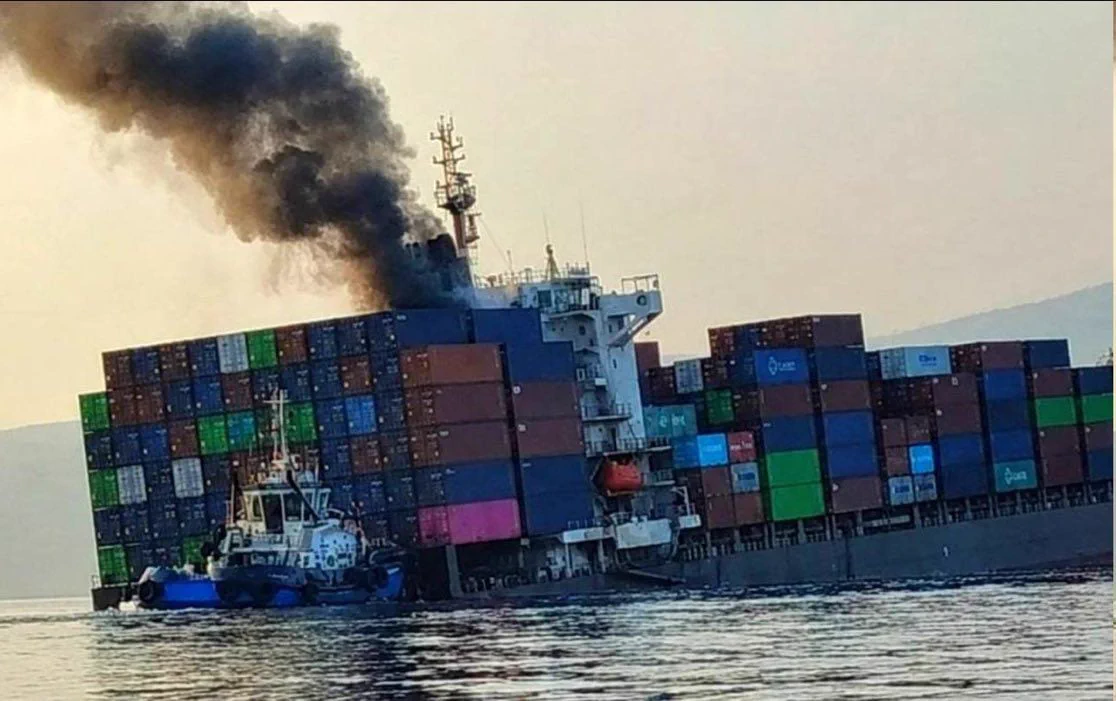
A container ship registered in Singapore has sunk after being hit by a projectile in the Strait of Hormuz. This incident adds to a growing list of attacks on commercial ships, raising concerns about the U.S. claims of control over this critical waterway.
The Maritime and Port Authority of Singapore (MPA) confirmed on Wednesday that the containership GFS PRIDE was damaged and caught fire after the attack on October 13, leading to its sinking. Fortunately, all 21 crew members were safely evacuated with no injuries reported. Iran has alleged, without evidence, that the ship hit a naval mine.
Another Singapore-registered container ship, GFS GISELLE, was struck on October 14, causing damage to its hull. However, the ship was able to reach a safe anchorage on its own power, with all 22 crew members reported safe.
The sinking of the GFS PRIDE marks the second confirmed sinking of a large ocean-going ship during the current conflict, following the loss of the Safeen Prestige.
This recent sinking comes amid a surge in attacks on commercial shipping. On October 11, at least six vessels were hit in just one day, prompting the UK Maritime Trade Operations (UKMTO) to issue four additional verified attack warnings for incidents on October 13.
The latest warnings, numbered 170-26 through 173-26, detail attacks on three containerships and one tanker.
The first two warnings reported a containership and a tanker hit by unknown projectiles, but did not identify the vessels or provide specifics about the damage or casualties.
Two subsequent reports described a 50,000-tonne container ship hit during an inbound transit and a 19,000-tonne containership hit during an outbound transit. Both vessels reported minor damage, no casualties, and were able to continue their journeys.
It remains unclear if any of the UKMTO reports relate to the two Singapore-registered vessels, so the total number of ships involved in the recent attacks has yet to be fully determined.
Singapore has condemned these attacks, calling them "unprovoked, unjustifiable, and a breach of international law."
"All actions affecting international shipping must fully comply with international law, especially the United Nations Convention on the Law of the Sea, and must not endanger the safety of seafarers and ships at sea," the MPA stated.
U.S. Claims Control Amid Ongoing Attacks
These latest attacks occurred just a day after U.S. Central Command (CENTCOM) stated that American forces and regional partners control the Strait of Hormuz, contradicting claims from Iran’s Islamic Revolutionary Guard Corps Navy that the waterway is under Iranian control.
"American forces and regional partners clearly control the Strait of Hormuz," CENTCOM stated on Tuesday.
The military command also mentioned that U.S. forces helped Gulf partners move over 19 million barrels of crude oil through the strait the day before.
However, the sinking of GFS PRIDE and continuous attacks on merchant ships indicate that there is a significant difference between military control of the waterway and ensuring the safe passage of commercial vessels.
The recent attacks extend a trend that has been increasing since late September.
Last week, two vessels were hit inside the Persian Gulf within three days, including an attack off Qatar, which is beyond the main shipping route through Hormuz.
Since then, the frequency of attacks has further intensified, including the six reported strikes on Sunday and the latest incidents involving containerships and tankers.
Impact on Commercial Shipping
The International Maritime Organization's incident list has recorded over 100 confirmed maritime security incidents since the start of the conflict, along with at least 24 deaths among seafarers.
This tally may be updated as more incidents are verified, especially as reports often emerge days after attacks occur.
UKMTO has repeatedly noted that its reporting relies on information from ships and other sources, meaning some incidents may not be listed in real-time.
The Joint Maritime Information Center (JMIC) has declared a SEVERE threat assessment for the Strait of Hormuz, reflecting the ongoing risk of further attacks on commercial vessels.
Despite U.S. efforts to facilitate shipping, traffic through the strait remains significantly lower than pre-conflict levels. Before the conflict, around 130 to 140 vessels usually passed through the strait each day.
The sinking of GFS PRIDE highlights the ongoing risks faced by shipowners and crews navigating this vital shipping corridor.
Even as U.S. forces continue to support commercial traffic and oil shipments through Hormuz, the recent wave of attacks shows that merchant vessels are still at risk, despite Washington's claims of control over the waterway.