
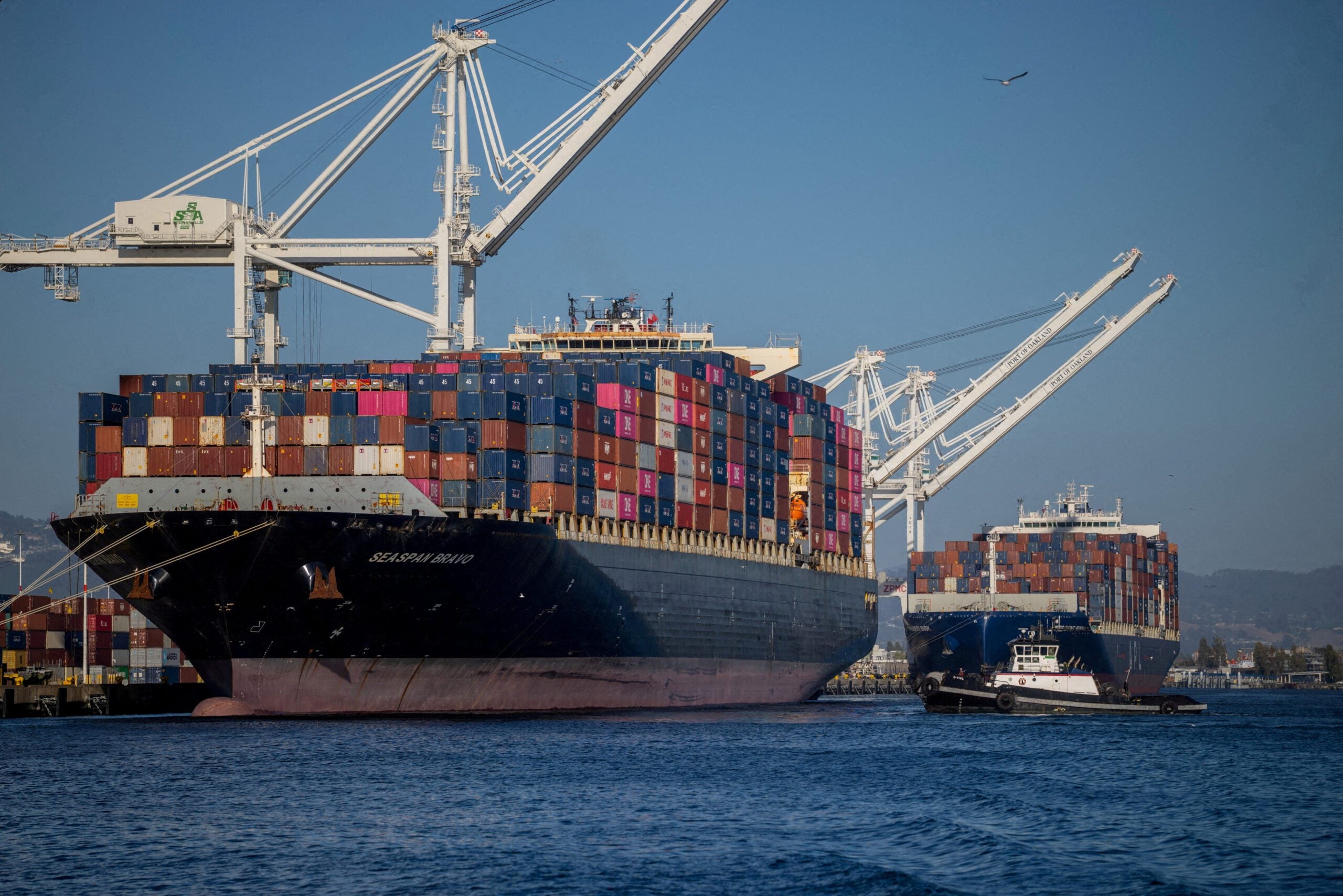
This week, container spot rates made a comeback after falling for three weeks in a row. Ocean carriers are applying new emergency fuel and peak season surcharges due to higher operational risks and ongoing concerns about the situation in the Strait of Hormuz.
The latest Drewry World Container Index (WCI) shows a 3% rise in the composite index, bringing it to $2,286 for a 40-foot container. This increase is mainly driven by higher rates on key Transpacific routes.
Specifically, rates from Shanghai to New York went up by 7% this week, reaching $3,721 per FEU, while rates from Shanghai to Los Angeles rose by 5% to $3,062 per FEU.
These rate increases are happening as carriers introduce Emergency Fuel Surcharges (EFS) and Peak Season Surcharges (PSS) in response to high bunker costs, uncertainty in voyage planning, and caution related to Middle East operations.
MSC raised its EFS on shipments from Asia to the U.S. East Coast from $430 to $644 per FEU and from Asia to the U.S. West Coast from $272 to $467 per FEU. Separately, CMA CGM announced a new peak season surcharge of $2,000 per FEU, starting May 1.
Drewry anticipates that freight rates for Transpacific trades will continue to rise next week.
This increase comes after weeks of instability caused by the ongoing U.S.-Iran conflict and disruptions in the Strait of Hormuz, where carriers remain cautious despite limited U.S.-escorted commercial transits allowed under the previous administration's "Project Freedom."
While vessel movements in the region have stabilized compared to the sharp drop earlier in the crisis, carriers are still adjusting their pricing and operational strategies to deal with high war-risk insurance costs, rerouting uncertainties, and fuel market fluctuations.
In the Asia-Europe trade, spot rates have been steadier. Rates from Shanghai to Rotterdam rose by 2% to $2,170 per FEU, and rates from Shanghai to Genoa increased by 1% to $3,075 per FEU.
Despite this stability, carriers are planning another round of aggressive rate hikes later this month.
CMA CGM, Hapag-Lloyd, and MSC have announced new Freight All Kinds (FAK) rates ranging from $3,500 to $4,500 per FEU for Asia-North Europe cargoes and between $4,500 and $4,600 per FEU for Asia-Mediterranean shipments starting May 15.
Drewry warns that the success of these rate increases is uncertain due to weak demand and ongoing vessel overcapacity.
To help support pricing, carriers are continuing to implement blank sailings and reduce effective capacity. Drewry predicts that effective capacity on Asia-North Europe routes will decrease by 3% month-over-month in May, and Asia-Mediterranean capacity is expected to drop by 10% month-over-month.
Despite the recent rebound in rates, the overall freight market remains highly responsive, with carriers increasingly relying on surcharges and capacity management instead of actual cargo demand to maintain their rates.