While the technology needed to digitize maritime operations is already available, there's still a lot to do to help organizations and their staff use it effectively, according to speakers at a recent Inmarsat Maritime ‘Connected to Perform’ seminar.
The maritime industry is filled with digital technology and data, but there are still gaps that need to be addressed for stakeholders to get the most value from these tools. This was the shared view of a panel of industry experts during the Inmarsat Maritime ‘Connected to Perform’ seminar in Hamburg.
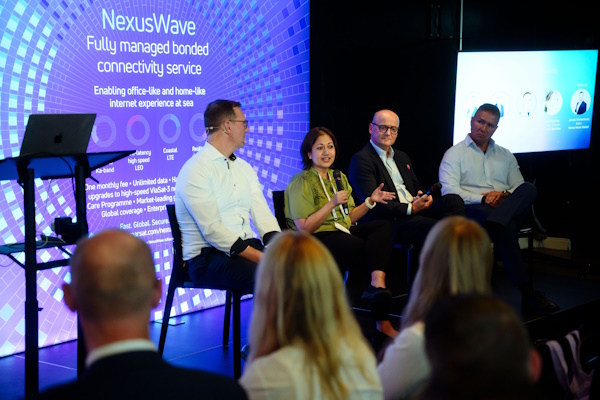
This panel discussion, part of SMM Hamburg, looked at how shipping can create a digital, secure, and human-friendly fleet, and how modern connectivity can help achieve this goal.
When asked about the biggest gap between “what connectivity and technology can offer and what shipping companies are using,” Audra Drablos, Strategy Director at Inmarsat Maritime, emphasized that the technology itself is not the problem anymore.
“We’re connecting global fleets,” she explained. “We’re utilizing advanced analytics and preventive maintenance. The technology is definitely there.” However, she pointed out that the issue may lie in how organizations implement those technologies: “To digitize processes, we also need to transform all our decision-making processes.”
Drablos’s colleagues shared how their companies are employing modern technology to digitize operations.
Patrick Briest, Senior Director of Operations for IT Products at Hapag-Lloyd, highlighted the company's use of real-time cargo tracking and voyage optimization to enhance speed and flexibility. Konstantin Pohsin, Fleet Captain at Fairplay Towage, explained how predictive maintenance helps maintain operational readiness. Matthias Becker, Managing Director of Anglo-Eastern Germany, discussed how the ship manager employs artificial intelligence to manage vessel emissions.
Although these companies have already introduced modern technology across their fleets, their representatives reiterated Drablos’s point, noting areas where further efforts are needed to improve digital and data-driven processes.
For Anglo-Eastern, the focus is on integrating separate systems. “We gather a lot of data today, but it's in isolated systems and products,” Becker noted, adding that the company could “find more savings and make better decisions by connecting all these different systems.”
In a similar vein, Briest mentioned that Hapag-Lloyd created its Fleet Data Ecosystem to consolidate all its data. This allows them to “view it as a whole, interconnect it, and draw meaningful insights.” He echoed Drablos’s comments, stating: “Even if you have the dashboard – the tool that shows what you should be doing – you must change how the entire organization works and how processes are structured so that it becomes a reality.”
At Fairplay Towage, the focus is on training to address what Pohsin called a “gap in knowledge” regarding connected onboard systems. “We need to explore the best ways to educate all our employees on the use of these facilities,” he commented.
However, Becker believes training alone is not enough; managing the “complex challenge” of digital transformation will also require collaboration across departments and industries.
“Seafarers won’t become IT experts,” he explained. “Technicians will stay technicians, so we need to bridge that gap. We must unite the crew, offshore personnel, and the data analytics and IT teams. Collaboration between operators, owners, managers, OEMs, and IT system providers is also essential.”
Supporting crews with the right tools to perform their roles effectively was a recurring theme during the session. The panelists suggested that technologies like AI are not meant to replace human expertise – “don’t stop thinking with your own brain” was Pohsin’s advice to seafarers – but rather to help take care of time-consuming tasks related to data analysis and compliance.
“I think that’s where AI can really make a difference,” Drablos remarked, citing a recent Seafarers Happiness Index report that showed the least happy seafarers are often those with the most responsibilities. “It could help prioritize data and assist [seafarers] in making better decisions,” she said.
Building on Drablos’s comments, Briest noted that AI could enable crews to concentrate on operating their vessels, and the growing use of cloud-based AI applications could increase the need for connectivity. “The overall connectivity requirements for these more intelligent, AI-driven systems will likely grow,” he stated.
As the maritime industry’s connection needs expand, so does the demand for strong cyber-security solutions. However, as Drablos pointed out, “the issue isn’t about connectivity versus security. It’s about how to implement security as a foundational element when establishing connectivity. That’s the key: ensuring it’s secure by design.”
This principle is a key focus for Inmarsat with its NexusWave solution. During the seminar's introduction, Gert-Jan Panken, General Manager and Vice President at Inmarsat Maritime, highlighted recent cyber security approvals for NexusWave from ClassNK and Bureau Veritas, confirming compliance with IACS’ Unified Requirement E27. “This shows that NexusWave has been developed in line with what our customers need, verified by an independent source,” he said.
Reflecting the overall theme of the discussion, Panken asserted that connectivity is becoming less about the connection itself and more about what it can enable. “It’s not just about having a fast internet connection,” he summed up. “It’s about building a foundational infrastructure that will drive business outcomes.”