
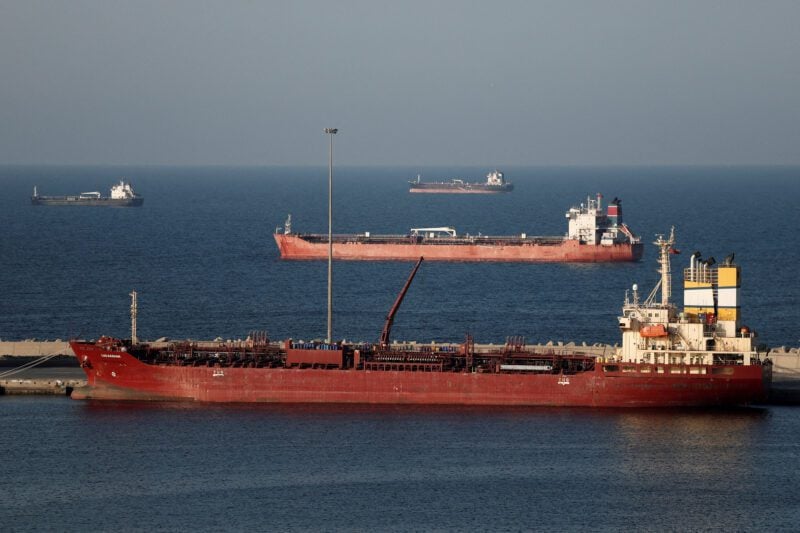
Shipbroker and maritime services leader Clarksons announced record earnings for the first half of 2026 on Monday. They noted that the crisis in the Strait of Hormuz contributed to exceptional trading conditions in global shipping markets, which are likely to boost their full-year results beyond earlier predictions.
The company, listed in London, reported a pre-tax profit of £61.5 million for the first half of 2026, a 56% increase from £39.4 million the previous year. Revenue also surged by 39% to reach £413.5 million. Earnings per share jumped to 147.6 pence from 98.6 pence, prompting the company to raise its interim dividend to 35 pence per share, marking the 24th consecutive annual increase in dividends.
“Clarksons achieved a record performance in the first half, driven by our investments in the business and the significant volatility caused by disruptions in global trade, including the situation in the Strait of Hormuz,” said Chief Executive Andi Case.
Looking ahead, the company anticipates that its full-year results will be “materially ahead of market expectations,” suggesting that this year’s earnings won’t be as concentrated in the second half as is usually the case, due to the strong performance in the first half.
Clarksons explained that the closure of the Strait of Hormuz has changed global trade flows, leading to significant increases in freight rates, longer voyage distances, and higher demand for chartering and market intelligence. Although the company expects the waterway to gradually reopen in the second half of the year, it warned that it will take time to return to normal trade patterns and reposition vessels.
Notably, the company’s broking division marked its best first half ever, with operating profit rising from £41.8 million to £64.8 million. The tanker markets benefited significantly from the recent disruptions.
Clarksons revealed that average spot earnings for Very Large Crude Carriers (VLCC) on the U.S. Gulf-to-Far East route jumped by 166% year-on-year in the first half, averaging around $120,000 per day. This spike occurred as Asian buyers sought crude oil from further suppliers while tankers were stranded in the Persian Gulf. The product tanker market also saw improvements, with average earnings for Medium Range (MR) tankers increasing by 86% compared to last year.
Moreover, the disruption positively impacted gas shipping markets. LNG carrier spot rates averaged $77,300 per day during the first half—more than triple compared to a year ago—thanks to vessels waiting outside the Gulf and increased voyage lengths, even amid reduced export volumes from the region. In the LPG market, Very Large Gas Carrier (VLGC) earnings briefly surpassed $200,000 per day during peak market disruptions.
Container shipping also remained robust despite a decrease in U.S. imports due to tariffs. Clarksons reported that ongoing diversions in the Red Sea, congestion, and slower sailing speeds tightened vessel availability, while the Shanghai Containerized Freight Index concluded the first half at its highest point outside of the pandemic surge.
Aside from shipping, Clarksons’ financial division nearly matched its entire 2025 revenue in just six months, benefiting from active debt and equity markets. Its research division also experienced growth as clients sought data and analysis in light of rising geopolitical uncertainty; demand grew for intelligence products tracking disruptions related to the Strait of Hormuz.
Despite these recent successes, Clarksons noted that future growth is closely tied to global political developments, particularly regarding the Strait of Hormuz, the Suez Canal, and evolving sanctions.
“We remain cautious in our outlook, aware that instability in the Middle East remains high and that markets take time to stabilize as geopolitical changes unfold,” Case added.