
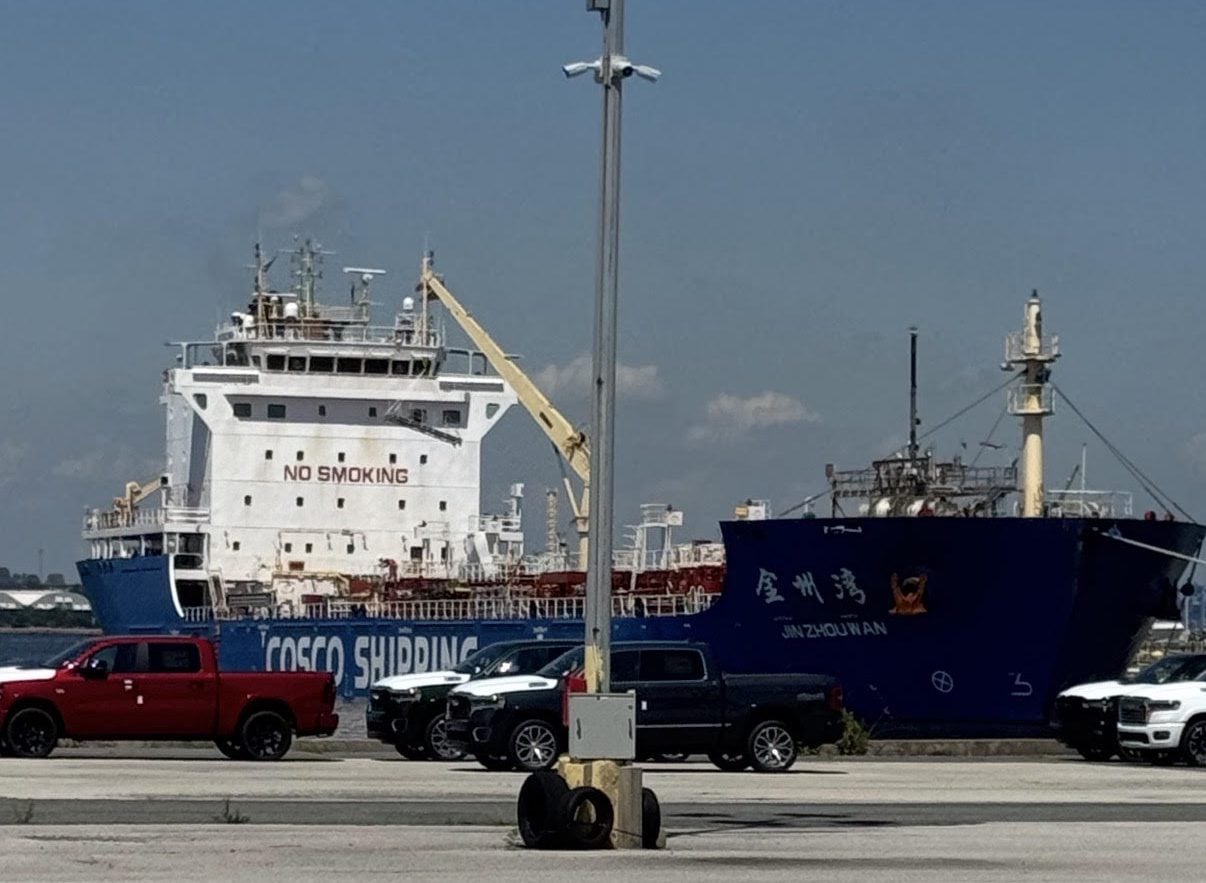
A tanker owned by a Chinese company has recently transported asphalt between U.S. ports under an emergency waiver of the Jones Act. This raised new concerns about the ongoing national security exemption, especially after the recent agreement between the U.S. and Iran to reopen the Strait of Hormuz and reduce tensions.
Vessel tracking information analyzed by gCaptain shows that the Chinese-flagged tanker JIN ZHOU WAN has just arrived in Baltimore, carrying asphalt sourced from New Jersey, while operating under the ongoing Jones Act waiver program.
This is at least the second occasion the vessel has engaged in domestic coastwise transport under this waiver. Earlier in May, gCaptain noted that the same tanker had carried asphalt from Harvey, Louisiana, to New Haven, Connecticut. This situation has drawn criticism from U.S. maritime groups, questioning the decision to allow a Chinese-owned ship to participate in domestic trade using a national security exemption.
The 13,265-deadweight-ton tanker was constructed in 2017 and is owned and operated by COSCO Shipping Asphalt Hainan, a branch of the state-run China COSCO Shipping Corporation.
Generally, the Jones Act mandates that cargo moving between U.S. ports must travel on vessels that are built in the U.S., owned by U.S. entities, flagged in the U.S., and primarily staffed by U.S. crews.
However, in March, the Trump administration exercised its emergency waiver authority under Section 501 of the Merchant Marine Act, citing national defense concerns stemming from disruptions linked to the Strait of Hormuz crisis. This 150-day waiver permits certain approved foreign-flagged vessels to transport specific energy cargoes between U.S. ports that would typically be restricted by the Jones Act.
When the waiver was announced, the administration noted disruptions to global energy markets and worries over domestic fuel supplies resulting from the Middle East conflict.
Since then, the security landscape has shifted significantly following the recent U.S.-Iran memorandum of understanding, which has contributed to lower oil and gasoline prices. Despite these developments, foreign-flagged vessels continue to carry out domestic trades under the emergency waiver.
Data from MARAD, as examined by gCaptain, indicates that the Trump Administration continues to authorize Jones Act waiver shipments of crude oil, refined fuels, jet fuel, naphtha, and asphalt between U.S. ports. Since the waiver took effect in March, 138 domestic voyages have been completed under this emergency status.
The ongoing use of the waiver has become a major point of contention for Jones Act supporters, who argue that the emergency authority is increasingly being used for regular commercial shipments instead of responding to urgent national defense needs.
“How can a waiver issued on 'national security' grounds allow Chinese ships to transport asphalt between U.S. ports?” questioned a spokesperson for the Seafarers International Union in a statement to gCaptain. “This waiver clearly isn't benefiting Americans. It’s putting U.S. mariners, who serve as America's fourth arm of defense, out of work and failing to provide price relief for consumers. It's time to end the waiver and prioritize America and its citizens.”
The American Maritime Partnership (AMP), representing the U.S. domestic maritime sector, has previously called attention to the JIN ZHOU WAN’s voyage from Louisiana to Connecticut, noting that the China COSCO Shipping Corporation has been identified in Department of Defense lists as a Chinese military-operated entity in the U.S. The company has disputed several aspects of these classifications.
The latest journey of the tanker is likely to intensify the discussion around whether the original justification for the national security waiver is still valid, especially as commercial shipping through the Strait of Hormuz steadily improves following the U.S.-Iran agreement and ongoing negotiations for broader resolutions.