
By Ryan Woo and Xiuhao Chen
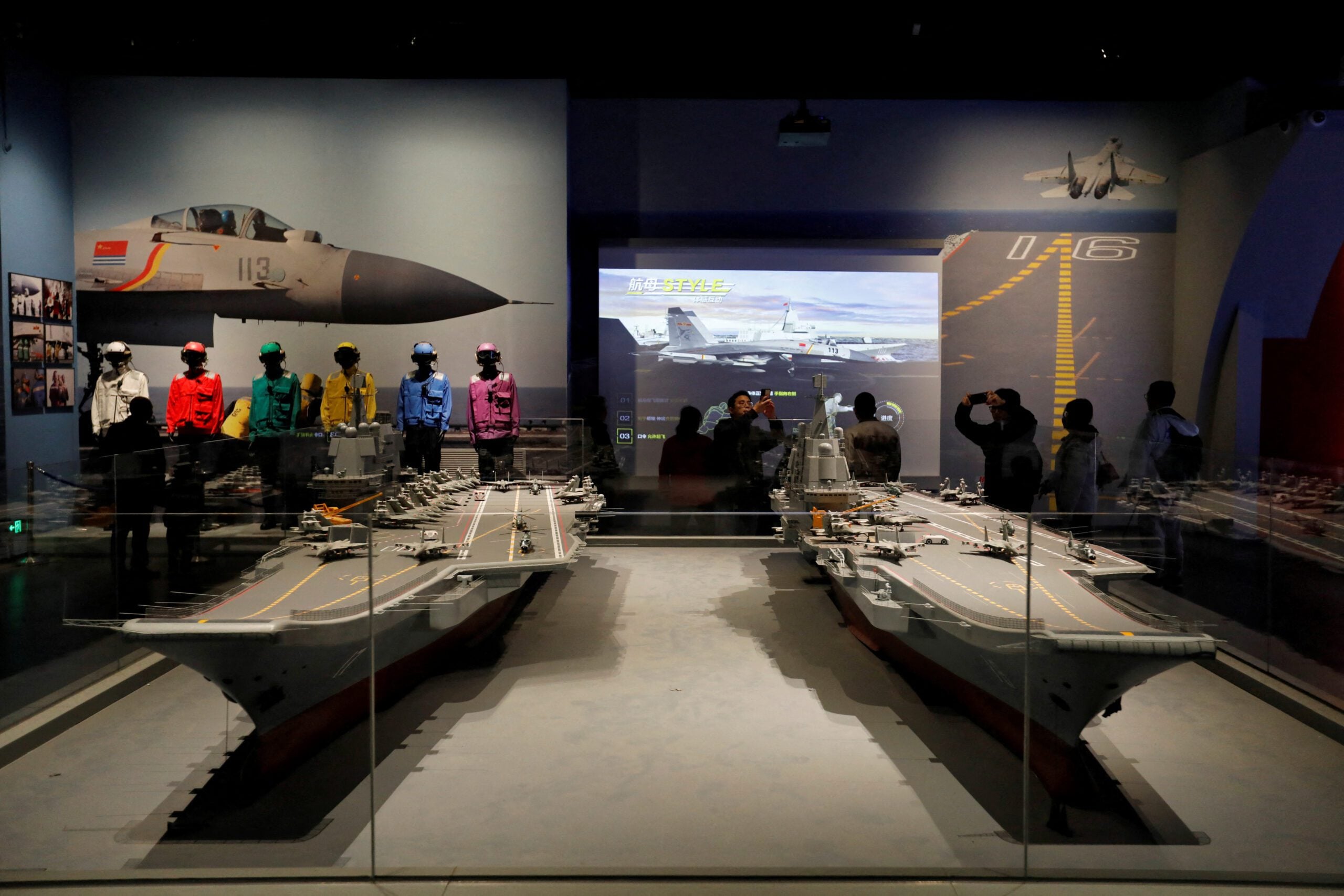
BEIJING, April 23 (Reuters) — China has released a video hinting at a new aircraft carrier, which may be its fourth and the first to be nuclear-powered. This move is part of China's efforts to strengthen its maritime capabilities, secure resources, and affirm its territorial claims.
The video was shared just before the 77th anniversary of the Chinese People's Liberation Army Navy. It featured fictional officers with names that sound similar to China’s current aircraft carriers: Liaoning, Shandong, and Fujian.
Titled “Into the Deep,” the video introduced a 19-year-old character named “He Jian.” His name resembles the Mandarin term for “nuclear vessel,” sparking speculation that he represents a nuclear-powered aircraft carrier.
The three operational carriers are conventionally powered, numbered 16, 17, and 18. The 19-year-old recruit's age suggests that “He Jian” would continue this numbering system.
China’s defense ministry has not responded to requests for comments on the video as of Wednesday.
Beijing is investing billions to develop a “bluewater navy” capable of projecting its power far from its shores, a goal that has been in place since President Xi Jinping took leadership in 2012.
Military training and operations in the Pacific were showcased in the video, which also appeared to send a message to Taiwan, a democratically governed region that China claims as its own.
A particular scene included a conversation between a naval officer and his son, “Xiao Wan,” a name that hints at Taiwan.
“I don’t want to go home just yet. I want to play out a little longer,” the boy says.
The father replies, “Xiao Wan, don’t be difficult. Mum is waiting for you at home. Let’s go home.”
ISLAND BUILD-UP
China’s natural resources ministry called for more efforts to “protect” the over 11,000 islands it claims, according to an article in the official People’s Daily.
Most of these islands are located within 100 km (62 miles) of the coast, with nearly 60% in the East China Sea and the rest in the South China Sea, based on an official count from 2018.
In disputed areas of the South China Sea, China has constructed artificial islands, airstrips, and military facilities through extensive land reclamation.
Last September, Beijing announced a national nature reserve at the disputed Scarborough Shoal to reinforce its claim over the atoll, a long-standing issue with the Philippines.
“The facilities on its artificial island bases allow Chinese law enforcement, naval, and militia vessels to patrol the waters of neighboring countries every day of the year, up to 1,000 nautical miles from the Chinese coastline,” said Gregory Poling from the CSIS think tank.
However, China’s strong presence in the area didn’t prevent a senior Taiwan official from visiting the Taiwan-controlled island of Itu Aba, part of the contested Spratly Islands.
Itu Aba has a runway capable of accommodating military resupply flights from Taiwan, and a new wharf opened in 2023 that can host a 4,000-ton patrol ship.
This week, the Philippines, the United States, and allied nations began military exercises, including maritime operations, across the Philippine archipelago.
The drills showcased a united front against China in a region crucial for over $3 trillion in annual maritime commerce.
“Beijing seems to have reached a point of diminished returns,” noted Poling, who leads the think tank's Southeast Asia program. “It hasn’t been successful in stopping any Southeast Asian energy project, resupply, or construction mission in at least four years.”