
By Weilun Soon
April 9, 2026 (Bloomberg) – Two fully loaded Chinese oil tankers are currently waiting near the Strait of Hormuz, and a third one is on its way. This positions them to possibly become the first ships to leave the Persian Gulf under a newly established US-Iran ceasefire. Shipowners are still examining the terms of the truce.
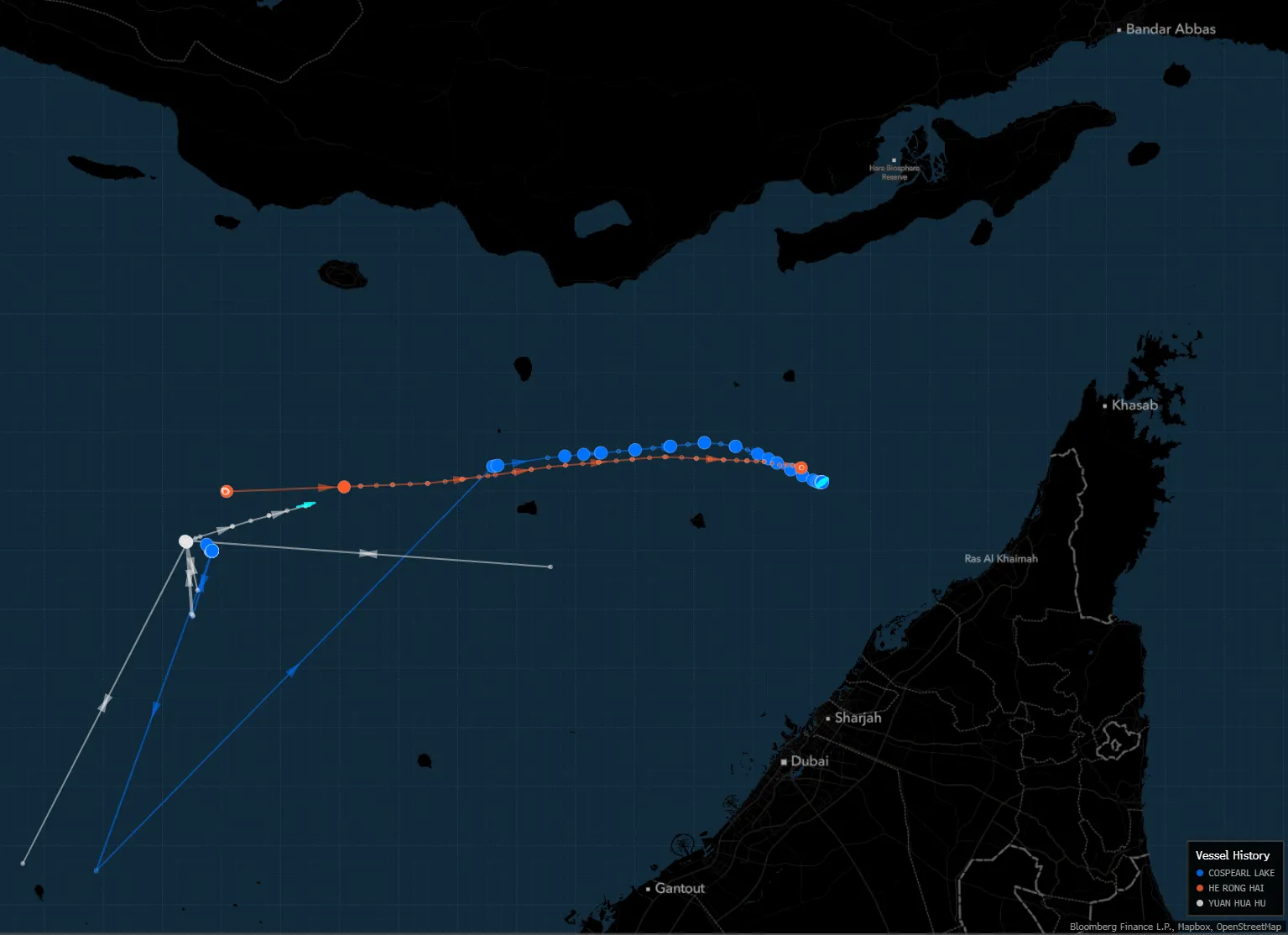
The Cospearl Lake, a very large crude carrier owned by China’s state-run Cosco Shipping Corp., and He Rong Hai, owned by a smaller company, were reported to be traveling east early Thursday morning at high speeds, based on ship-tracking data, before they stopped. Shortly after, another Cosco-related VLCC, the Yuan Hua Hu, began its journey eastward.
All three tankers have indicated Chinese ownership on their tracking systems, which is a common safety procedure during transits approved by Iran.
These tankers are part of a growing group of vessels gathering at the entrance to the strait, near the United Arab Emirates. A Saudi-flagged VLCC, the Jaham, has moved east towards a waiting area close to Dubai. Other ships in the vicinity include two Indian-flagged supertankers that have been there since late March — the Desh Vibhor, located off Ras Al Khaimah, and the Desh Vaibhav, close to Dubai.
Iran and the US have agreed to a pause in fighting in exchange for reopening the Strait of Hormuz, although the specifics of the agreement remain unclear. Ongoing attacks, such as Israeli strikes in Lebanon, have raised doubts about the ceasefire's effectiveness. Since the announcement about the ceasefire and the expected opening of the strait was made a day ago, there hasn't been much change in maritime traffic.
The movements of the Chinese and Saudi vessels show their intentions to pass through the strait after being stuck in the inland sea for weeks. However, their future journeys remain uncertain.
On Thursday, shipowners mentioned they are still waiting for information about how safe passage can be accomplished. Iran cautioned vessels on Wednesday through radio messages that any transit still needs permission from Tehran. Additionally, Iranian media reported that the country has established designated routes for vessels moving through Hormuz, ensuring both inbound and outbound traffic avoids Larak Island in the strait.
Japan’s Mitsui OSK Lines Ltd., a major global shipping company, stated it needs to see “sustainable stability” before sending its ships through the strait.
“We really need to understand how this will be implemented in the water,” said Jotaro Tamura, the company's new president, in an interview.
The Chinese ships are notable for their cargoes. Two are transporting Iraqi crude, while the third is carrying Saudi oil. While Iran has referred to Iraq as a "brotherly" nation, most previous transits have been to friendly countries. Iraq has informed traders and refiners that vessels carrying its oil can now transit the Strait of Hormuz due to an Iranian exemption.
The Cospearl Lake and Yuan Hua Hu are set to make history as the first Cosco tankers to attempt this route during the six-week conflict. The company is known for its cautious approach, and its crude carriers have been stuck since US and Israeli strikes on Iran began, leading Iran to largely close Hormuz in retaliation.
The three Chinese VLCCs were idling in the Persian Gulf throughout March before moving eastward on Thursday, where the first two eventually slowed and stopped just at the entrance of the strait.
In the area, electronic interference can disrupt ships' signals and misrepresent their actual positions. Some vessels may also turn off their transponders when navigating through high-risk waters.
Late last month, two Cosco container ships took a similar route before navigating north along the Iranian coast, a path that others have successfully used to exit with Tehran's approval. China later acknowledged working with relevant parties to facilitate the removal of Chinese vessels from the gulf, although it did not specify which ships were involved.
The Cospearl Lake entered the gulf in late January and spent some time waiting off Dubai before heading to Iraq’s Basrah to load nearly 2 million barrels of crude in early March. The Yuan Hua Hu also arrived in late February to load Basrah crude around the same time as the Cospearl Lake.
According to the maritime database Equasis, these vessels are managed by Cosco Shipping Energy Transport. The registered owner of Cospearl Lake is Cospearl Lake Maritime Ltd., which shares the same address as CSET. The Yuan Hua Hu is also owned by CSET, but China Cosco Shipping Corp., CSET’s parent, did not respond to requests for comments.
The He Rong Hai entered the gulf right before the war began in late February, picking up over 2 million barrels of crude from Saudi Arabia’s Juaymah terminal in early March.
Its owner is named as Hainan Herong Shipping Co., according to Equasis, which has the same address as the manager, Shanghai Yucheng Shipping Co. No contact information was available for either company.