
By Greg Torode
HONG KONG, Aug 19 – China has finished the first phase of building a man-made island at Antelope Reef in the Paracels archipelago. This area in the South China Sea is highly disputed, and experts believe the island will play a crucial role in China’s largest military base.
For the first time, satellite images reviewed by Reuters provide a clear view of the newly formed land structure, indicating the completion of six months of dredging and construction in this busy maritime region.
The development of Antelope Reef highlights the growing military presence in the South China Sea, a region increasingly marked by competition between China and the United States along with its allies. This rivalry is significant for any potential conflict surrounding Taiwan.
“The northern part of the South China Sea is especially vital in a Taiwan conflict scenario, making Antelope well-positioned,” noted Ben Lewis, the founder of PLATracker, an open-source data platform.
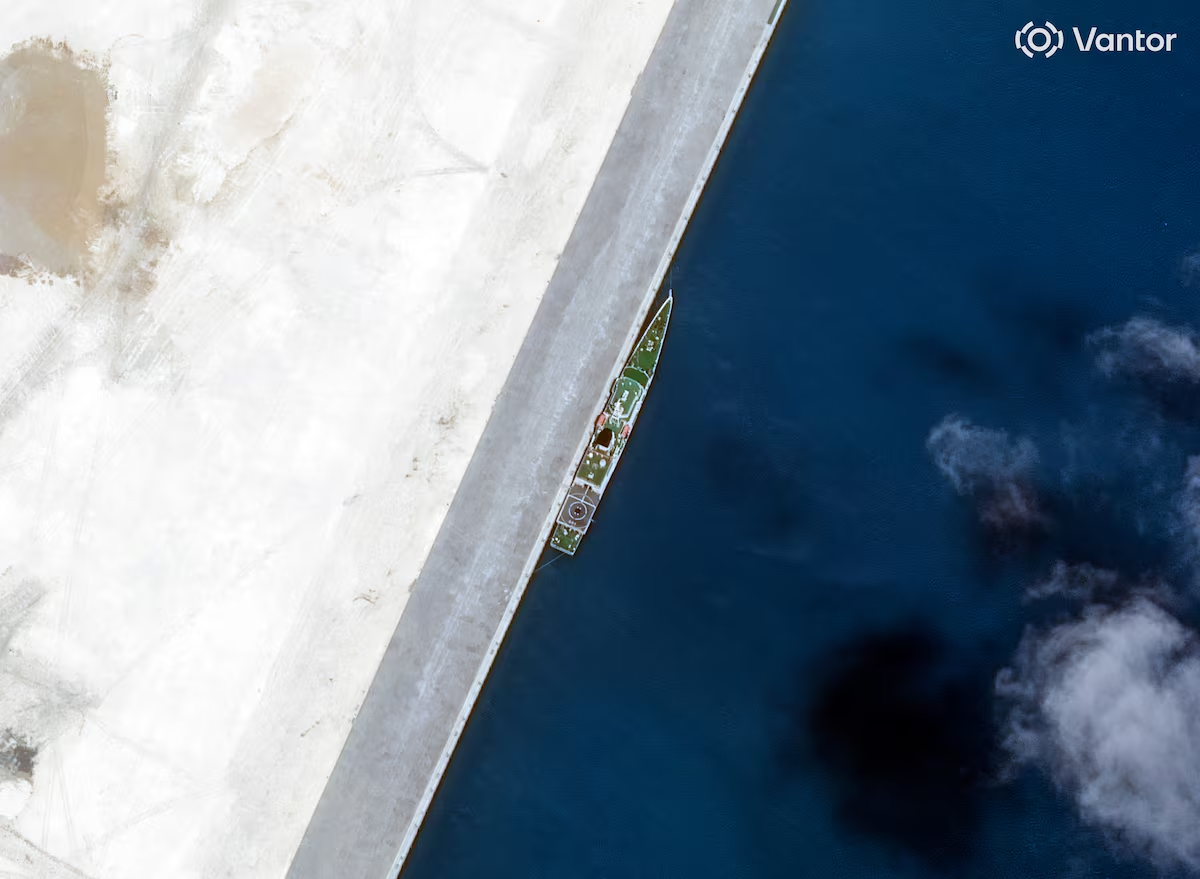
Construction activities have commenced in the southeast section of the island, including a helicopter landing pad, as seen in satellite images captured by Vantor on July 19.
China's defense ministry did not respond to a request for comment from Reuters.
So far, China has not admitted to building a new military base, with state media claiming Antelope will primarily serve civilian purposes such as weather forecasting and scientific research.
IMPACT ON CHINA'S MILITARY PRESENCE
Security analysts believe this development is more likely to enhance China's military control in the northern South China Sea.
Satellite imagery reveals that the reclaimed island stretches nearly 6 km (4 miles) long, with a straight coastline exceeding 3 km (2 miles), which some experts consider suitable for a runway.
A 680 m (740 yards) wharf accompanies a deep-water harbor, with one image from Vantor showing a coast guard ship nearby.
A recent study by the Washington-based Center for Strategic and International Studies indicated that excavation for a new runway may already be underway.
Damien Symon, an open-source intelligence tracker, first reported dredging at the reef on social media back in early January, noting that he had seen signs of work in December.
Lewis believes Antelope Reef could become one of the Chinese military's key assets in the South China Sea, potentially larger than Woody Island and easier to defend than other bases in the Spratlys archipelago.
He added that the significance of the South China Sea and the Southern Theater Command has heightened in the past year, largely linked to Taiwan issues, as noted by China’s top military committee, which is led by President Xi Jinping.
STRATEGIC MILITARY PLANS
China’s military strategists may prefer to keep certain weapons, like H-6 strategic bombers, within the Paracels, closer to the mainland, instead of farther south in the Spratlys.
Chinese South China Sea expert Ding Duo described the construction as “modest” in a recent article for the official China Daily. He asserted that the aim of the project is peaceful and constructive, aiming to enhance safety for all who rely on these waters.
Ding's statements reflect China’s earlier positions regarding its construction efforts in the Spratlys, an area also claimed by neighboring nations like Vietnam, the Philippines, Malaysia, Taiwan, and Brunei.
Historically, Woody Island has served as China’s main administrative point in the South China Sea, hosting jet fighters and surface-to-air missiles at times. Triton Island, also in the Paracels, is equipped with extensive long-range surveillance systems.
China has maintained control over the Paracels since 1974, when it removed the South Vietnamese navy. Vietnam, which claims the entire archipelago, has been expanding its presence in the Spratlys recently.
Vietnam’s foreign ministry has not yet responded to Reuters’ inquiries and previously reaffirmed its claims over Antelope, stating in March that it “strongly opposes such actions and has made representations.”
The island could also bolster China’s ability to create "bastions" or protected maritime areas in the South China Sea to secure its nuclear-armed submarines, according to security expert Collin Koh from Singapore.
Koh noted that this island development, likely to be equipped with advanced surveillance technology, could complicate submarine operations for both the United States and Vietnam, who are both active in the region.
Such bastions near home ports would help shield China’s submarines from potential threats, allowing them to avoid deploying into the broader western Pacific.
Some analysts believe the South China Sea was selected for a recent long-range missile test fired from one of China's submarines.
Once completed, the facilities in the Paracels will enhance China’s ability to monitor U.S. and allied activities during peacetime and add complexity during conflicts, according to Carl Thayer, a professor at the Australian Defence Force Academy.
“This adds another challenge for the United States, requiring defensive measures from the Chinese mainland,” Thayer stated.