
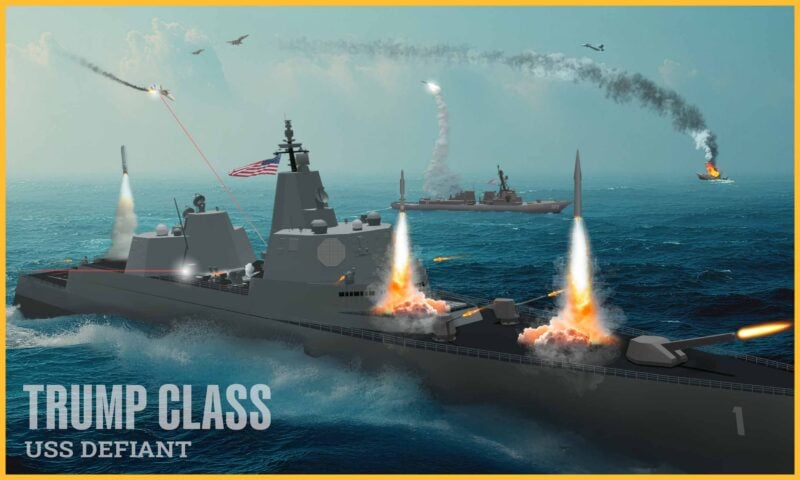
The U.S. Navy aims to design and build a new class of nuclear-powered battleships, with the project expected to cost about $275 billion over the next 30 years. This would create significant demands on the country's shipbuilding industry, according to a report from the Congressional Budget Office (CBO).
The CBO report estimates that the Navy plans to create a fleet of 15 Trump-class nuclear-powered guided missile battleships. The first ship would cost around $23.4 billion, with each of the follow-up ships averaging $18 billion, making them some of the priciest warships ever constructed. Overall, the program's cost, when adjusted for 2026 dollars, is anticipated to be $275 billion between 2027 and 2056.
This estimate is much higher than previous projections for a conventionally powered version of the ship. The Navy had initially estimated the lead ship would be about $15.1 billion, and later ships about $10.2 billion, before deciding to switch to nuclear power in its 2027 "Golden Fleet" shipbuilding plan.
These battleships would be entirely different from anything the Navy has built since World War II. With a full-load displacement of about 35,000 tons, they would be more than three times larger than an Arleigh Burke-class destroyer. They would be equipped with a wide array of weapons, including vertical launch cells for anti-air, anti-ship, and land-attack missiles, hypersonic missiles, high-powered lasers, a rail gun, and nuclear-tipped cruise missiles.
Even with the high costs, the CBO notes that the ships might end up having lower operating costs over their lifespans, as they would not require conventional fuel. However, the report mentions that there's not enough information available to accurately predict those savings.
Challenges for the Shipbuilding Industry
One of the biggest concerns is the strain this new fleet will put on the already overburdened U.S. shipbuilding industry.
According to the CBO, the Navy's 2027 shipbuilding plan would need annual spending on large surface combatants to rise from about $11 billion to approximately $19 billion. The workload for major surface combatants would also increase significantly.
By 2035, shipbuilders would need to more than double the annual tonnage of large surface combatants compared to previous plans. Overall, production of large surface combatants is expected to increase by around 60%, while output of smaller surface combatants would decrease by about 40%.
The report cautions that this massive increase could "be a challenge for the shipbuilding industry."
These challenges come as U.S. shipyards continue to face labor shortages and production delays. Currently, destroyers take an average of 11 years from funding to delivery, a significant rise from about five years in the 2000s. Aircraft carrier and submarine construction also remains behind schedule.
The Navy plans for Newport News Shipbuilding to handle the final assembly of the nuclear battleships, as it is the only shipyard certified for nuclear-powered surface ships. However, Newport News is already working on Ford-class aircraft carriers and nuclear submarines, raising concerns that adding the battleship program could further strain its production timetable.
The CBO also warns that starting construction before the design is sufficiently developed—a common issue in recent Navy projects—could result in higher costs and delays. The report highlights that the battleship design is still in the early stages, despite the Navy's goal to order the lead ship by 2028.
While the Navy believes that advancements in digital engineering, modular construction, and AI-driven design tools can help lower risks to the schedule, the CBO points out that recent issues with programs like the Constellation-class frigate indicate that there are still significant challenges ahead.