
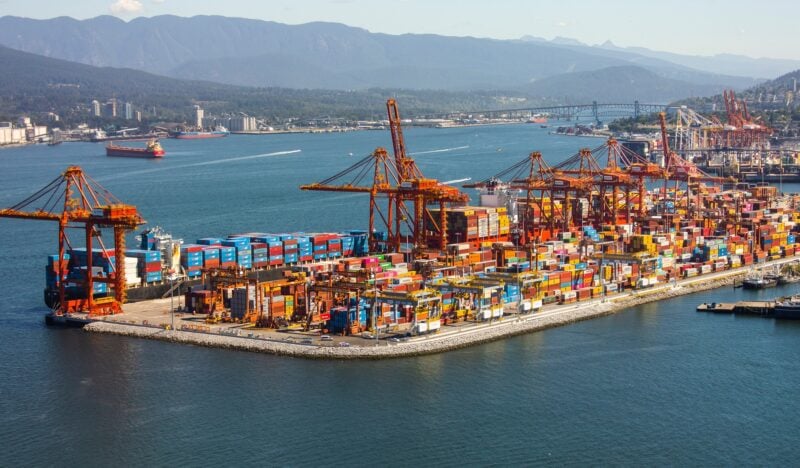
The largest West Coast ports in Canada are getting ready to take on a bigger role in the country's efforts to diversify trade beyond the United States. A new study highlights the significant amount of cargo already flowing through British Columbia's Pacific ports.
In 2025, the ports of Vancouver, Prince Rupert, and Nanaimo handled a record 200 million metric tonnes of cargo, worth $409 billion, according to an economic impact study released on Wednesday.
These ports collectively managed nearly $270 billion of Canada's trade with international partners, accounting for almost half of the country's trade outside North America.
The findings are timely, as Canada aims to double its exports to non-U.S. markets over the next decade, focusing more on Pacific trade routes and accessing rapidly growing economies in the Indo-Pacific region.
“West Coast ports like Vancouver have a critical role in Canada's goal to double exports to non-U.S. markets in the next 10 years, which is vital for a strong national economy,” said Peter Xotta, president and CEO of the Vancouver Fraser Port Authority.
The three ports export a diverse range of Canadian products, including energy, grain, potash, forestry goods, and critical minerals, as well as containerized cargo and imports like vehicles and consumer goods.
Their strategic location provides Canada with direct access to Indo-Pacific markets that are expected to represent half of the global GDP by 2040. Additionally, rail and highway connections link the ports to producers and consumers throughout Canada.
Vancouver, the largest port in Canada, operates across 29 major deep-water terminals that handle containers, cars, bulk, and breakbulk cargo. The port is also preparing for the proposed Roberts Bank Terminal 2 project, which would significantly increase container capacity on Canada's West Coast.
Prince Rupert is currently working on around $3 billion in projects to enhance its role as a northern Pacific gateway.
Kurt Slocombe, President and CEO of the Port of Prince Rupert, mentioned various projects aiming to boost capacity and diversify cargo flows, such as the CANXPORT and LinX logistics initiatives, the Ridley Island Energy Export Facility, and the addition of more marine berths and rail infrastructure.
“The Port of Prince Rupert will be a crucial gateway to help Canada achieve its goal of doubling non-U.S. exports,” Slocombe stated.
Nanaimo also aims to expand its role in Canada's Pacific trade network. Located about 30 nautical miles from Vancouver, it operates three deep-water terminals that serve container, auto, bulk, breakbulk, cruise, and logistics operations.
“As Canada seeks to strengthen trade routes and improve access to global markets, strategic investments in infrastructure, industrial development, and transportation connectivity will be vital,” said Ian Marr, president and CEO of the Nanaimo Port Authority.
The report also highlighted the broader economic impact of these three ports and their supply chains.
Together, they supported an estimated 152,100 jobs across Canada in 2025, including approximately 61,000 direct jobs ranging from longshore workers and train engineers to truck drivers and administrative staff. These jobs generated about $13 billion in annual wages and contributed nearly $25 billion to Canada's GDP.
This study comes at a time of renewed uncertainty in Canada's trading relationship with the United States, adding urgency to Ottawa's long-term effort to expand trade with other markets.
Canada and the United States had been in talks for a broader trade agreement this summer, but discussions were halted last week due to unresolved differences. This breakdown has been followed by a new wave of tariffs and Canada's planned retaliation, further underscoring its reliance on the U.S. market.
For Canada's West Coast ports, this push could lead to a significant increase in cargo across Pacific trade routes.
“Canada's West Coast ports are a vital national asset, connecting Canadian businesses to global markets and supporting thousands of jobs that sustain families,” said Mike Leonard, president and CEO of the BC Maritime Employers Association. “As global trade evolves, having a stable and reliable waterfront and resilient national supply chains will be essential for unlocking new economic growth, diversifying trade, and keeping Canada competitive.”
The Economic Impact of West Coast Ports study was conducted by InterVISTAS for the Vancouver, Prince Rupert, and Nanaimo port authorities, the BC Maritime Employers Association, and the BC Marine Terminal Operators Association.