
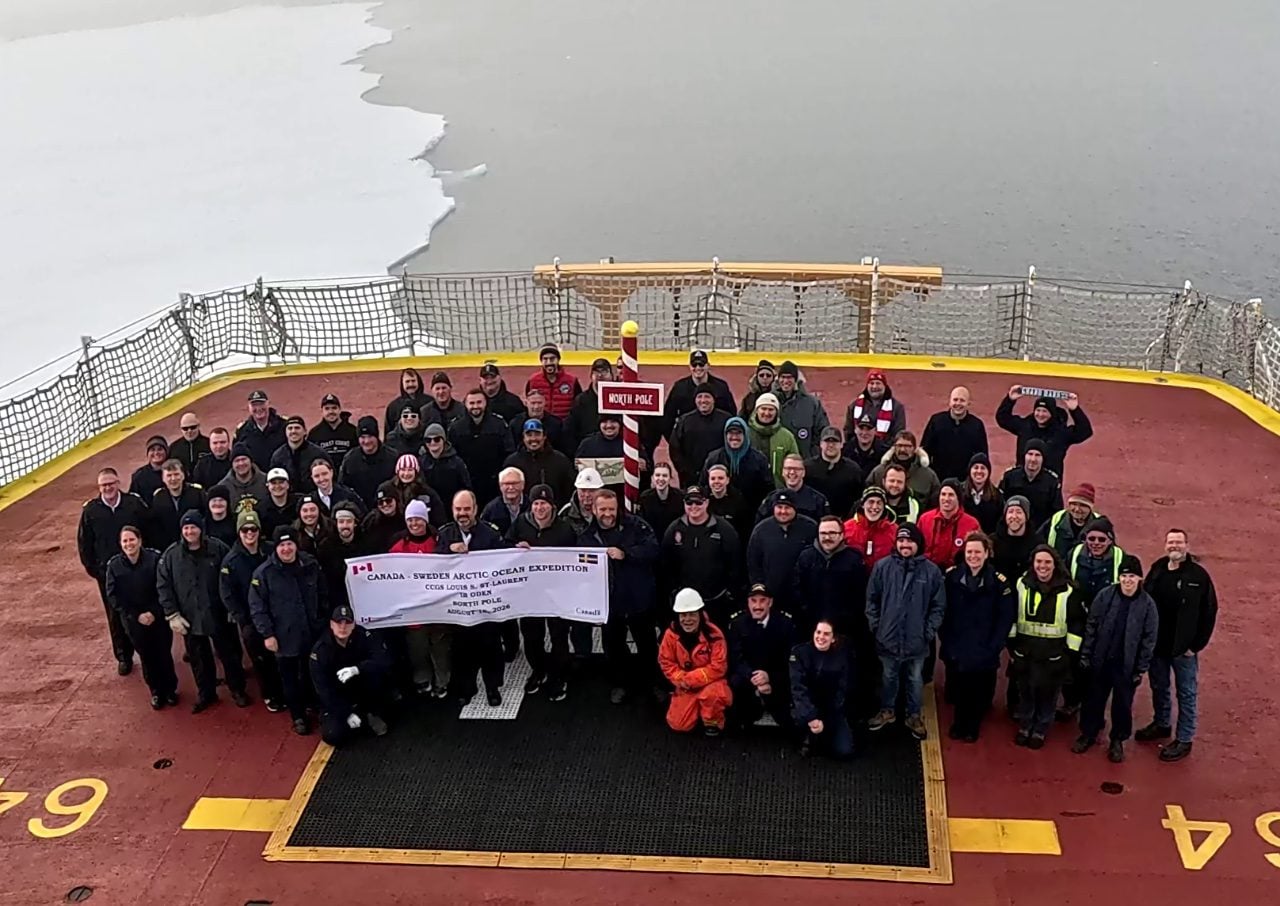
Canada's largest icebreaker has successfully reached the North Pole as part of a long-term plan to map the country’s continental shelf and strengthen its presence in the Arctic.
The Canadian Coast Guard Ship Louis S. St-Laurent arrived at the North Pole on August 16 during its 2026 Arctic mission, as reported by Canada's Department of National Defence and the Canadian Coast Guard.
This journey is part of ongoing efforts by Natural Resources Canada and Fisheries and Oceans Canada to gather detailed geoscience and hydrographic data from the Arctic region.
The aim of this work is to help Canada define the outer limits of its continental shelf under the United Nations Convention on the Law of the Sea (UNCLOS), which allows countries to claim rights to seabed resources beyond their 200-nautical-mile exclusive economic zones under specific conditions.
Current Arctic missions are planned from 2024 to 2027.
“The arrival of CCGS Louis S. St-Laurent at the North Pole is a significant milestone that shows Canada's long-term commitment to the Arctic,” said Defence Minister David J. McGuinty. “With the support of Canadian Coast Guard personnel, this mission enhances scientific knowledge, strengthens our presence in the North, and reinforces Canada’s sovereignty and security.”
This journey highlights Canada's increasing focus on Arctic security and sovereignty, especially given the rising geopolitical competition in the area and changing sea-ice conditions that are making parts of the Arctic more accessible to shipping and other activities.
CCGS Louis S. St-Laurent is a heavy icebreaker and the largest ship in the Canadian Coast Guard’s icebreaking fleet. It has been essential in Canada’s Arctic scientific programs, including previous missions to collect seabed and geological data that support Canada's continental shelf claims.
Canadian Coast Guard Commissioner Kevin Brosseau stated that reaching the North Pole also showcases the operational skills needed to function in the challenging conditions of the region.
“Reaching the North Pole reflects the professionalism and dedication of the CCGS Louis S. St-Laurent crew and everyone who supports our Arctic operations,” Brosseau said. “Our icebreakers allow the Canadian Coast Guard to operate safely and effectively in Canada’s Arctic, supporting northern communities, scientific research, and government priorities across the North.”
Canada’s summer Arctic operational season typically runs from June to November. During this time, Coast Guard icebreakers assist northern communities, carry out scientific missions, and provide services to vessels navigating Arctic waters.
The Louis S. St-Laurent is nearing the end of a career that began over 50 years ago. The vessel was commissioned in 1969 and has had several major upgrades throughout its time in service.
Canada is launching a significant renewal of its icebreaking fleet, which includes building new polar icebreakers to ensure better capability and sustained presence in the Arctic as the Louis S. St-Laurent and other older vessels are gradually retired.
The government stated that the North Pole mission showcases Canada’s ability to operate in isolated Arctic waters while promoting scientific research, mapping of the continental shelf, and broader national interests in the region.