
By David Shepardson and Laila Kearney
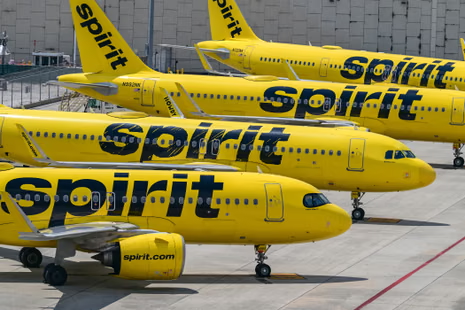
May 2 (Reuters) – The U.S. government and major airlines scrambled to assist stranded passengers and employees after discount airline Spirit Airlines ceased operations on Saturday. This marks the first major airline failure linked to the ongoing war in Iran. The sudden collapse of Spirit, which was already struggling, was accelerated by a sharp rise in jet fuel prices due to the conflict. This situation is expected to result in the loss of thousands of jobs.
President Donald Trump had proposed a $500 million bailout to save Spirit, but faced opposition from some advisors and many Republicans in Congress. The company's shutdown highlights the unforeseen fallout from the U.S.-Israel war against Iran, despite a fragile ceasefire. While Spirit was battling to make a profit before the price surge, global airlines are now grappling with rising jet fuel costs as Iran continues to block most traffic through the Strait of Hormuz and the U.S. Navy restricts access to Iranian ports.
Transportation Secretary Sean Duffy explained that creditors rejected the bailout proposal despite vigorous efforts from the Trump administration to stabilize Spirit. The airline’s failure will lead to the loss of around 15,000 jobs for Spirit employees and contractors.
Some of Spirit’s key creditors, including hedge fund Citadel, opposed the government-backed rescue plan, arguing that it would devalue their claims by prioritizing federal funding over existing debts.
Fond Tributes on Social Media
No U.S. airline of Spirit's size, which accounted for 5% of U.S. flights last year, has shut down in the past two decades. Spirit played a crucial role in keeping ticket prices low in markets where it competed against major airlines. On social media platform X, many users shared nostalgic posts about their experiences with Spirit, with some incorporating the hashtag “RIP.”
At Orlando International Airport, bright red notifications on digital displays indicated numerous canceled Spirit flights to various destinations.
United Airlines, Delta Air Lines, JetBlue, and Southwest Airlines are offering capped ticket prices for Spirit customers who need to rebook, provided they present a Spirit flight confirmation number. Competitor airlines are also providing free seats for Spirit employees to help them return home. “This is the airline industry stepping up,” remarked Duffy.
Duffy also mentioned that U.S. low-cost carriers are seeking $2.5 billion in government assistance to cope with rising fuel costs, but he did not feel an immediate government bailout was necessary.
Airline Collapsed Overnight
Duffy criticized the previous Biden administration for blocking a 2024 merger between JetBlue and Spirit, claiming that this decision contributed to Spirit’s downfall. The airline had filed for bankruptcy protection twice within a year and had not turned a profit since 2019.
Spirit built its reputation on low fares for budget-conscious travelers willing to forego extras like checked baggage and seat assignments. However, demand for ultra-low-cost carriers has decreased since the pandemic, as travelers are now prioritizing comfort and experience.
The closure of Spirit is likely to benefit competitors like JetBlue and Frontier Airlines, which are also facing challenges due to rising costs. Spirit had over 4,100 domestic flights planned between May 1 and May 15, offering nearly 810,000 seats.
Trump stated on Friday that the White House had presented a final rescue proposal to Spirit and its creditors after negotiations stalled regarding a $500 million financing package that would enable the airline to continue through bankruptcy.
Spirit had a potential deal in place with its lenders that would have helped it recover from its second bankruptcy by early summer. However, the increase in jet fuel prices disrupted these plans, making it difficult for Spirit to manage its costs. The airline’s restructuring strategy assumed jet fuel prices of about $2.24 a gallon in 2026 and $2.14 in 2027, but by the end of April, costs had risen to approximately $4.51 per gallon, leaving Spirit unable to survive without additional funds. Jet fuel represents about a quarter of airlines' operating expenses.
In February, Spirit carried around 1.7 million domestic passengers, holding a 3.9% market share, down from 5.1% the year before.