An autonomous surface vessel (ASV) operated by the U.S. Navy, created by Saronic, successfully rescued two U.S. Army aviators after their AH-64 Apache helicopter crashed off the coast of Oman. This event marks what seems to be the first publicly acknowledged personnel recovery carried out by an unmanned surface vessel.
U.S. Central Command (CENTCOM) reported that the helicopter went down near Oman while on patrol operations on Monday, June 8. The two crew members were rescued within about two hours and are currently in stable condition. The cause of the crash is still under investigation.
The rescue was conducted by U.S. Naval Forces Central Command and Task Force 59 of the U.S. 5th Fleet, which focuses on integrating unmanned systems and artificial intelligence within maritime operations.
President Donald Trump later shared on social media that Iranian forces shot down the Apache while it was flying over the Strait of Hormuz, labeling the incident as an attack that warranted a response from the U.S. “The Iranians shot down one of our highly sophisticated Apache Helicopters while patrolling over the Strait of Hormuz,” Trump stated on Truth Social, adding that both crew members are safe and the United States "must, of necessity, respond to this attack."
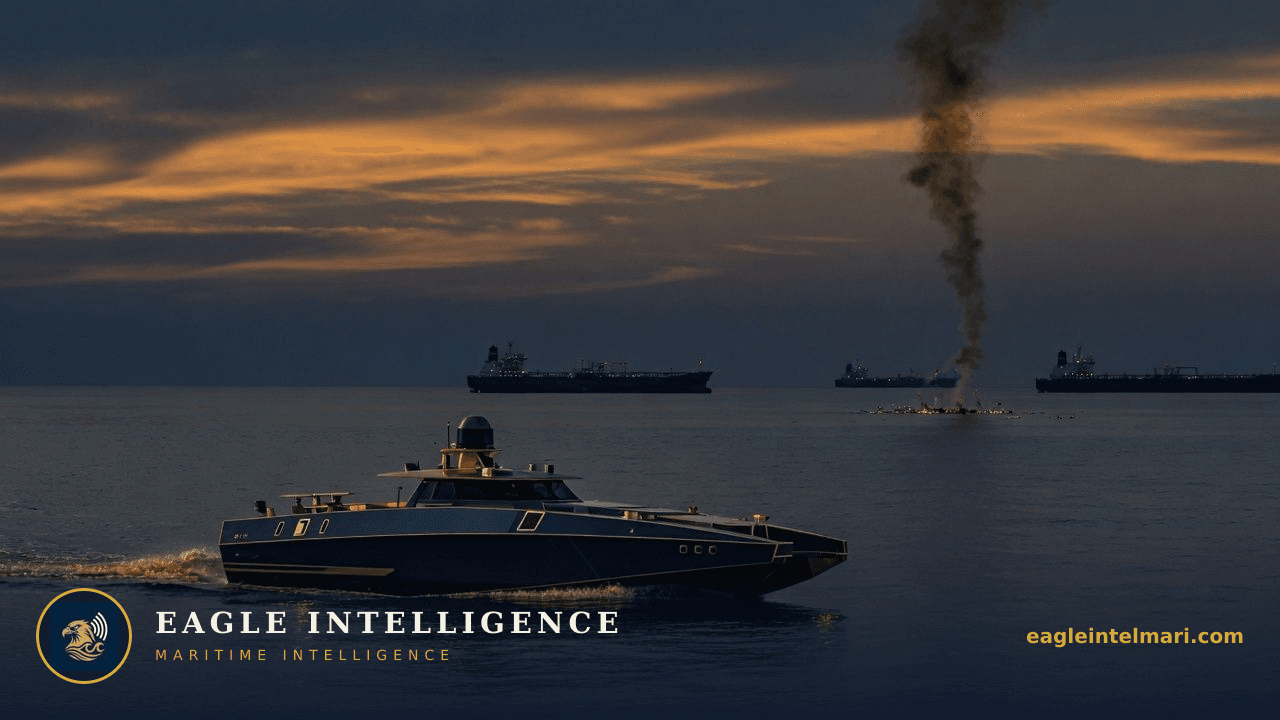
According to Reuters, citing Navy Capt. Tim Hawkins from CENTCOM, the Saronic Corsair autonomous surface vessel was sent to retrieve the pilots from the water.
Hawkins told Reuters, “The drone picked them up and moved them to another location on the water where they were lifted onto a helicopter for further transport.”
While not much is known about the recovery operation, the mission signifies an important achievement for both Task Force 59 and Saronic, which is rapidly growing in the field of maritime autonomy.
The vessel involved in the rescue was Saronic’s Corsair, a 24-foot autonomous craft designed for maritime security, surveillance, force protection, and logistics. This diesel-powered platform can carry payloads of up to 1,000 pounds and operate over more than 1,000 nautical miles without a crew on board.
The Corsair features radar, cameras, satellite communications, onboard computing, and autonomous navigation software that enable it to operate independently while remaining aware of nearby traffic and hazards. It can function under remote oversight or completely autonomously for long stretches.
In a statement to gCaptain, the company confirmed that a Saronic Corsair was utilized in the rescue operation following the helicopter's downing.
This successful operation comes just six months after the U.S. Navy awarded Saronic a $392 million production contract for its Corsair surface vessels. This is one of the swiftest transitions from prototype to production in recent Navy procurement history, showcasing the Pentagon's growing trust in unmanned maritime systems and positioning Corsair as a leading autonomous vessel program.
Earlier this year, Saronic completed an extensive testing campaign with eight Corsair vessels operating continuously over 70 nautical miles offshore. During this exercise, the vessels covered over 4,500 nautical miles while performing autonomous harbor transits, long-range patrols, and multi-day loiter missions.
The company stated that these tests confirmed the vessel's ability to stay on station for extended periods while efficiently managing fuel and power use, which aligns well with the operational needs of Task Force 59.
Founded in 2021, Task Force 59 is the U.S. Navy's main unit for experimenting with and operating unmanned maritime systems in the Middle East. It conducts operations across the Persian Gulf, Gulf of Oman, Red Sea, Gulf of Aden, and Arabian Sea—areas that include some of the world's key maritime chokepoints like the Strait of Hormuz and Bab el-Mandeb.
The rescue occurs amidst a period of rapid growth for Saronic.
In April, the company based in Austin, Texas, announced it raised $1.75 billion in Series D funding at a valuation of $9.25 billion, making it one of the largest fundraising efforts within a maritime technology company. The funds are intended to expand Saronic's autonomous vessel lineup and develop new shipbuilding capacity in the U.S.
Saronic has positioned itself as both a developer of maritime autonomy and a shipbuilder, emphasizing the need for the U.S. to boost its industrial capabilities to compete with China's advancing maritime influence.
This goal was further highlighted in May when Saronic launched its first Marauder Medium Unmanned Surface Vessel (MUSV), a 180-foot autonomous ship designed for long-range defense and commercial tasks.
The first Marauder hull moved from initial design to water trials in under a year. The vessel can reach speeds over 25 knots, travel up to 5,400 nautical miles, and carry payloads of up to 150 metric tons, including standard shipping containers.
Multiple Marauder hulls are currently under construction at Saronic's shipyard in Franklin, Louisiana, where the company aims to produce up to 20 vessels annually.
The company's growth has also been driven by increasing demand from the U.S. military. Last year, Saronic received a $392 million production contract with the U.S. Navy, speeding up the transition of its autonomous systems from prototypes to operational use.
For years, developers of autonomous vessels have been promoting various future applications, ranging from surveillance and logistics to combat roles. The recent rescue off Oman provides a rare real-world example of an autonomous vessel utilized during an actual emergency.
Instead of gathering intelligence or conducting surveillance, the Corsair was assigned to recover personnel from the water and safely transport them—something typically done by manned rescue vessels.
As navies look for ways to enhance operational reach and minimize risks to troops, this mission may offer an early insight into how autonomous vessels could become part of standard search-and-rescue, force protection, and maritime security operations in the future.