
By Weilun Soon
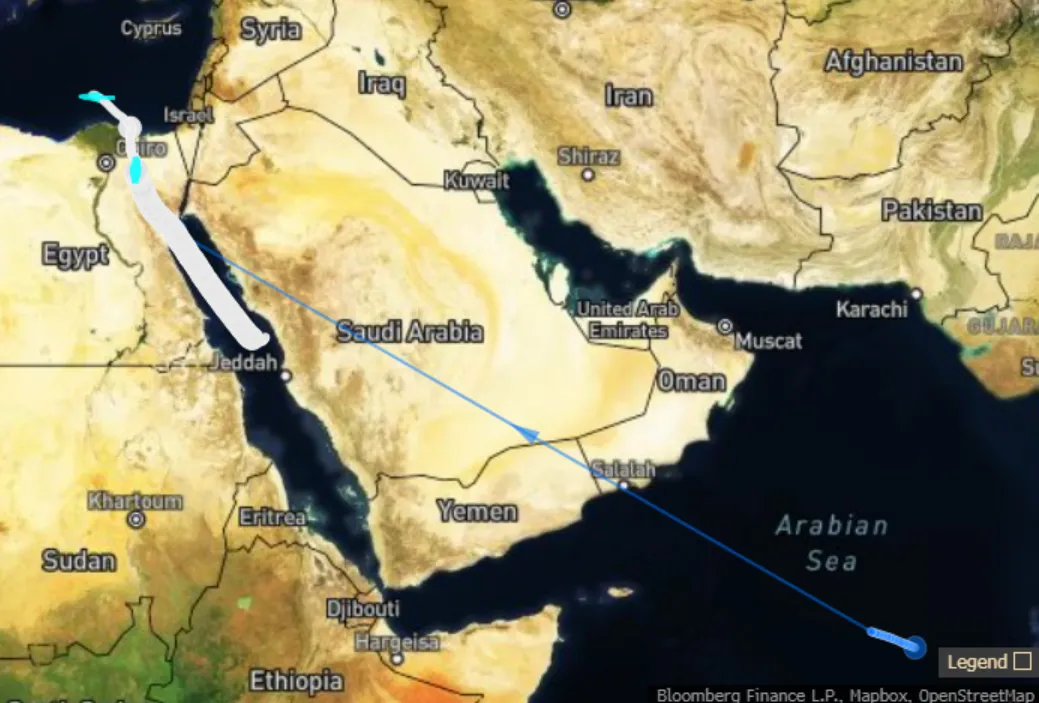
July 27, 2026 (Bloomberg) – A supertanker carrying Saudi oil, named Olympic Luck, has taken a longer route through the Suez Canal to reach Asia after leaving the Red Sea. This decision comes as threats from Houthi rebels increase tensions in the area, leading other vessels to still navigate the riskier Bab el-Mandeb Strait.
The Olympic Luck, a very large crude carrier, moved through the Suez Canal mostly loaded with Saudi oil and entered the Mediterranean Sea late on Sunday, as reported by market data firm Kpler. Shipping records show that this Greek-owned ship is now on its way to an undisclosed location in Asia after diverting from Europe.
Olympic Luck is likely the first supertanker with Saudi oil to take this more expensive path around Africa. This decision follows recent attacks on vessels and a blockade declared by Houthi rebels in the Red Sea. Despite this, ships from Saudi Arabia operated by Iran-friendly countries like China and Pakistan continue to pass through Bab el-Mandeb.
It is unclear why Olympic Luck opted for this longer route, which might be due to its Western ownership or a cautious Asian buyer.
A VLCC (Very Large Crude Carrier), which can hold 2 million barrels of crude, can't transit the Suez Canal fully loaded since it sits too low in the water. To navigate the canal, the supertanker must unload about half of its cargo at Ain Sukhna in the Red Sea, which is then transported north to Sidi Kerir in Egypt where it can refill before continuing its journey.
Another supertanker heading to Asia, the DHT Gazelle, is expected to follow Olympic Luck through the Suez. This vessel began signaling from the Red Sea on Sunday and is currently waiting at the canal's entrance, partly filled with crude from the Saudi port of Yanbu. Records suggest it’s headed for an oil refinery in the Philippines.
Data indicate the Marshall Islands-flagged DHT Gazelle was in the Arabian Sea on July 17, suggesting it crossed Bab el-Mandeb without reporting its position. The tanker likely loaded at Yanbu late last week and reappeared near Suez on Sunday, according to Kpler.
The Houthi rebels have escalated conflict in the Middle East, impacting traffic in the Strait of Hormuz. On Monday, traffic through this vital waterway was sparse, and there is anticipation for an increase in activity now that hostilities between the US and Iran have calmed.
On Sunday, eight commodity vessels, mainly smaller product tankers and bulk carriers, crossed the strait, as reported by Kpler. Over the weekend, at least two ships carrying naphtha left the Persian Gulf with their tracking devices off, providing some relief to Asian importers who convert this fuel into chemicals.
In the Red Sea, the Lahore, a Pakistani-flagged Aframax tanker, moved into the Gulf of Aden after partially loading in Yanbu last week. Another Pakistani Aframax, the Karachi, is also on its way to the chokepoint, also partly filled from the same port.
Chinese tankers carrying Saudi crude have been passing through Bab el-Mandeb without incident, along with at least one Greek ship that traveled with its tracking device turned off. However, traffic has slowed down. On Sunday, only 14 commodity vessels passed through the corridor in both directions, the lowest number recorded this year according to Kpler data. These figures may be updated as more information becomes available.