
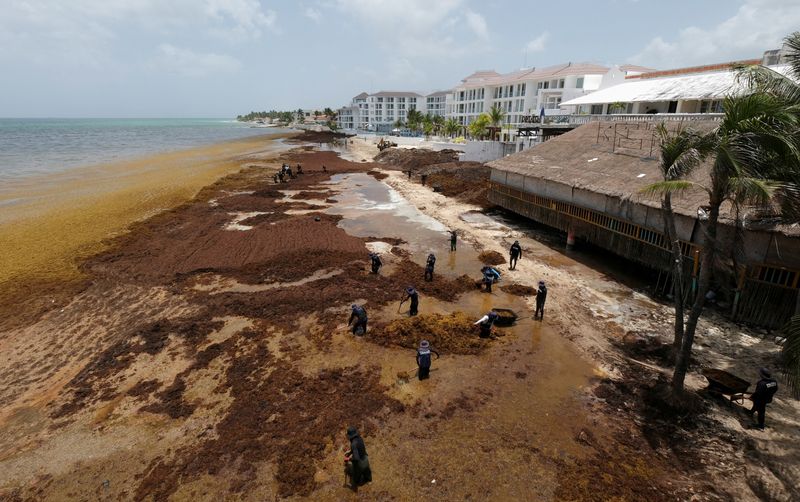
MEXICO CITY, July 31 (Reuters) – Every day at dawn, many hotel staff, tractor operators, and Navy specialists are going to the beach to clear away large amounts of decaying sargassum seaweed from the beautiful Caribbean coast near popular tourist spots.
This seasonal issue has led hotels across the Caribbean to lower their prices and invest millions in removing the unpleasant-smelling algae from their shores, while both governments and businesses look for solutions.
HOW IT STARTED
Sargassum is a brown seaweed that typically floats on the ocean's surface. It used to be confined to the Sargasso Sea in the North Atlantic, but strong winds around 2010 carried it into nutrient-rich tropical waters off West Africa, where it flourished.
This seaweed formed a self-sustaining belt that travels on ocean currents to northern Brazil and the Caribbean, bringing large quantities of algae to Caribbean nations, including the popular Riviera Maya and the Gulf of Mexico.
In the tropical Atlantic, sargassum thrives on nutrients coming from major rivers like the Amazon, Orinoco, and Congo, as well as deep ocean currents, Saharan dust, and rising sea temperatures.
WHERE IT'S HEADED
The University of South Florida’s Optical Oceanography Lab predicts that 2026 will likely be at least the second-highest year for sargassum growth, with more seaweed expected to accumulate around the Caribbean and southeastern Florida in the coming months.
Brian Barnes, a research assistant professor from the university's College of Marine Science, explained that the novelty of this issue makes it hard to predict its future trajectory. “Before 2010, there was nothing, but we saw an increase from about 1 million metric tons in 2011 to 40 million last year,” he stated, indicating that the seaweed could double its mass every five years.
RECORD IN MEXICO
In Mexico, officials are taking steps to safeguard important tourist locations along the beautiful Riviera Maya, including Cancun, Tulum, and Playa del Carmen, by acquiring more boats for sargassum cleanup and installing larger barriers offshore.
Mexico mostly collects sargassum after it washes onto its beaches and has gathered approximately 96,151 metric tons this year, an increase from 92,783 tons last year, according to government figures.
“Experience has taught us that the best way to tackle sargassum is to intercept it at sea before it reaches our shores,” said Mara Lezama, the governor of Quintana Roo.
Mexican federal officials expect a new sargassum collection vessel to arrive within a month and are also looking to acquire more ships from Japan while providing smaller Mexican-made vessels to the Dominican Republic.
CARBON CREDITS
Some companies are trying to obtain carbon credits for using boats to collect sargassum, which releases methane when it decomposes, and then sinking it to the ocean floor. However, this method raises concerns about potential harms to deep-sea ecosystems and over-harvesting.
“It’s a balance because offshore sargassum is a natural habitat for many turtles and fish,” Barnes mentioned. “If you try to clear the Caribbean entirely, you’ll cause a lot of collateral damage.”
Barnes said that many companies have sought his advice on carbon credit projects, but he is skeptical about their positive impact.
WHEN LIFE GIVES YOU SARGASSUM
The excess sargassum has motivated several entrepreneurs to convert the seaweed into alternative energy sources or profitable products, tackling challenges like safely removing toxic metals found in the algae.
Environment Minister Alicia Barcena noted that of nearly 200 projects in Mexico, at least 11 have potential for industrial scaling, and 39 are already producing a variety of products, including fuel, fertilizers, laminates, bioplastics, and handmade sandals.
Felix Navarrete, an executive at the sargassum refining company Carbonwave, shared that his business is already selling fertilizer globally and is now looking to supply it to local farmers after receiving approval from Mexico’s health authority.
Carbonwave is also aiming to provide materials for the cosmetic and textile industries, while the Quintana Roo state government plans to expand a biofuel production facility in Cancun.
WHAT’S NEXT
While Caribbean government and industry leaders acknowledge the seriousness of this crisis, they also encourage tourists to continue visiting their beaches and making the most of their vacations by staying informed and choosing less-affected areas.
Mexico will host a joint European Union-Caribbean conference on sargassum in early October in Cancun, where representatives will discuss ways to improve sargassum collection while protecting beaches and coral reefs.