
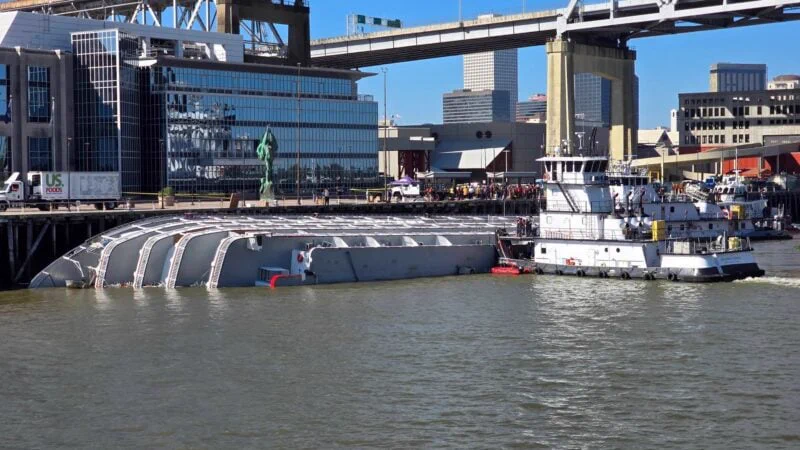
The captain and crew of the American Heritage, along with tugboat operators and first responders, are being recognized as heroes after a serious incident on the Mississippi River. The river cruise ship capsized due to a collision, but thankfully, everyone on board survived.
American Cruise Lines praised Captain Leonard Stewart for his bravery. He stayed on the bridge as the ship tipped over after being hit by the tanker Atlantic Asphalt near the Port of New Orleans on November 13.
In a statement on Saturday, the company said, “The quick actions of Captain Leonard Stewart and our crew allowed for a fast evacuation of the vessel.”
“Captain Stewart remained on the bridge as the vessel capsized, calling for help and keeping the ship close to the dock for as long as he could.”
The accident took place around 12:30 p.m. local time, just below the Crescent City Connection bridge. The impact caused the American Heritage to fill with water and eventually roll onto its side, throwing passengers and crew into the Mississippi River.
As the riverboat began to capsize, help came from nearly everywhere.
Harbor tugs, towboats, and other vessels sped to the scene, joining the U.S. Coast Guard, Port of New Orleans Harbor Police, New Orleans Fire Department, and other emergency teams in a large rescue operation.
Data from AIS and local reports indicated that crews from several towing companies were on-site within minutes after the collision.
The rescue boats that arrived included Moran’s Becky S, Crescent Towing’s Mardi Gras, and others like the E.N. Bisso tug Marauder and several Stone Oil towboats. Canal Barge’s Elly Lane and the Port of New Orleans fireboat Gen. Roy S. Kelley were also included in the response.
Though AIS data alone doesn’t specify exactly what each vessel did, videos and witness accounts showed working boats assisting emergency responders in the rescue.
Captain Kenny Brown of The Maritime Throwdown acknowledged the private-sector crews whose help often goes unnoticed amid the focus on government first responders.
“When something goes wrong on the river, the first boats you typically see are towboats and tugs,” Brown noted. “Nobody calls them; they’re already on-site and head straight for the trouble.”
Brown recognized the captains, pilots, and deckhands for their quick actions to assist in the response.
“To the captains who made the call, the pilots who kept the boats steady, and the deckhands on deck with life rings: that’s true courage, and the river witnessed it.”
The response was remarkable for its speed and scale.
New Orleans Harbor Police Chief Melanie Montroll reported that 87 passengers and crew members managed to evacuate before the American Heritage capsized. It took about 30 to 45 minutes for rescuers to save the remaining individuals from the river and ensure everyone was accounted for.
Mayor Helena Moreno described the event as a “miracle on the Mississippi,” crediting the teamwork between government responders and other nearby vessels that stepped in to help.
Everyone on board was accounted for, with no fatalities reported. However, 32 people, including two Harbor Police officers, were taken to hospitals. As of Saturday, eight individuals were still hospitalized, according to local authorities.
American Cruise Lines expressed gratitude to the Coast Guard, Port of New Orleans, New Orleans Police Department, and all the agencies involved in the rescue.
“We are proud of our crew and thankful for the first responders,” the company said, adding that they will continue to work with authorities throughout the investigation and recovery effort.
The National Transportation Safety Board is looking into the collision, including claims that the Atlantic Asphalt may have had a steering issue before hitting the docked riverboat. The exact cause is still unknown.
The American Heritage is currently partially submerged along the riverfront, and salvage operations are expected to take several weeks.
For Brown, this incident highlighted the necessity of maritime safety training and readiness to respond quickly in critical situations.
“Practice until it becomes second nature,” he advised. “You don’t rise to the occasion; you rely on your training.”
The situation in New Orleans served as a reminder of the professionalism present throughout the maritime industry, from passenger vessel crews to the hardworking mariners on the tugs and towboats that keep the Mississippi River active.