
The Unsung Heroes of American Power
By Bruce Kimbrell (Policy Op-Ed)
On July 17, a significant moment occurred on the waterfront.
Admiral Karl Thomas, who leads the U.S. Fleet Forces Command, awarded the first-ever Presidential Unit Citation to a civilian-operated ship in the 77 years of Military Sealift Command’s existence. This event was more than just a military event; it signified one of the highest honors given to America’s merchant mariners, highlighting their vital role in national defense.
When the crew of the USNS Kanawha received the Presidential Unit Citation, given by President Donald J. Trump to both USNS Kanawha and USNS William McLean, I thought of another president who recognized the value of America’s merchant mariners.
President Franklin D. Roosevelt famously referred to wartime merchant ships as the “Ugly Ducklings” and dubbed the Merchant Marine the “Fourth Arm of Defense.” While history often celebrates battleships and generals, Roosevelt kept in mind something else.
The sailors and ships that helped secure victory in World War II were not designed for fame; they were built to transport goods.
The Unsung Heroes Who Supported the War Effort
These ships traversed treacherous oceans, navigating through enemy submarines, carrying essential supplies like fuel, ammunition, food, tanks, and aircraft. They transported the resources that ultimately defeated tyranny.
Every journey faced dangers from enemy submarines, mines, aircraft, storms, and the harsh sea. Still, they sailed on, knowing the success of America’s military depended on them.
After the war, while America celebrated its triumph, Roosevelt’s “Ugly Ducklings” gradually faded from public consciousness.
Steady Service in Uncertain Times
Merchant mariners continued their service without pause.
Their ships kept America’s trade flowing, supported military operations from Korea to Vietnam and beyond, provided humanitarian aid after disasters, and ensured American power could reach anywhere it was needed.
Even when unnoticed, merchant mariners kept showing up for America. In 2026, America acknowledged their dedication.
America Gives Recognition
On National Maritime Day in May 2026, Secretary of Transportation Sean Duffy and Maritime Administrator Steve Carmel highlighted the role of merchant mariners by presenting the Gallant Ship Award to the crew of the Stena Immaculate.
Founded by President Roosevelt in 1944, the Gallant Ship Award honors extraordinary civilian bravery at sea and has been awarded only about forty times in its history, making it a rare honor in American maritime service.
The 23-member crew from Crowley earned this honor for their exceptional response during a 2025 collision in the North Sea, battling a fire fueled by military jet fuel long enough to ensure a safe evacuation and avert a greater disaster.
A Historic Modern Honor for Civilian Mariners
Then, an unprecedented honor came to be.
President Donald Trump conferred one of the nation’s highest military honors to the civilian crews of Kanawha and William McLean, who provided crucial support to the USS Gerald R. Ford Carrier Strike Group during Operation Epic Fury.
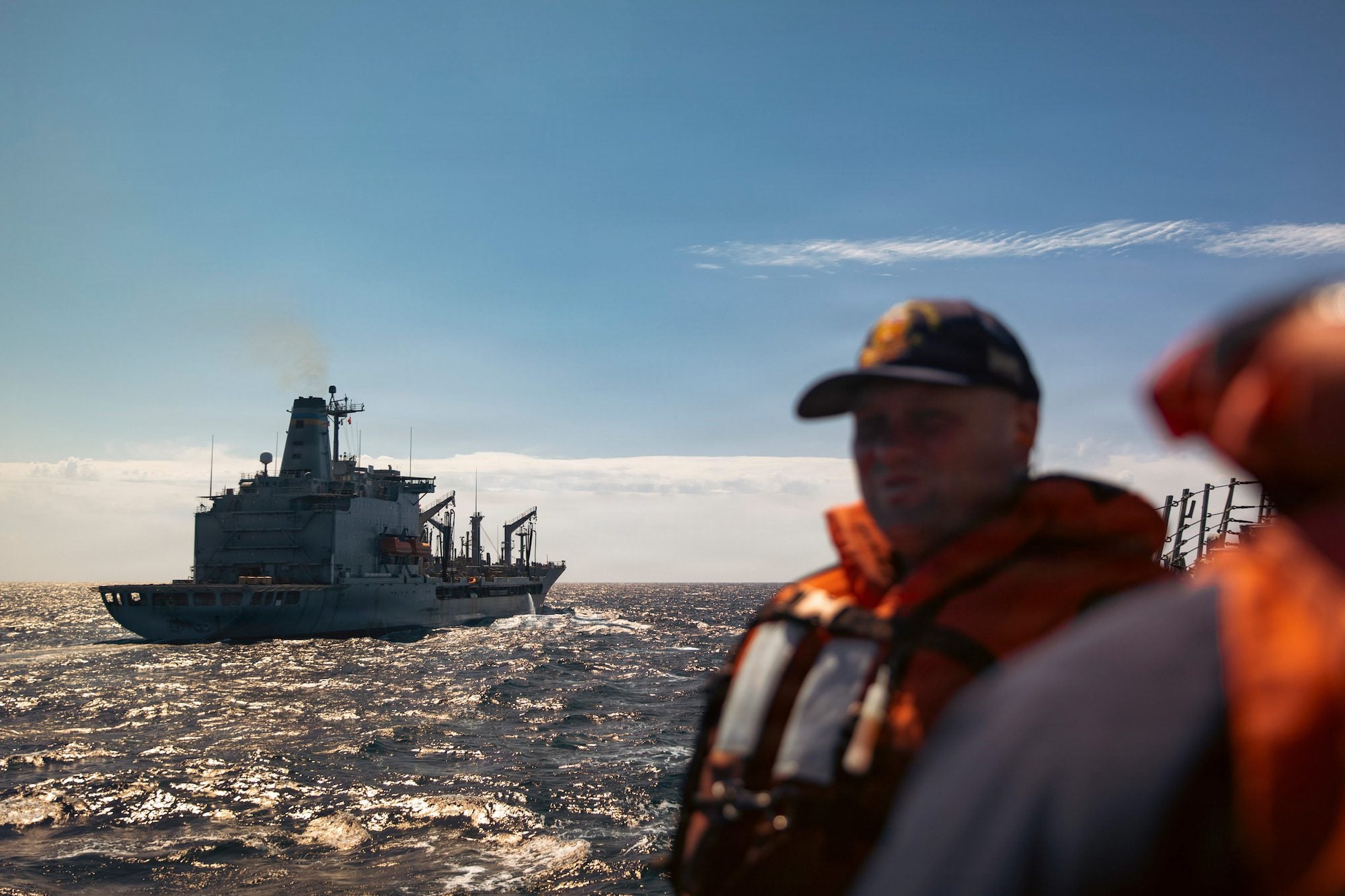
They successfully completed 41 refueling operations, transferring millions of gallons of fuel and thousands of pallets of supplies, ensuring that American warships could remain operational, aircraft could continue flying, sailors remained fed and connected to families, and missions could persist without interruption.
Like the crews of Roosevelt’s “Ugly Ducklings,” they made history without engaging in combat.
From Recognition to Renewal
These two unique honors signify a broader recognition: America’s Merchant Marine is not just a relic of the past.
It is a crucial component of national defense.
President Trump has made enhancing American maritime strength a national priority through his Executive Order on Restoring America’s Maritime Dominance and the White House Maritime Action Plan. Maritime Administrator Steve Carmel has stressed that ships alone do not ensure maritime power; trained mariners are essential too.
Secretary Sean Duffy has pointedly stated: “the strength of our maritime forces propelled us through World War II, and it will be the strength of mariners that safeguards us in future conflicts.” This understanding now resonates throughout the national security community.
Acting Secretary of the Navy Hung Cao hailed America’s mariners as “the strongest and best U.S. Merchant Mariners in the world.” He has highlighted the diminutive size of the U.S.-flag international trading fleet as evidence that America’s maritime strength should not be taken for granted. Chief of Naval Operations Adm. Daryl Caudle has prioritized sustained operations at sea under combat conditions in his directives.
Different departments, different missions, but the same understanding.
The Work Required for Recognition
Recognition is essential, especially as it signals the start of national renewal.
That is why Congress is working on the bipartisan SHIPS for America Act, led by Senators Mark Kelly (D-AZ) and Todd Young (R-IN), along with Representatives John Garamendi (D-CA) and Trent Kelly (R-MS).
It is also why the Navy's shipbuilding programs and the White House Maritime Action Plan are just as significant as the medals themselves. The leaders behind these initiatives recognize that American sea power starts long before the first missile is launched.
The nation’s maritime strength begins with the civilian mariners who build, supply, sustain, and transport military forces.
Upholding American Power
Perhaps 2026 will be remembered not just as the year when merchant mariners finally received the respect they deserved, but as the moment America rediscovered their importance.
Long before an aircraft carrier enters contested waters, before Marines step ashore, before humanitarian aid arrives in disaster zones, and before American goods sail across oceans, an American merchant mariner has already ventured out to sea.
Their contributions are often unnoticed, and their victories aren’t measured by battles, but by the missions they enable.
For generations, Roosevelt’s “Ugly Ducklings” have transported America’s cargo and quietly bolstered its power.