
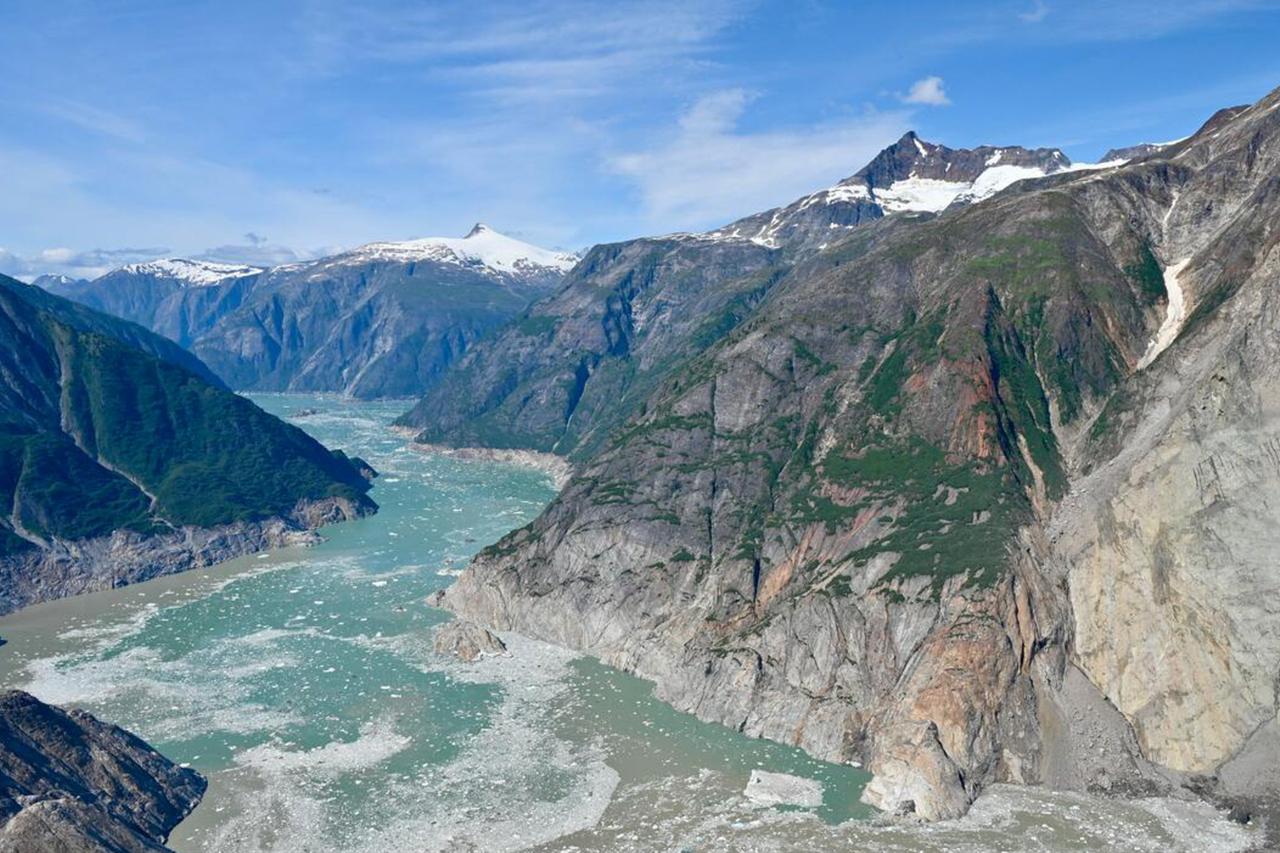
A large landslide in Alaska's Tracy Arm fjord caused one of the highest tsunamis ever recorded, sending water up 481 meters (about 1,578 feet) against the opposite fjord wall. Scientists are calling this event a close call for cruise tourism, linked to climate change.
This incident took place on August 10, 2025, and was explained in a new study published on Wednesday in Science. The landslide involved over 64 million cubic meters of rock that fell into the fjord near South Sawyer Glacier, located about 80 miles south-southeast of Juneau. The landslide created an initial wave that was 100 meters high, moving faster than 70 meters per second, followed by a megatsunami that stripped away vegetation from the steep fjord walls.
Fortunately, no one was hurt or killed during this event. Scientists attribute this to the timing, as the landslide occurred early in the morning when no cruise ships or large crowds of visitors were present.
"We were incredibly lucky that this landslide happened so early in the morning. Next time—because there will be a next time—we might not be so fortunate," said Dan Shugar, a geomorphologist from the University of Calgary and the lead author of the study.
Tracy Arm is a popular spot for cruise ships, tour boats, and kayakers who come for the tidewater glaciers, steep cliffs, and floating ice. The study warns that these very features can enhance landslide-triggered tsunamis, creating extreme hazards with little warning.
The U.S. Geological Survey reported that the landslide happened around 5:26 a.m. local time and was detected by seismic devices. Kayakers camping at Harbor Island near the fjord's mouth later reported that their gear was swept away by waves. A NOAA tide gauge in Juneau, about 80 miles away, recorded tsunami waves reaching up to 36 centimeters above tide level for several hours.
Researchers observed that the landslide was preceded by several days of increasing microseismic activity, suggesting that future collapses in glacier fjords might be detected before they happen. The event also produced seismic waves equivalent to a magnitude 5.4 earthquake and created a long-lasting sloshing motion, known as a seiche, that lasted for up to 36 hours.
The study links this event to glacial retreat caused by climate change. As glaciers shrink, they can destabilize steep mountain slopes, exposing unstable rock faces over narrow fjords and coastal waters.
Alaska has a history of extreme landslide tsunamis, including the 1958 incident in Lituya Bay, which resulted in a record runup of about 530 meters. However, the Tracy Arm event is significant because it happened in a heavily trafficked cruise area, turning a remote geological hazard into a present maritime safety risk.
The message for the cruise industry is clear: glacier fjords are becoming less stable just as more vessels and passengers enter them.
While the Tracy Arm tsunami was not a disaster with many casualties, scientists note that it easily could have been.