
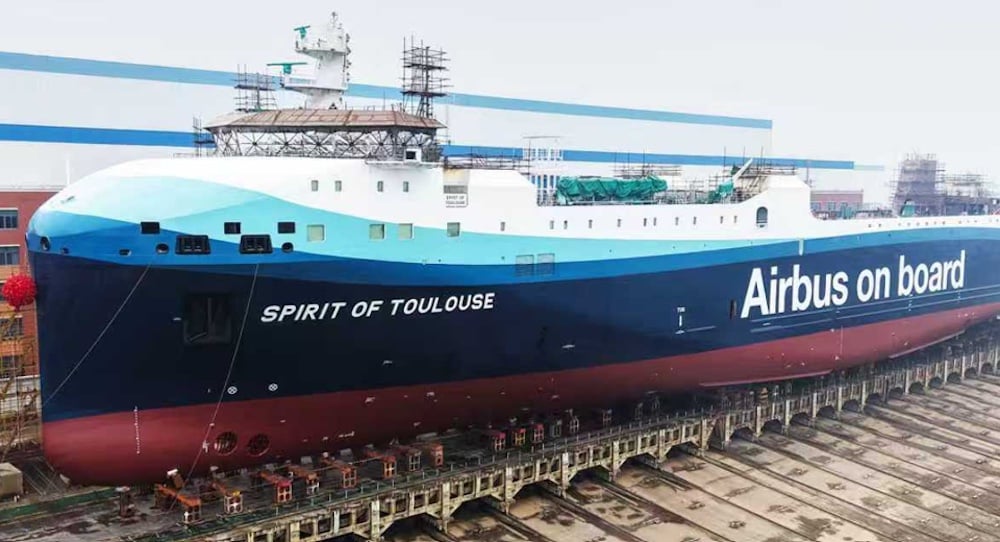
Last weekend, a ro-ro cargo vessel was launched at a shipyard in Wuhan, a less publicized event compared to an Airbus A320 coming off the assembly line in Toulouse or Mobile. However, these two events are more related than they may seem.
The newly launched vessel, named Spirit of Mobile, is one of three specially designed ships meant to transport vital components like wings, fuselage sections, engine pylons, and tail assemblies for Airbus’s single-aisle jets across the Atlantic. This initiative aims to see if a blend of traditional wind technology, alternative fuels, and AI-based routing software can effectively cut the maritime carbon footprint of one of the largest aerospace programs globally in half.
Spirit of Mobile is the second of three vessels commissioned by French shipowner Louis Dreyfus Armateurs from Wuchang, part of the China State Shipbuilding Corporation. The first, Spirit of Toulouse, was launched in early February 2026 and is currently in pre-delivery testing. The third, Spirit of Mirabel, is still being built. All vessels are expected to be delivered in 2026 and will operate between Saint-Nazaire in France, where Airbus manufactures major components, and Mobile, Alabama, where the final assembly takes place. The names of the ships reflect their connection to the cities central to this production system.
The commercial background of this program is notable. In October 2023, Airbus chose LDA to revamp its chartered fleet for its Atlantic logistics. This decision put the shipowner on a path for significant capital investment during a time of strategic change. In 2025, LDA shifted to a new ownership model after InfraVia Capital Partners acquired 80 percent of the company and brought a €1 billion investment plan to double the fleet size and speed up technology deployment. The three Airbus vessels are key to this vision.
These vessels will significantly increase capacity compared to the older ships. LDA currently operates two vessels on the transatlantic route for Airbus, with the largest, Ville de Bordeaux, able to carry the equivalent of six complete aircraft subassembly sets per trip. The new vessels will match that capacity in terms of aircraft while also carrying about 70 forty-foot containers per trip, optimizing the use of available space.
The replacement of the existing fleet with these three new ships is expected to cut average annual transatlantic CO2 emissions from roughly 68,000 tons in 2023 to 33,000 tons by 2030, achieving around a 50 percent reduction at the fleet level. For each vessel, the anticipated CO2 reduction compared to older models is 70 percent annually, marking a significant improvement in emissions for this industrial logistics operation.
To achieve these emissions reductions, the design includes advanced wind-assisted propulsion. Each vessel is outfitted with six rotor sails, standing 35 meters tall, provided by Norsepower of Finland, a leader in modern Flettner rotor technology. This system uses the Magnus effect: rotating cylindrical rotors create aerodynamic lift from the wind, translating into forward thrust and allowing the ship's main engines to operate at reduced power without slowing down.
Norsepower estimates that the rotor sails contribute 15 to 20 percent of the propulsion energy on a typical transatlantic route with standard North Atlantic winds. This figure is specific to the route and depends on weather, making it a credible estimate. The rotors are made from composite materials and include recycled components. Having six rotors on a single vessel of this size is unprecedented in commercial shipping as of now.
The propulsion system features two main engines and two auxiliary engines that can use either methanol or marine diesel oil. One of the main environmental benefits of methanol is that it does not contain sulfur, eliminating sulfur oxide emissions when burned. The NOx emissions are more complex; methanol combustion generally results in lower NOx outputs compared to heavy fuel oil or marine diesel, with reductions of 30 to 60 percent reported depending on engine type and conditions.
However, meeting International Maritime Organization Tier III NOx limits typically requires aftertreatment systems alongside fuel switching. Claims of over 80 percent NOx reduction solely due to methanol combustion lack substantial backing from engine test data and should be viewed with caution.
The vessels will initially run on marine diesel oil while the methanol supply infrastructure is developed, gradually shifting to e-methanol, which is created using renewable energy and captured carbon. This distinction is important for lifecycle emissions: methanol from natural gas, often called grey methanol, has greenhouse gas emissions similar to conventional marine fuels, while e-methanol can reduce lifecycle CO2 emissions by 70 percent or more based on the energy source and production method.
The long-term emissions benefits of this program will largely depend on how quickly a reliable e-methanol supply chain develops for transatlantic shipping.
The design was done by Deltamarin, a Finnish naval architecture company responsible for concept development, contract design, and model testing. Bureau Veritas is overseeing classification, while BERG handles power management and propulsion integration. The vessels also include a waste heat recovery system that turns exhaust heat into extra electrical power, high-efficiency props made from recycled steel, low-friction coatings, and an AI-driven routing system that adjusts speed, direction, and rotor operation based on current weather to maximize wind propulsion and minimize resistance.
Spirit of Mobile was launched using a traditional inclined slipway method. It will now undergo dockside testing of its systems before sea trials and delivery to LDA in November 2026. Spirit of Toulouse is expected to begin operations on the Airbus route later this year, followed by Spirit of Mirabel in 2027.
In conclusion, this program isn’t just about Chinese shipbuilding, despite Wuchang’s significant role. It’s about whether the maritime industry can successfully prove the viability of wind-assisted propulsion combined with alternative fuels at the scale and specifications necessary for a major operator with stringent supply chain requirements and binding emissions reduction goals. The industry will closely watch the results of this endeavor.