
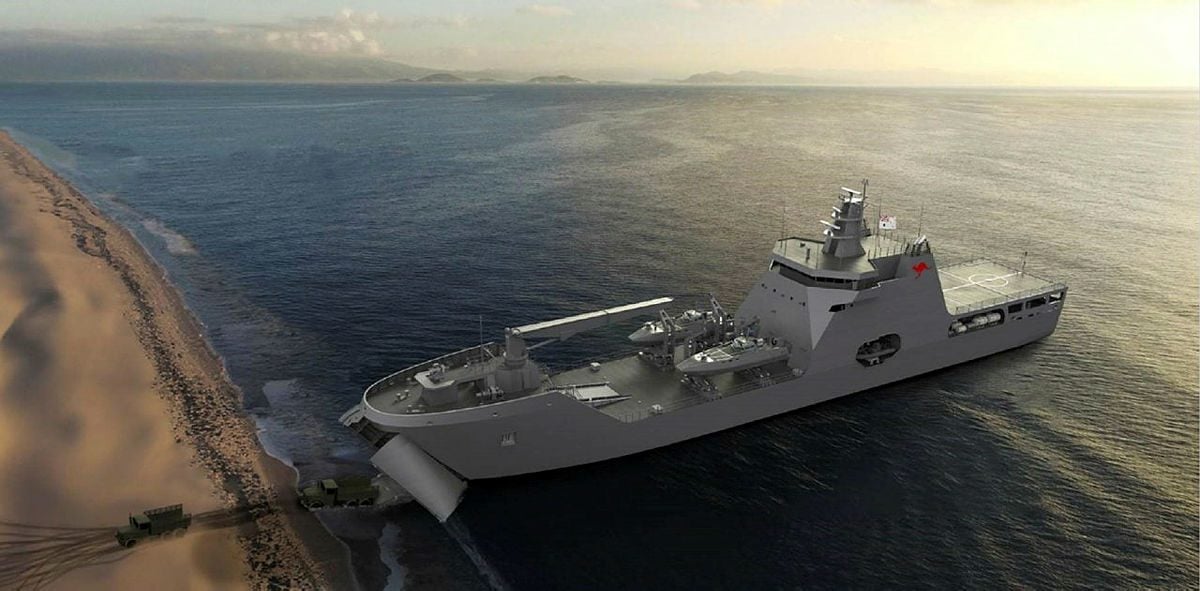
The U.S. Navy has made a Request for Proposal for a Vessel Construction Manager (VCM) to supervise the production of the Medium Landing Ship. This approach is a big change from the usual shipbuilding contracts as the Navy aims to speed up delivery times and manage costs, especially with increasing delays in its fleet modernization efforts.
Instead of contracting directly with shipyards, the Navy plans to have a commercial prime contractor act as the middleman. This contractor, the VCM, will hold the main contract and work directly with the shipyards, taking charge of schedules, quality control, and overall yard performance.
Navy officials believe this new structure will help lower risks, simplify oversight, and enhance delivery speed.
For the first production round, the VCM will oversee construction at Bollinger Shipyards and Fincantieri Marinette Marine. Bollinger received a contract in September 2025 for the long-lead materials and initial ship design work, while Marinette Marine is set to build four vessels. The VCM will decide how to distribute contracts for the last three ships authorized under the base agreement.
“The VCM approach not only speeds up construction times but also strengthens our industrial base by involving several shipyards,” stated Rear Adm. Brian Metcalf, the program executive officer for ships. “By using an established ‘build-to-print’ design and allowing a VCM to manage production, we are making oversight for this acquisition more efficient.”
A Proven Design — On Paper
The LSM will be based on Damen Naval’s LST 100 design, which was chosen in December 2025 as a “non-developmental” baseline.
This approximately 4,000-ton vessel has a range of over 3,400 nautical miles and is already being produced in Australia for that country's Heavy Landing Craft program. The Navy believes that by starting with an existing design instead of creating a new one, they can avoid the engineering delays that have affected other projects.
The overall LSM plan aims for a fleet of 35 ships to address what the Navy and Marine Corps see as a significant gap between smaller landing crafts and large amphibious warships. The ships are meant to support Marine Corps operations in challenging coastal environments, especially in the Indo-Pacific area.
A Response to Increasing Delays
This new contracting strategy comes at a tough time for Navy shipbuilding.
Secretary of the Navy John Phelan recently canceled four Constellation-class frigates at Marinette Marine that had not started construction, as delays pushed the delivery date for the lead ship from April 2026 to April 2029.
The VCM strategy reflects a wider effort to bring commercial shipbuilding practices into naval programs. In this model, the Navy provides a mature, ready-to-build design while the construction manager supervises production across multiple yards, ideally with fewer government staff and better cost control.
There is a successful example in the past. The U.S. Maritime Administration’s National Security Multi-Mission Vessels were delivered using a similar method. MARAD hired TOTE Services as the Vessel Construction Manager while Philly Shipyard managed construction. These ships were delivered on time and within budget, and the program is often viewed as a rare example of well-organized U.S. ship procurement.
Whether the Navy can achieve this kind of success on a larger scale — especially given the more complex demands of building combat ships — is still uncertain.
A contract award for the VCM for the LSM program is expected by mid-2026, signaling what Navy leaders call a major change in how the service constructs and deploys its fleet, especially as U.S. shipbuilding capability continues to fall behind China's rapidly growing industrial base.