
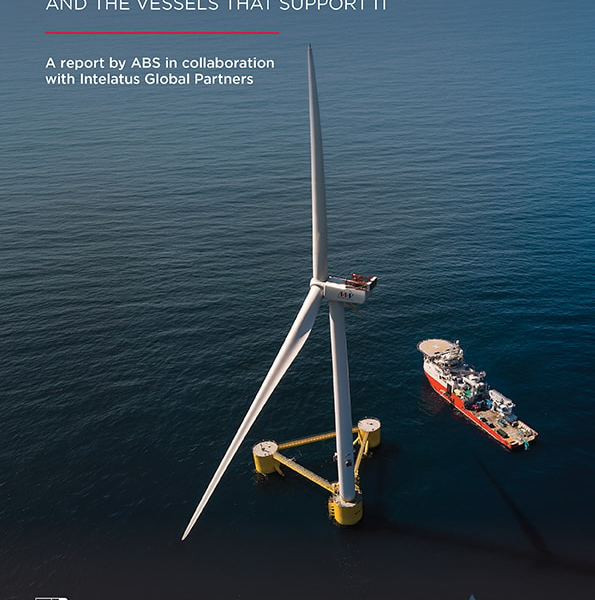
Floating offshore wind is about to create strong demand for high-quality offshore support vessels, with possible supply issues appearing before the decade ends, according to a recent report from the classification society ABS.
The report, Floating Offshore Wind and the Vessels That Support It, produced with Intelatus Global Partners, states that the need for large anchor handling tug supply vessels (AHTSs) and multipurpose support vessels (MPSVs) will grow significantly as floating wind projects transition from testing phases to commercial-scale production.
ABS indicates that the current offshore oil and gas fleet is a solid basis, but many vessels will need upgrades or replacements with purpose-built ships to meet the specific needs of floating wind installations.
“Floating offshore wind brings unique challenges, particularly concerning vessel capability, mooring systems, and project execution,” said Rob Langford, ABS Vice President of Global Offshore Markets. “This report shows where existing offshore experience can be used while also highlighting areas where planning, investment, and technical readiness will be increasingly vital as projects progress.”
The report predicts that floating wind projects will increase the demand for vessels involved in towing floating foundations, installing anchors and mooring systems, carrying out hook-up operations, and installing subsea cables. As commercial projects grow in Europe and Asia-Pacific, the availability of vessels is expected to become a more significant limitation.
The study suggests that the demand for capable AHTSs and MPSVs should strengthen starting in the late 2020s, with potential shortages in specific vessel types possibly beginning as early as 2029 if offshore oil and gas operations remain strong. ABS believes this outlook serves as an early warning for owners to review their fleet positioning and investment strategies before the market tightens.
The report also highlights the scale of what’s needed for floating wind installations. A typical 1 GW floating wind farm might require about 198 anchors and nearly 200 kilometers of mooring lines, which is much more than what a single deepwater floating production, storage and offloading (FPSO) unit would need. This means greater requirements for deck space, winch capacity, chain handling equipment, crane capability, and overall offshore construction effectiveness.
Though floating offshore wind is still a small part of the global offshore wind market today, ABS anticipates steady growth over the coming decade. The global installed floating wind capacity is expected to rise from around 270 MW in 2025 to approximately 5 GW by 2035 and over 14 GW by 2040, primarily due to projects in Europe. South Korea, Japan, and Taiwan are expected to lead growth in Asia, while large-scale projects are also anticipated in the United States, Canada, and Brazil during the 2030s.
For vessel owners, the report suggests evaluating whether existing offshore support vessels can be adapted for floating wind use or if upgraded or specially built vessels will be required to seize new opportunities. Companies that invest early in vessel capability, mooring expertise, and offshore project execution are expected to be in the best position as the market grows, according to ABS.