
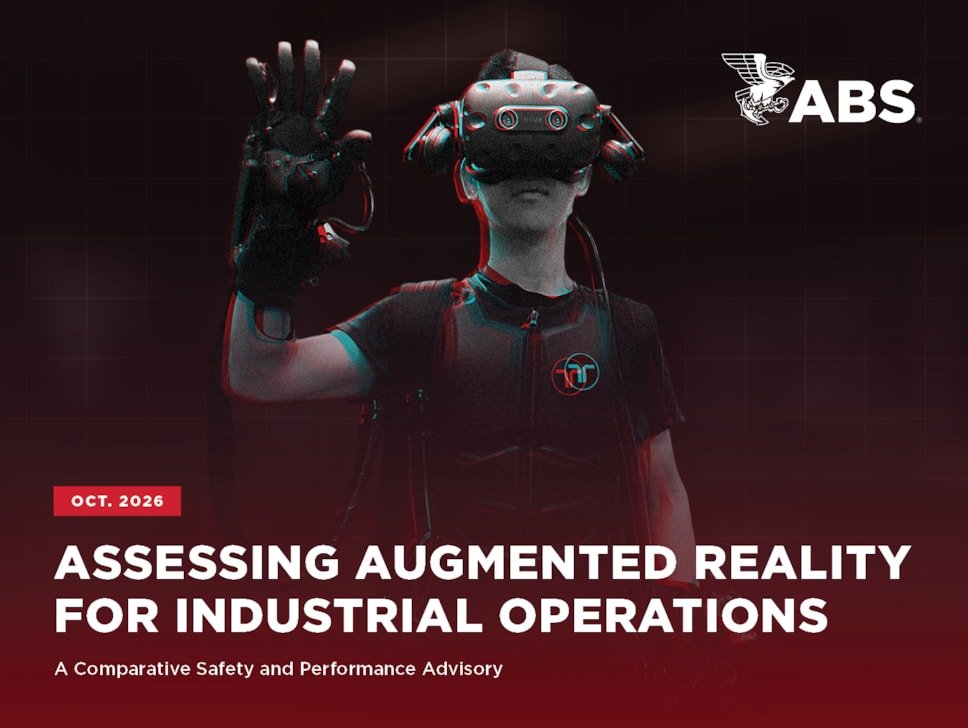
Augmented reality (AR) has the potential to help industrial teams work more efficiently and consistently. However, for it to be widely used, it must be proven that these productivity improvements do not come at the cost of safety.
This is the main point made by ABS in its recent publication, which aims to assist marine and offshore operators in deciding if AR technologies are suitable for their teams. The ABS Advisory on Assessing Augmented Reality for Industrial Operations provides guidance on how to assess the impact of AR on safety and performance for various tasks like inspection, maintenance, navigation, training, and remote assistance, and compares these effects to current work methods.
“Augmented reality has the potential to transform industrial work by bringing expert guidance, operational data, and digital workflows right into the user’s view. For this potential to be realized in a responsible way, the industry must clearly understand the safety and performance implications. This advisory gives the necessary tools to rigorously and consistently evaluate these implications,” stated Patrick Ryan, ABS Senior Vice President and Chief Technology Officer.
One of AR's main benefits is its ability to present relevant information directly to the user. This technology can show step-by-step instructions in front of a technician, highlight inspection points and tolerances on equipment, as well as indicate hazard zones and restricted areas as teams navigate their surroundings. However, the real benefits depend on the specific task, the user, and the environment they are in.
Created with help from the ABS Laboratory for Ocean Innovation at Texas A&M University, the advisory provides a detailed method for comparing AR tasks with standard practices in terms of safety and performance. It underscores how different task types—like those that depend on navigation, hand-eye coordination, memory, or information processing—put different stressors on users, making it crucial to evaluate AR for the specific task it is intended to support. The advisory also discusses the potential downsides of AR applications, such as distraction, visual blockage, and overdependence on system outputs.
As AR technology transitions from pilot programs to everyday applications, ABS will keep collaborating with the industry to ensure the safe integration of this new technology. You can download a copy of the advisory here.