
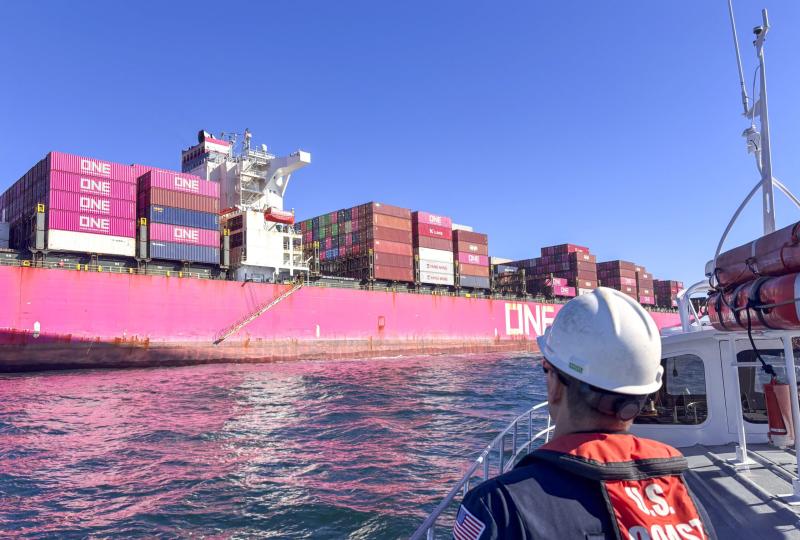
Ocean Network Express has stopped unloading cargo from the fire-damaged ship ONE Henry Hudson at the Port of Los Angeles. This pause is necessary as crews are working to pump out contaminated water from one of the cargo holds.
A barge has arrived at Yusen Terminal to assist with this water removal, which has temporarily delayed efforts to take off the cargo. The ship is currently under the watch of the United States Coast Guard (USCG), and any cargo operations can only resume with their permission.
This situation added to what Coast Guard Captain Stacey Crecy, the Incident Commander, describes as “the most technically challenging salvage operation in recent port history.”
“The initial response to the fire, moving the ship to a safe location, and then bringing it back to the pier were all crucial and needed careful planning,” Crecy stated. “Now, we start a new phase where the damaged cargo and firefighting water need to be safely removed and disposed of. I’m confident the team will handle this work safely and efficiently.”
The emergency began in late November when a fire broke out in the lower decks while the ship was docked. All 23 crew members were safely rescued while nearly 200 firefighters from Los Angeles worked to control the fire. A mid-ship explosion caused a power outage, forcing firefighters to retreat and fight the blaze from the pier.
The ship’s owners, Fukujin Kisen, have declared a General Average, a maritime rule that spreads losses among all parties when a ship and its cargo are sacrificed to save the journey. Richards Hogg Lindley has been appointed to help coordinate the necessary documentation and securities collection from those with interests in the cargo.
Due to this declaration, cargo will not be released until arrangements are made with the Average Adjusters, who will work directly with cargo owners and their insurers.
The salvage operation is facing significant logistical challenges. Cargo hold 03 is estimated to be 80% flooded due to the firefighting efforts. The salvage company DONJON-SMIT has brought in experts from various locations globally to assist with the operation.
All waste onboard, including the water used to fight the fire, will be disposed of according to an approved waste management plan, with contaminated water sent to treatment facilities.
This incident temporarily closed four out of seven container terminals and caused disruptions on State Route 47 due to smoke, although port operations resumed quickly.
The Coast Guard and the National Transportation Safety Board are working together to investigate the cause of the incident.