
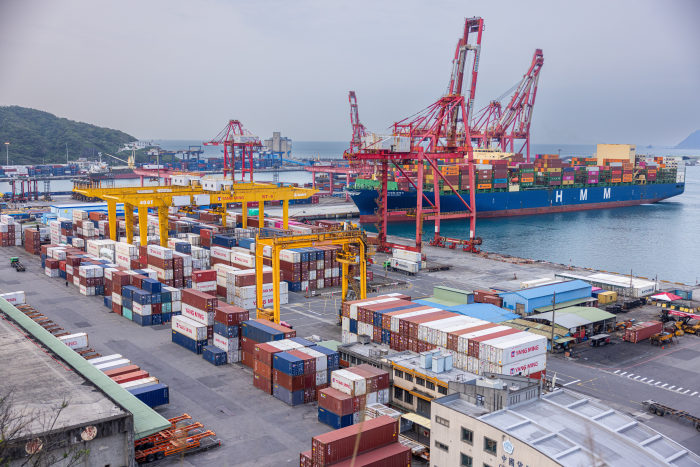
The import volume of cargo at major U.S. container ports is expected to drop to its lowest monthly levels of the year in November and December. This is happening as retailers finish stocking up for the holiday season amidst ongoing tariff uncertainties, according to the latest Global Port Tracker report from the National Retail Federation and Hackett Associates.
Most holiday products are either in warehouses or on store shelves, leading to projections of 1.85 million Twenty-Foot Equivalent Units (TEUs) in November, which is a 14.4% decrease compared to last year. December's numbers are expected to drop even further to 1.75 million TEUs, a decline of 17.9%. This forecast makes December the slowest month since March 2023.
“We have been concerned about how tariffs impact inflation and the supply chain throughout the year, but now that the holiday season is here, our efforts to manage these issues seem to have worked," said NRF Vice President for Supply Chain and Customs Policy Jonathan Gold. "Shelves are well-stocked, and price increases have been limited. Retailers have taken measures like bringing in goods ahead of expected tariff hikes or absorbing some costs themselves, which should help consumers find what they want at reasonable prices.”
The decline in imports is happening alongside quick changes in trade policy. A 20% "fentanyl" tariff on China was lowered to 10% as of November 10, and a postponed increase in "reciprocal" tariffs has been delayed for an additional year. However, a 10% reciprocal tariff under the International Emergency Economic Powers Act is still in effect, with the Supreme Court currently reviewing its legality.
In September, U.S. ports handled 2.1 million TEUs, which is a 9.3% decrease from August and a 7.4% drop compared to last year. The peak of 2.39 million TEUs reached in July is now far behind us as the typical end-of-year slowdown sets in.
These significant year-over-year drops are partly due to high volume concerns for 2024 linked to potential port strikes, as well as earlier-than-usual cargo brought in this year due to tariff worries.
“These market conditions make it difficult to predict future trends,” said Hackett Associates Founder Ben Hackett. “Our forecast predicts a slight decline in imports this year compared to 2024, with a more substantial decrease expected in the first quarter of 2026.”
Data from Descartes’ global trade intelligence platform indicates that U.S. container imports fell by 0.1% from September, totaling 2,306,687 TEUs in October—marking only the second October in the last ten years to see a month-over-month decline. Following decreases in August and September, imports from China rose by 5.4% compared to September but were still down 16.3% year-over-year. China's share of total U.S. imports increased to 34.9% in October, up from 33.0% in September.
All major Chinese import categories saw year-over-year declines: toys/sporting goods down 30.4%, furniture/bedding down 13.6%, and electrical machinery down 17.2%.
“The performance in October likely reflects the cautious approach of U.S. importers as they deal with ongoing geopolitical tensions and regulatory changes, which create more supply chain unpredictability and complexity,” noted Jackson Wood, Director of Industry Strategy at Descartes.
Despite the slowdown, NRF’s Global Port Tracker indicated that the first half of 2025 saw 12.53 million TEUs, a 3.7% increase compared to last year. The total for the full year now stands at a forecasted 24.9 million TEUs, a decrease of 2.3% from the 25.5 million TEUs recorded in 2024.
Looking ahead to 2026, the NRF’s projections remain tough, with estimates of 1.98 million TEUs in January (down 11.1%), 1.85 million TEUs in February (down 9%), and 1.79 million TEUs in March (down 16.7%).
These trends come as the NRF predicts that holiday sales in 2025 will rise between 3.7% and 4.2% compared to 2024, reaching just over $1 trillion.