
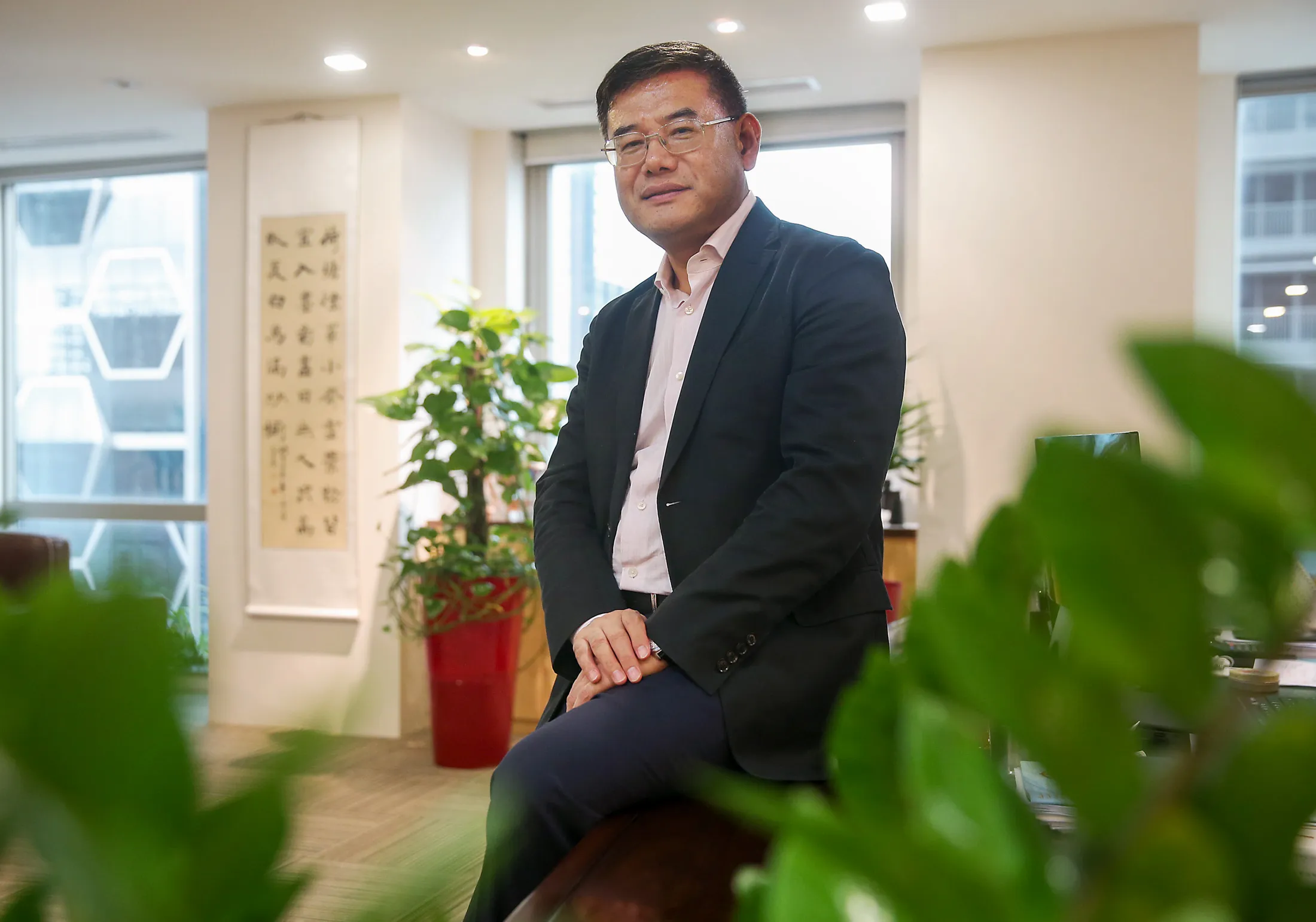
Sun Xiushun first ventured to Guinea about ten years ago as a low-profile shipowner looking to stay involved in the aluminum industry. At the time, West Africa was battling an Ebola outbreak, which caused even the most seasoned investors to retreat.
Despite the challenges, Sun, originally from Shandong and a long-time associate of the aluminum giant China Hongqiao Group, decided to persevere.
His goal was to secure a bauxite supply to replace Indonesia, which was preparing to ban exports of the ore. This required linking the bauxite deposits in Guinea's remote forests to a network of smelters in China. Achieving this involved using barges, floating cranes, and building the first new rail line in fifty years. As a result, Guinea emerged as a crucial exporter and a key supplier in the global metals market.
Sun has now accomplished a similar feat by unlocking the world's largest untapped iron ore deposit, creating a 600-km (around 370-mile) railway, along with bridges, tunnels, and a newly constructed port. This endeavor has likely made him a billionaire.
The Simandou project, located in Guinea's mountainous southern region, has had a tumultuous history, often seen as an example of the mining industry's struggle to execute large-scale operations effectively. After nearly three decades since Rio Tinto Group received its exploration license, loading has finally begun for the first shipment from the new Morebaya port, largely thanks to Sun's efforts. This $23 billion project highlights China's significant role in African infrastructure and serves as a strong argument for Western mining executives to collaborate with Chinese companies, even amid rising geopolitical tensions.
“For years, the problem at Simandou was not about the ore itself, but rather the massive infrastructure needed to access it,” explained Qiang Fu, an economist and professor at the National University of Singapore. “By prioritizing the railway and port as vital components of the project, Sun was able to redefine the initiative and advance it at a pace few anticipated.”
Unlike large, diversified mining companies, Sun's approach involves minimal subcontracting. His personal investment and stake in the project motivated him to take action even before formal agreements were finalized. Though this urgency sometimes led to shortcuts and safety incidents, by the time a co-development agreement was signed in 2023, nearly half of the needed infrastructure was in place and completed at a lower cost than expected.
His rapidly moving plans aligned with the goals of the Guinean government, as stated by sources on Sun's team who wished to remain anonymous due to the confidential nature of the negotiations. And he certainly delivered.
“The key strategy is trading action for trust and trust for resources,” Sun remarked during a 2016 speech to students, later recounted by attendees. “By keeping our promises, we gained high recognition from the government, which in turn gave us access to the resources we required.”
Simandou, so vast and rich that it could potentially supply ten percent of the global steelmaking market, has faced significant hurdles over the years. Its isolated location complicates coastal access, making logistics one of the biggest challenges and increasingly expensive. Moreover, issues like coups, economic fluctuations, government interventions, and corruption investigations have slowed progress.
Initially, Rio Tinto owned the entire deposit, but in 2008, the then-President of Guinea seized it due to dissatisfaction with the slow advancement. Parts of the deposit were given to Israeli mining entrepreneur Beny Steinmetz, who later partnered with Brazil's Vale SA. That collaboration ended after legal disputes and bribery allegations, and Steinmetz eventually left. Sun, having built trust with the government through his bauxite operations, stepped in with his Singapore-based Winning International Group, acquiring the northern blocks of Simandou in 2019.
Now, with a mix of Chinese partners and competitors, Rio Tinto shares the southern section with the Aluminum Corporation of China and other smaller stakeholders. Guinea holds minority stakes in both halves of the deposit.
Rio Tinto declined to comment on the situation, while Winning did not respond to requests for information.
Abdoulaye Magassouba, Guinea's mining minister until 2021, mentioned in a January 2025 speech at Williams College that dealing directly with China helps secure funding for projects and creates a market for those projects, making them viable. He noted that investors willing to start work even before all paperwork is finalized—presumably referring to Sun—boost confidence.
Getting Down to Business
Sun was born in 1964 into a farming family in Shandong and studied at a maritime school. Eager for adventure, he spent nearly a decade as a seaman and mechanic before advancing through the ranks and eventually moving to a branch of Cosco Shipping Holdings Co. in Qingdao. Friends describe him as direct and ambitious, but not ostentatious. He favors a home life in Singapore over the lavish banquets often attended by high-ranking Chinese executives, frequently sending deputies in his place.
After founding Winning in 2002, Sun primarily focused on transporting bauxite for China Hongqiao, creating close ties with the influential Weiqiao family, closely associated with the aluminum company. This relationship led him to Zhang Bo, now the chairman of Shandong Weiqiao Pioneering Group Co., who became a key ally and significant financial supporter.
Sun's major opportunity came in 2013 when Indonesia initiated plans for a bauxite ban. Recognizing both the poverty in Guinea and the solution he could provide through infrastructure, he moved quickly into the region. His experiences and connections were instrumental in laying the foundation for future successes.
While building a bauxite port in northern Guinea, Sun encountered challenges in moving large quantities of material onto land due to shallow waters. He brought in a small team of specialists from Yantai to study tides and suitable landing sites. Tugboats needed to transport barges to shore, offload cargo, assess for damage, and then return.
The situation was likened to “duct-tape logistics on an industrial scale” by one team member.
Yet, the bauxite operation fostered valuable trust. Construction commenced in March 2019 and finished in June 2021. At the opening ceremony, Magassouba extended his hand to Sun, stating, “This is the first time Guinea has seen a railway completed and opened since I was born,” according to attendees at the event.
Sun viewed this moment as pivotal. “What turned the tide for Simandou was our demonstrated capability,” he shared in a rare interview earlier this year.
However, in 2019, skeptics questioned Sun's limited mining experience beyond his recent success in aluminum. Singapore and Chinese bankers were hesitant to back him or his consortium, which included long-standing aluminum partner Hongqiao and later China Baowu Steel Group. Undeterred, Sun invested his own funds and diligently trimmed costs.
Instead of relying on a single engineering firm as is customary in the industry, Sun decided to manage construction directly, delegating tasks to various specialized teams and collaborating with seasoned Chinese crews alongside thousands of local workers, according to project personnel. On-site, he pursued a strict work ethic that had served him well early in Guinea, focusing solely on daily accomplishments and insisting teams rectify any missed targets.
However, Simandou presented a new level of difficulty. While the Dapilon–Santou bauxite line spanned 125 km, the iron ore project requires a line nearly five times longer, set in more challenging terrain. Sun opted for fewer middlemen but increased the number of contractors, partnering with China Railway Engineering and China Harbour Engineering. His rapid pace shocked established Western companies, mentioned by advisors.
Once again, Sun's unconventional approach flipped the conventional mining project development timeline. Instead of first confirming reserves and then studying feasibility, he prioritized logistics and infrastructure. He utilized Chinese standards, designs, materials, and crews, mirroring the methods employed in Indonesia and the Democratic Republic of Congo. He was nearly always present on-site, commuting regularly from Singapore to Conakry via Paris.
Years ago, even during the Ebola crisis, he maintained strict safety protocols with three on-site doctors. He applied similar measures during the Covid pandemic by creating secure zones and setting up mobile testing stations to keep his teams safe and projects on track.
While Sun's speed and tenacity led to progress, it wasn't always without issues, as the project moved through communities in a delicate equatorial ecosystem. There were reported fatalities, prompting the Guinean government to investigate safety standards earlier this year. The Winning consortium has claimed it is committed to continually improving safety measures to meet international guidelines.
Rio Tinto officials, for whom Simandou has long been both a headache and a potential gold mine, became aware of the developments after visiting the bauxite project in the north. They approached Sun's group, but Sun was hesitant, feeling that teaming up with the world's second-largest mining company could bog him down in bureaucratic processes, risking the momentum he had gained.
However, the new Guinean government, which came to power following a coup in 2021, was keen to advance the country’s flagship project using a unified, jointly funded railroad to serve both sections of the deposit. Officials arranged a meeting with Rio's CEO, Jakob Stausholm, at the presidential palace. Understanding the political climate, Sun recognized the opportunity.
The parties formed Compagnie du TransGuinéen, a joint venture for the shared rail line, including state representation alongside Rio's Simfer and Winning Consortium Simandou.
As loading intensifies and shipments commence, all participants will celebrate a well-timed win—a massive new mine for Rio, featuring some of the highest quality iron ore, and a notable infrastructure success for China at a time when its major spending in Africa has slowed. Vice Premier Liu Guozhong will represent President Xi Jinping at the official inauguration this week.
“Simandou offers China a chance to reinforce its presence and assertiveness in Africa,” remarked Tara O'Connor, the managing director of Africa Risk Consulting, who has closely monitored the mine's progression. “Given the current climate of tariffs and trade tensions, this project holds even greater significance for them.”