
The current geopolitical climate is changing global energy trade routes, with sanctions causing almost a third of the world's tankers to operate in the shadows. This has led to a serious shortage of high-quality vessels, driving charter rates to historically high levels.
During a recent presentation by Capital Link, Dr. Nikos Tsakos, the Founder and CEO of Tsakos Energy Navigation Ltd (TEN), called this time unprecedented. He remarked that the past five years have been the most tumultuous in the company’s history, citing a series of crises that have impacted the industry since 2020.
“The pandemic caused a significant drop in oil demand and energy consumption overall. Additionally, the war in Ukraine has reshaped global energy transportation, leading to new trade routes," Dr. Tsakos explained. He mentioned that rising tariffs, ongoing instability in the Middle East, events in Venezuela, and persistent issues in Iran have created added uncertainty. “Geopolitical events affecting oil production are happening almost weekly,” he noted.
However, for companies like TEN, which works exclusively with major oil firms such as ExxonMobil, Equinor, Shell, Chevron, Total, and BP, these disruptions have turned into substantial opportunities. With nearly 30% of the global fleet now in gray and black markets due to sanctions, there is a significant demand for vessels that meet the strict safety and operational standards set by major energy companies.
“The market has improved significantly,” Dr. Tsakos stated. “VLCCs are now going for over $100,000 per day, up from around $50,000 last year, which was already considered strong.”
Aggressive Fleet Renewal Amid Chaos
Instead of stepping back during this chaos, TEN has launched one of the most aggressive fleet renewal initiatives in its 32-year history. The company has sold 17 older ships and welcomed 33 modern vessels, nearly doubling its fleet size, tripling its carrying capacity, and significantly reducing the average age of its fleet.
A major factor in this expansion is the shuttle tanker sector, which Dr. Tsakos described as “one of the most demanding and high-value parts of the industry.” He added that TEN’s Naval Academy is one of just two worldwide accredited to issue DP shuttle tanker diplomas.
George Saroglou, President and COO, announced that TEN has secured one of its largest contracts ever with Petrobras in Brazil, involving nine newbuild DP2 vessels. Deliveries are already taking place, with more vessels expected quarterly through 2028.
The company now operates a diversified fleet of 82 vessels, which includes DP-2 shuttle tankers, VLCCs, product tankers, and LNG carriers, alongside ongoing new builds, totaling about 11 million deadweight tons.
Conservative Strategy in a Strong Market
Despite strong market conditions, TEN has stuck to its cautious financial approach. Its debt-to-equity ratio has never exceeded 50% and is currently well below that level. The company has paid dividends continuously since its founding in 1993, with the current dividend set at $1.00 per share for 2025.
“We have maintained our dividend payments since we started. We have never stopped,” Dr. Tsakos emphasized. Half of the dividend for 2025 was paid in December, with the rest scheduled for February 19, 2026.
The management has assured that dividends will keep coming, with no share buybacks on the agenda for now. Dr. Tsakos also mentioned the possibility of selling some older vessels if the market conditions allow, aiming to generate more cash for shareholder returns.
Harrys Kosmatos, Co-CFO, explained that the company's employment strategy balances risk through a combination of fixed-rate time charters, time charters with profit-sharing, and spot market trading. “This structure ensures that our fleet generates enough revenue to cover its operating costs regardless of global market conditions,” he noted.
Structural Tailwinds Support Multi-Year Runway
Looking forward, management sees several factors that could support high rates for the next few years. Kosmatos stated that global oil demand is at record levels, while the order book for new tankers remains low at about 14% of the existing fleet.
“Vessels older than 15 years will leave the fleet soon, and they will need replacements. The new builds are not enough to fill this gap, suggesting at least two to three more years of favorable market conditions,” he concluded.
Dr. Tsakos also pointed out that regulatory uncertainty regarding the IMO’s decarbonization framework has led to caution in the industry, keeping newbuilding orders low. “People may see us as overly cautious, but that is why we’re still here after 32 years,” he commented.
On the demand side, Europe’s move away from Russian energy has greatly increased ton-mile demand. Routes that used to take 2 to 3 days from Russia now require almost double the distance if sourced from West Africa, three times the distance from the U.S. Gulf, and similar increases from Venezuela.
Dr. Tsakos noted that there is a strong interest among major oil companies to secure vessels in the coming 18 months due to escalating geopolitical tensions. He warned that any escalation involving Iran would significantly impact global trade flows and dramatically change export routes to Western markets.
About TEN Ltd.
Founded in 1993 and now celebrating 32 years as a public company, TEN is one of the first and most established public shipping companies globally, operating a diverse energy fleet that has made it a preferred choice for leading energy firms.
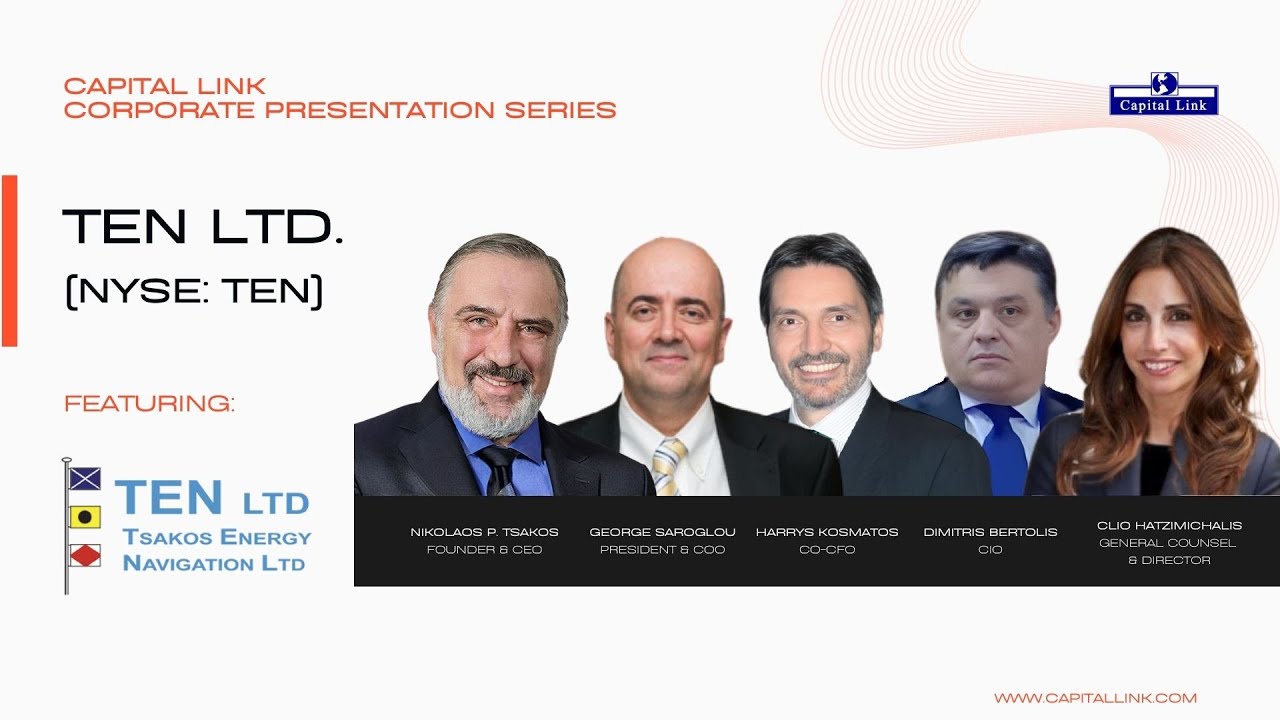
Capital Link 2026 Corporate Presentation Series – TEN Ltd.
In the latest episode of Capital Link’s 2026 Corporate Presentation Series, the senior management team at Tsakos Energy Navigation Ltd (TEN) discussed the company’s history, recent achievements, and strategic plans, including fleet renewal and securing major contracts during challenging market conditions.