
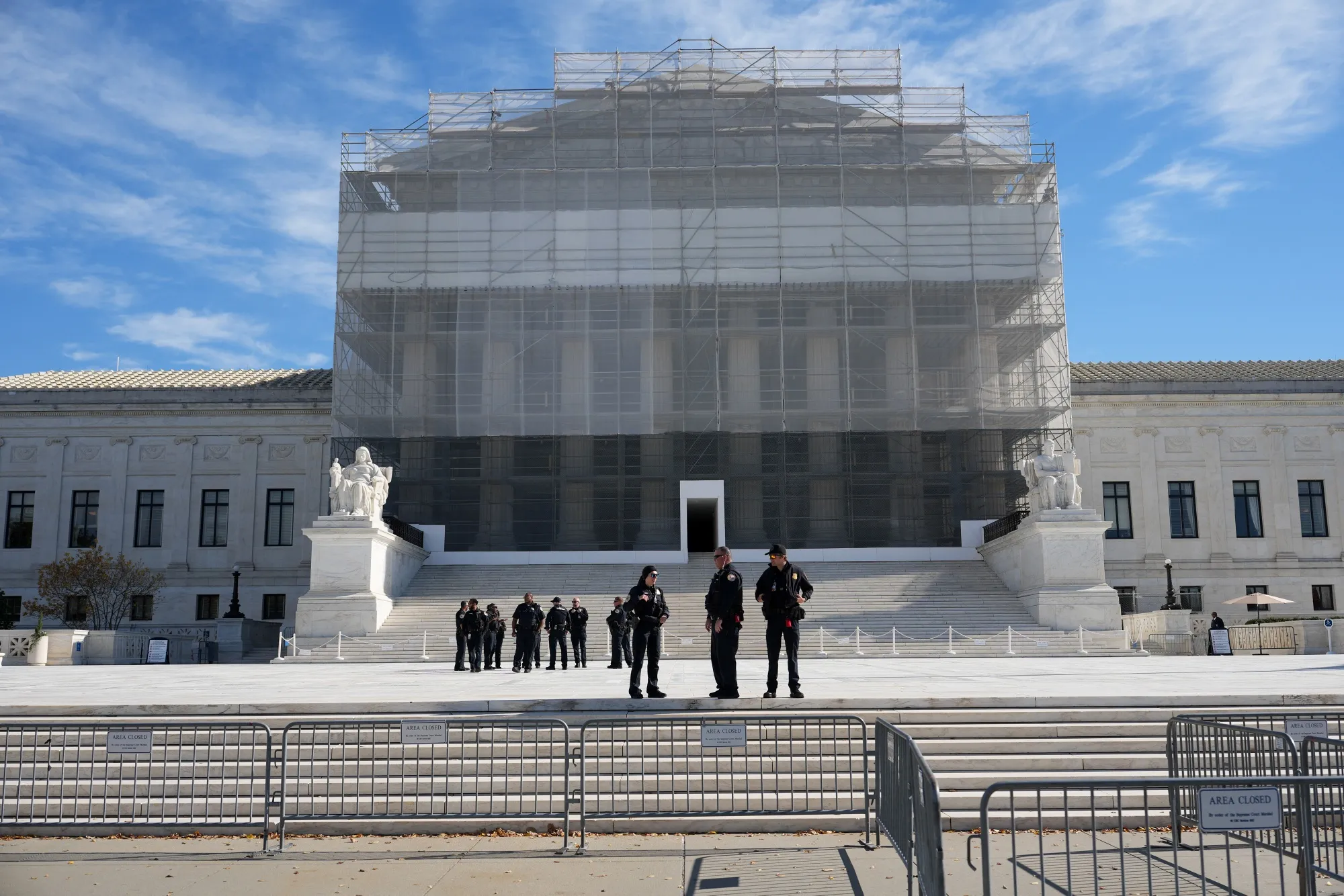
The US Supreme Court showed doubts about President Donald Trump’s broad global tariffs during a lengthy argument session that lasted over 2.5 hours. Several justices hinted that he may have exceeded his authority with this key economic policy.
During the session, three justices from the conservative majority questioned Trump’s use of a law that allows for emergency powers to impose tariffs worth billions of dollars each month.
Chief Justice John Roberts noted that the tariffs essentially act as taxes on Americans, a power that traditionally belongs to Congress. Justice Neil Gorsuch appeared likely to vote against the president, while fellow Trump appointee Amy Coney Barrett asked challenging questions to both sides.
If the court rules against Trump, it could lead to over $100 billion in refunds, reduce the financial burden on US importers paying these tariffs, and weaken a tool the president has used against trading partners. More widely, it would represent a significant check on Trump’s assertion of power that goes beyond what past presidents have claimed.
The court’s liberal justices—Elena Kagan, Sonia Sotomayor, and Ketanji Brown Jackson—also expressed skepticism about the legality of the tariffs. A ruling might be issued by the end of the year, as the court has set an expedited schedule for this case.
The atmosphere during Wednesday’s session was unexpectedly relaxed for a court often marked by division, with laughter breaking out during the arguments. At one point, Kagan humorously corrected Roberts after he confused her with Sotomayor, who had just wrapped up her questions.
The case involves Trump’s tariffs introduced on April 2, which impose taxes ranging from 10% to 50% on most US imports based on their country of origin. Trump argues these tariffs are necessary to address the longstanding trade deficit. This legal battle also includes separate tariffs aimed at Canada, Mexico, and China to combat fentanyl trafficking.
Questioning Authority
Trump claims his tariffs are authorized by the 1977 International Emergency Economic Powers Act (IEEPA), which grants the president various tools to deal with national security, foreign policy, and economic emergencies. However, the act does not explicitly mention tariffs. A key section allows the president to “regulate” the “importation” of goods in response to a crisis.
Gorsuch expressed concern about the Trump administration's argument that Congress transferred its constitutional authority over tariffs to the president.
He asked, "What would stop Congress from giving up all its responsibility to regulate foreign commerce—or even declare war—to the president?" He later inquired if a president could impose a 50% tariff on gas-fueled cars and auto parts to address climate change. The administration’s lawyer, D. John Sauer, responded affirmatively.
Barrett questioned whether the law's language was sufficient for the president to impose tariffs. “Can you point to any other part of the code or any historical instance where ‘regulate importation’ has been used to grant tariff-imposing authority?” she asked.
Nonetheless, Barrett and Justice Brett Kavanaugh also questioned whether the challengers' arguments held up, noting that IEEPA allows the president to halt trade entirely with another country. They wondered why Congress would limit the president from taking the less drastic step of imposing tariffs.
“That seems a bit unusual,” Kavanaugh said.
Barrett also raised concerns about how refunds would work if the tariffs were found unlawful. “That could be a mess,” she remarked.
Lawyer Neal Katyal, representing the companies challenging the tariffs, acknowledged that refunds would be complicated, but argued that the Supreme Court had maintained that “serious economic dislocation isn’t a reason to take action.”
Sauer asserted that Trump felt the rising trade deficits had pushed the country to the brink of an economic national security crisis.
The court is reviewing two lawsuits by small businesses and a separate case from 12 Democratic state attorneys general. All lower courts that have examined the issue deemed the tariffs unlawful.
Roberts stated that the case seemed to fall under the “major questions doctrine,” which the court previously used to block much of Joe Biden’s agenda during his presidency. Under this doctrine, federal agencies must have clear congressional authorization to undertake actions with major economic or political impact.
“The justification here seems to allow the power to impose tariffs on any product from any country in any amount for any duration,” he noted. “That certainly appears to be major authority.”
The tariff debate drew significant attention in Washington. Among those present were Treasury Secretary Scott Bessent, Commerce Secretary Howard Lutnick, and US Trade Representative Jamieson Greer. Democratic Senators Amy Klobuchar and Ed Markey as well as Republican Representative Jason Smith were also in attendance, along with comedian John Mulaney.
If Trump loses the case, officials have suggested that many of the tariff duties could be enacted through other, more complex legal avenues. The tariffs on steel, aluminum, and automobiles were implemented under a different law and are not directly affected by this case.
The cases are known as Trump v. V.O.S. Selections and Learning Resources v. Trump.