
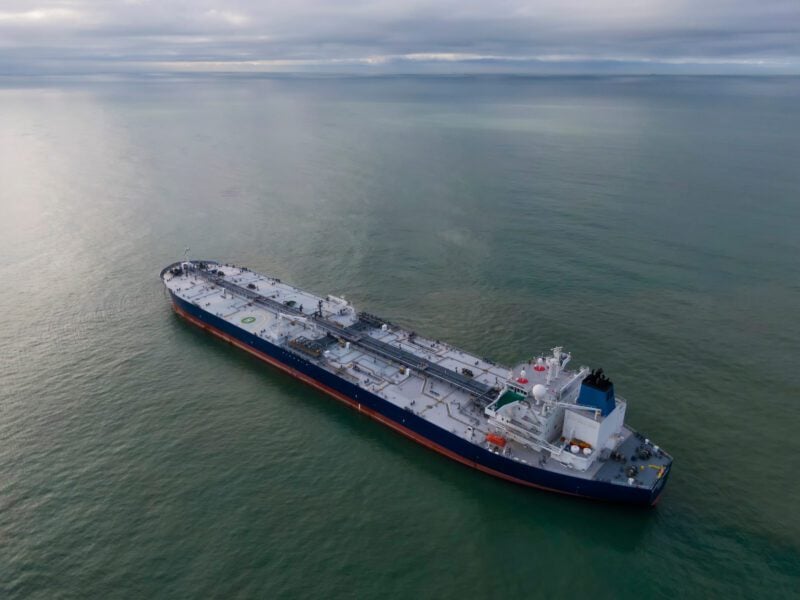
By Alex Longley and Weilun Soon (Bloomberg) — A bold investment by a shipowner in oil tankers has given them significant power, allowing them to control a large portion of supertankers capable of transporting American oil next month.
The Sinokor group from South Korea, supported by Mediterranean Shipping Co., has been aggressively acquiring very-large crude carriers, resulting in its unprecedented control over a significant segment of the global fleet available for immediate hiring. This strategy has been described as "seismic" by competitors and has driven hiring costs to multi-year highs.
This week, the extent of Sinokor’s influence became clearer as they controlled nearly all the Very Large Crude Carriers (VLCCs) ready to load oil from the US Gulf Coast, a key oil-exporting area. In the next 30 days, they will oversee every ship that could arrive in the US Gulf without a cargo on board, according to data from Signal Ocean, a shipping analytics platform.
Signal’s findings align with opinions from several other participants in the tanker market, who agree that Sinokor has a commanding share of available carriers in that region.
The situation in the Gulf shows how Sinokor’s actions are reshaping the tanker market and boosting profits for shipowners. On Thursday, the cost to book a supertanker from the US Gulf Coast to China exceeded $17.3 million, the highest level since 2020. Sinokor’s large fleet allows them greater control over the rates at which they charter ships, as noted by market insiders.
“It’s not quite a ‘one-stop shop’ yet, but options are limited, especially for those who prefer a ship that is not currently carrying cargo,” said Halvor Ellefsen, a London-based director at Fearnley’s Shipbrokers UK Ltd.
Market Positions
The recent spike in tanker earnings has been driven by increasing oil production, returning Venezuelan oil to the market, and geopolitical risks like potential US conflict with Iran. One owner recently estimated that Sinokor controls about 150 vessels, or nearly 40% of the global fleet of unsanctioned ships available for hire that are not already under contract. This has contributed to rising rates for the benchmark route from the Middle East to China.
If we consider vessels with cargo that could arrive in the US Gulf within the next 30 days, Sinokor controls around two-thirds of those ships, per Signal Ocean.
Sinokor Merchant Marine has not responded to requests for comments regarding their significant acquisitions of supertankers.
Shipowners typically share their vessel availability with brokers and customers, providing insight into how many ships can be hired at any given time. Thus, broker estimates can differ based on individual agents’ insights about when ships will be free.
Sinokor’s growing number of empty vessels in the Atlantic follows many of them having discharged cargoes in Asia in mid-January.
There are alternatives when the VLCC fleet becomes too stretched. As rates rise, it may be more economical for two smaller ships to carry a load that a larger one would usually handle. Earnings for vessels transporting 1 million barrels of oil have also increased recently.
Booking fees are expected to climb even higher. In late March, a Sinokor VLCC was booked to travel from the US Gulf to China for $18 million, as reported by brokers.
“This represents a fundamental shift in ownership,” said Lois Zabrocky, CEO of supertanker-owner International Seaways Inc., during an earnings call discussing Sinokor’s acquisitions. “It’s got staying power.”
Energy Daily Newsletter: Oil Supertankers Become the Hottest Commodity