
An unusual situation has arisen at the Pentagon just as Washington is trying to revive its shipbuilding industry, leaving questions about whether the current maritime strategy can withstand political challenges.
The Pentagon's surprising move to consider recalling Senator Mark Kelly to active duty for prosecution has cast doubt on the Trump administration’s plans for maritime revival. This follows shortly after the administration suspended port fees, which many viewed as a critical part of that strategy.
On November 24, the Pentagon announced it was looking into serious misconduct allegations against Kelly, a retired Navy captain and senator from Arizona. This came after he and five other military-veteran Democrats urged U.S. troops to disregard unlawful orders. Defense Secretary Pete Hegseth accused them of sedition, labeling their video message “despicable, reckless, and false” for suggesting that troops ignore their commanders’ orders.
The video, released on November 18, seemed to respond to worries that the administration had ordered lethal military actions against suspected drug traffickers in Latin American waters, possibly breaking U.S. law. President Trump himself accused Kelly of sedition, stressing in a social media post that such a crime could lead to the death penalty.
In response, Kelly, a decorated combat pilot and former NASA astronaut, stated firmly: “I’ve given too much to this country to be silenced by bullies more interested in their own power than in protecting the Constitution.”
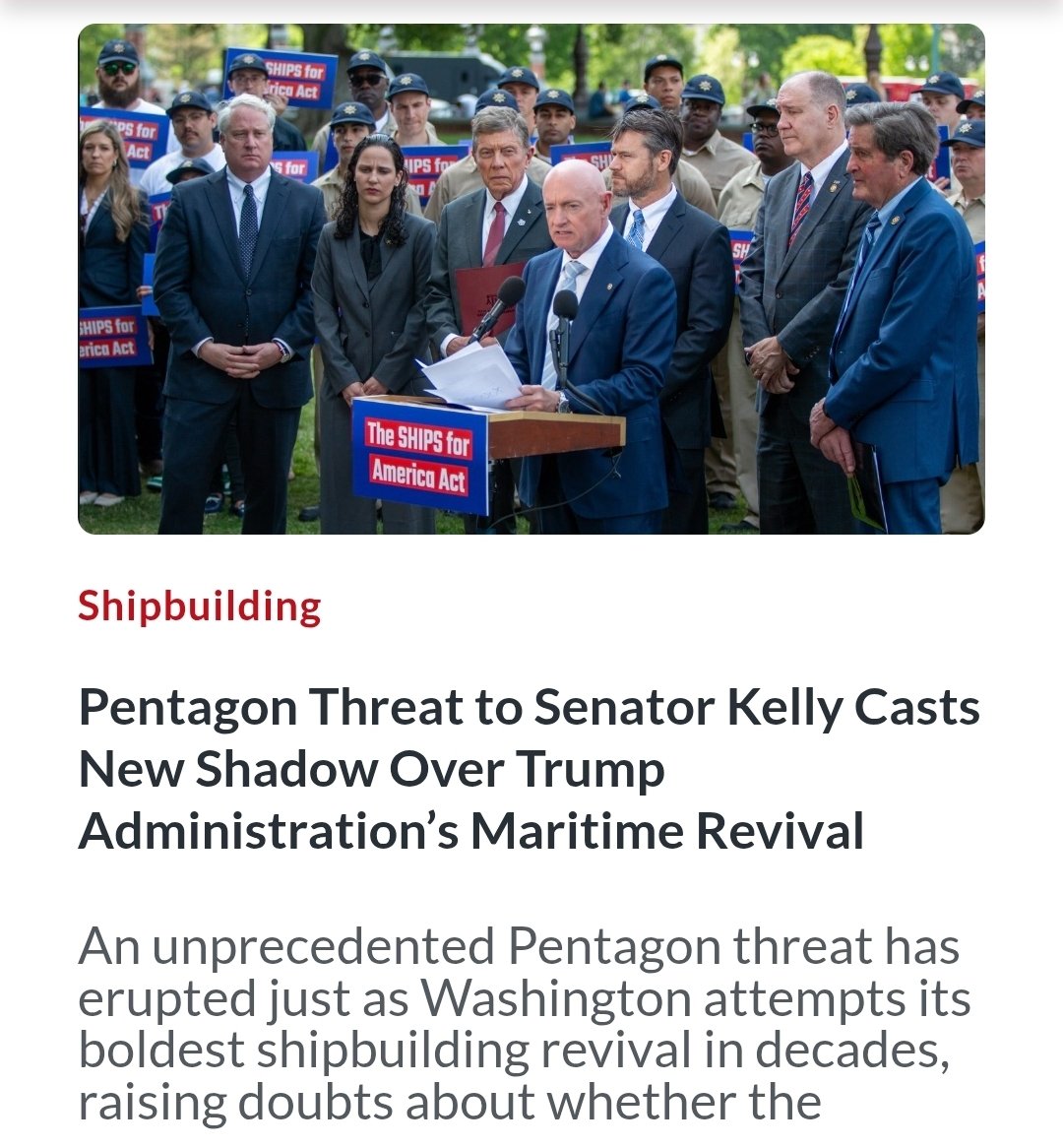
This political showdown comes at a crucial time for the U.S. maritime industry. Kelly is a significant advocate for boosting American shipbuilding capacity. Together with Senator Todd Young (R-IN), he co-sponsored the SHIPS for America Act, reintroduced in April 2025, which aims to strengthen the U.S. shipbuilding sector and increase the American-flagged commercial fleet. The Act suggests a Strategic Commercial Fleet Program to grow the U.S.-flag fleet to 250 ships, require all government cargo to be transported on U.S.-flagged vessels, and implement new rules for some commercial goods from China to be shipped on U.S.-flag vessels starting in 2030.
In October, three maritime experts urged the Senate Subcommittee on Coast Guard, Maritime, and Fisheries to support the SHIPS Act, stressing the urgent need for the U.S. to rebuild its commercial shipbuilding industry after years of decline and competition from Chinese industry.
The hearing also addressed President Trump’s “Make Shipbuilding Great Again” initiative within the National Security Council and previewed parts of the administration’s Maritime Action Plan, a key element of the President’s April executive order, Restoring America’s Maritime Dominance.
During the hearing, Professor Salvatore Mercogliano from Campbell University informed lawmakers that the SHIPS Act, alongside the suspended Section 301 maritime port fees and the April shipbuilding executive order, represents “the most significant U.S. maritime reform since 1970,” and suggested it is a “long overdue Merchant Marine Act of 2025.”
After the hearing, Senators Kelly and Young released a joint statement highlighting “growing, bipartisan momentum to rebuild American shipbuilding,” claiming that the bill would “revitalize our maritime and shipbuilding industries, create good-paying jobs, and counter China’s dominance over the oceans.”
Port Fee Suspension
The controversy surrounding Kelly comes right after the November 10 suspension of the USTR’s maritime-focused Section 301 port fees, which were paused for a year as part of a trade agreement between Trump and Xi. These fees had been implemented for less than a month.
Labor unions and industry experts quickly warned that this suspension undermined the administration’s own maritime policy. In a joint statement, representatives from USW, IAM, IBEW, and IBB said that workers and shipyards were once again being “sidelined” despite previous strong commitments to strengthen maritime capabilities.
Hunter Stires from the Navy League’s Center for Maritime Strategy described the decision as “a significant strategic mistake.”
The port fees were intended to support the trade policy foundation of the administration’s maritime revival, alongside the Restoring America’s Maritime Dominance executive order and the SHIPS Act.
The U.S. Trade Representative plans to reassess the suspension before the 2026 deadline. However, with increasing political controversy surrounding military policies and a crucial maritime advocate now facing a Pentagon legal threat, the anticipated revival of America’s maritime power seems more uncertain than ever.