
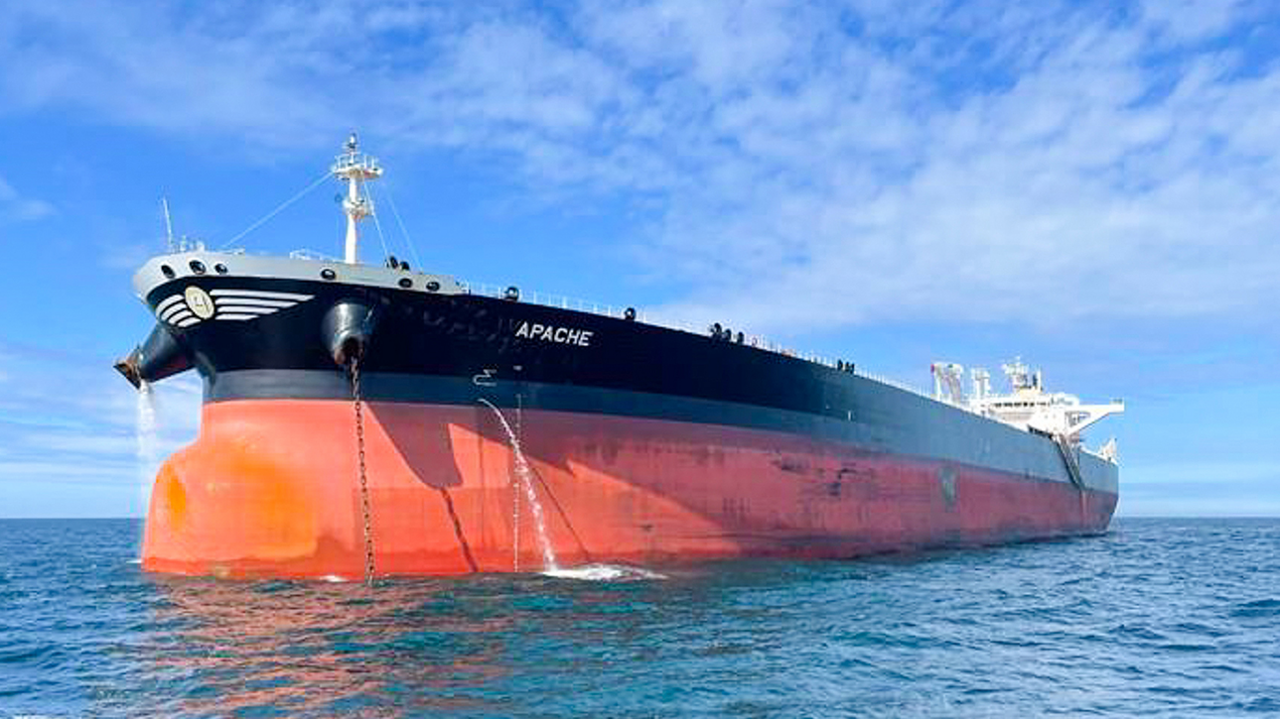
A recent collision between an oil tanker and a fishing trawler in Scotland's Firth of Clyde has led investigators to recommend mandatory navigation training for crews of small fishing vessels. This incident highlighted serious safety issues.
The tanker Apache collided with the fishing vessel Serinah on April 25, 2024, causing the trawler to sink quickly. Fortunately, all three crew members survived, although the skipper of Serinah spent about 15 minutes in the water before being rescued by his crew, who managed to use an inflatable liferaft.
A report released today by the UK’s Marine Accident Investigation Branch (MAIB) revealed that neither the tanker nor the trawler took the necessary actions to avoid the collision, despite clear rules under the International Regulations for Preventing Collisions at Sea (IRPCS). Investigators found that the crew of Serinah had no formal navigation training, leaving them unaware of their responsibilities and unable to recognize the risk as it developed.
“This accident could have been much worse,” said Chief Inspector of Marine Accidents Andrew Moll OBE. “The investigation found gaps in the navigational practices of both vessels.”
The MAIB noted that while the Apache was supposed to give way—since the Serinah was restricted in maneuverability while fishing—the tanker’s crew assumed the trawler would change course based on previous experiences. No effective actions were taken to avoid the collision.
The accident happened around 3:00 p.m. as Serinah was making circular fishing tows in a depression on the seabed. When the bow of Apache ran over the trawler's towing wires, the situation worsened quickly, leading Serinah to list heavily and sink. Apache initially continued towards its pilot station at Finnart Oil Terminal, only turning back after the Belfast Coastguard reminded them of their duty to assist.
Investigators pointed out that the fishing gear limited Serinah’s ability to maneuver. By the time it was obvious that Apache wouldn’t change course, there was little time for either vessel to take evasive actions. Both crews made assumptions about each other's actions, which delayed a timely response until the collision became unavoidable.
The MAIB has issued three formal safety recommendations. The Maritime and Coastguard Agency has been urged to require approved navigation training for skippers and watchkeepers on UK fishing vessels ranging from 7 to 16.5 meters. Apache’s management company, Nereus Shipping S.A., has been advised to enhance their understanding of fishing vessel behavior, while Serinah’s operator, S & B Fish (Agency) Limited, has been instructed to ensure all watchkeepers receive adequate training and are familiar with the IRPCS.
Since the incident, Nereus Shipping has audited navigation practices across its fleet and has implemented new procedures and in-house training programs. Peel Ports Group has also announced plans to improve monitoring systems at Clyde Port to vessel traffic service standards.
This collision underscores a critical weakness in the UK's maritime safety regulations: mandatory training for fishermen does not ensure that those managing navigation watches are sufficiently qualified. As commercial and fishing vessels continue to operate in increasingly crowded waters, the MAIB stresses the importance of formal training and strict compliance with collision-avoidance rules to prevent accidents at sea.
The complete report can be found on the UK MAIB website.