
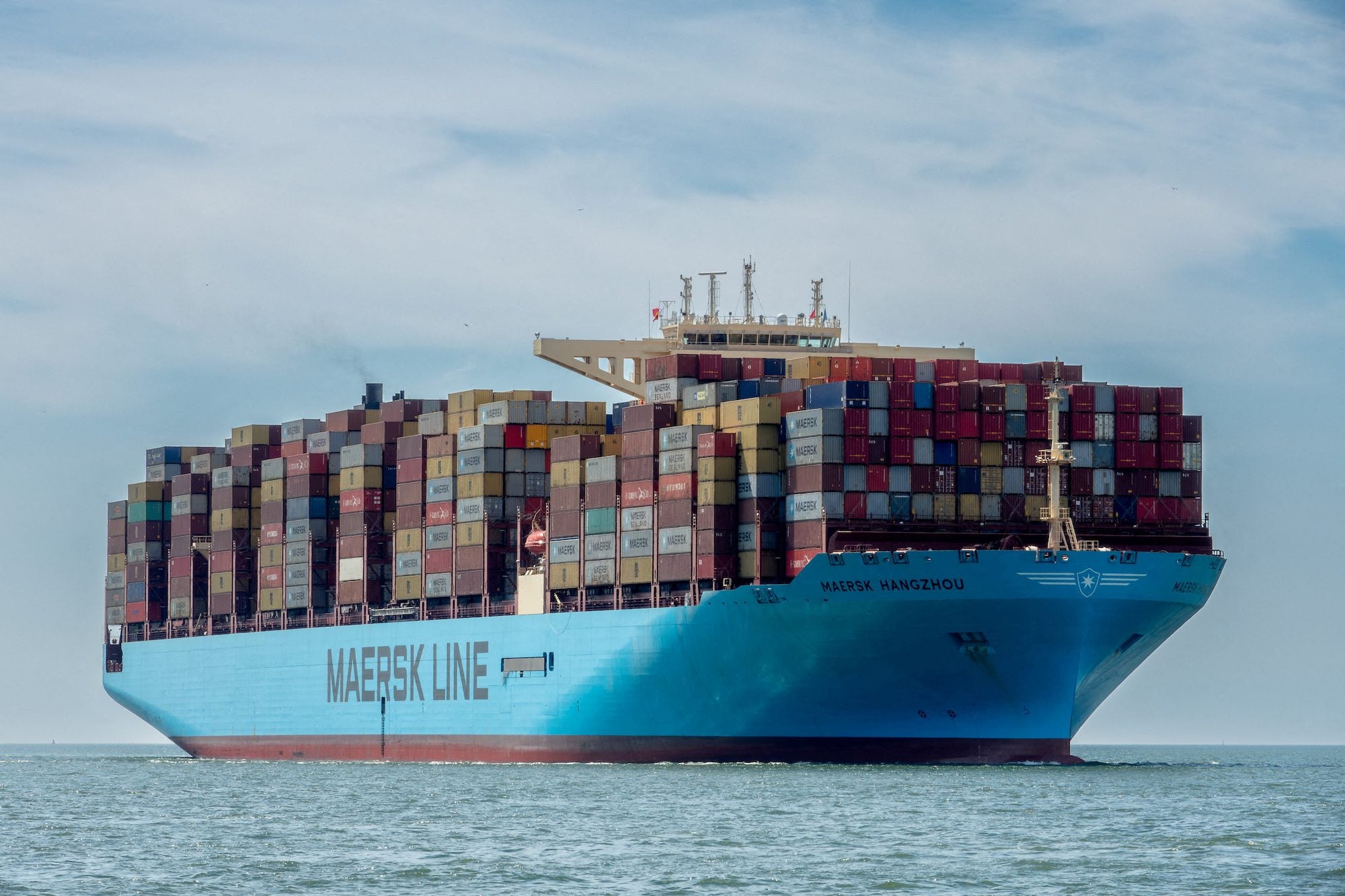
A.P. Moller – Maersk announced on Tuesday that it is still avoiding routes through the Strait of Hormuz due to uncertainties concerning the fragile ceasefire between the United States and Iran. This reflects the shipping industry's ongoing lack of confidence in the security situation in the Persian Gulf.
In its latest advisory for Middle East operations, Maersk described the situation as “highly volatile” and “deeply dynamic,” cautioning that “full maritime certainty” has not been achieved yet.
The company stated, “Volatility continues. In cooperation with our security partners, we have determined that transit through the Strait should be avoided for now.”
As the world's second-largest container carrier, Maersk indicated that any future decision to resume transit through Hormuz will rely on ongoing risk assessments, security monitoring, and guidance from authorities and industry partners.
This update comes as the Trump administration pursues diplomatic negotiations alongside increasing military and economic pressure to stabilize the region and restore commercial shipping through this vital waterway, which handles about one-fifth of global oil flows and is essential for containerized cargo, LNG, and refined products.
While Maersk appreciates U.S.-led efforts to ensure freedom of navigation, it refrained from supporting an immediate return to normal operations. The company stated, “It is essential that freedom of navigation is restored, and we value any efforts to achieve this.”
This reference likely pertains to the now-suspended Project Freedom, a U.S.-led operation intended to assist stranded commercial vessels in the Strait of Hormuz with naval protection. One of the first vessels escorted under this initiative, which was halted after only 36 hours, was the U.S.-flagged vehicle carrier Alliance Fairfax, operated by Maersk Line, Limited, a subsidiary of A.P. Moller – Maersk.
Maersk’s advisory makes it clear that shipping lines remain skeptical about the actual decline in risks, despite the recent ceasefire announcements.
The guidance aligns with a general caution across the maritime sector in recent weeks. Major operators, insurers, and organizations like BIMCO and the International Chamber of Shipping have consistently warned that military de-escalation alone is not enough to restore commercial confidence without reliable security guarantees and mine-clearance assurances.
On the commercial front, Maersk has announced a continued suspension of ocean cargo bookings for much of the Upper Gulf region, including Iraq, Kuwait, Qatar, Bahrain, Saudi Arabia’s eastern ports of Dammam and Al Jubail, and nearly all UAE ports except Khor Fakkan.
This suspension affects not only imports and exports but also transshipment cargo passing through these countries.
However, the company noted that limited exceptions may be made for essential shipments, such as food, medicines, and perishable goods.
Additionally, Maersk is expanding its multimodal “landbridge” operations across the Gulf region to keep cargo flows moving through alternative routes. Options include overland connections via Saudi Arabia, Jordan, Oman, and the UAE, along with sea-land-sea combinations connecting Jeddah, Bahrain, Kuwait, Iraq, and Qatar.
Maersk has also temporarily paused several inland cargo routes involving the UAE, Qatar, Oman, and Saudi Arabia as it adapts its logistics network to changing operational conditions.
This advisory highlights the widening gap between political statements regarding de-escalation and the shipping industry’s actual assessment of navigational risks in the region.