
By Yusuke Maekawa and Annie Lee
February 2, 2026 (Bloomberg) – Japan is speeding up a long-term plan to gather rare earths from the deep ocean. This initiative has gained urgency as the country aims to reduce its reliance on supplies from China.
A state-owned ship is set to return to port this month after installing equipment underwater in Japanese waters, close to a coral atoll 2,000 kilometers (1,243 miles) from Tokyo. The goal is to extract metal-rich mud from the ocean floor for testing, starting as soon as February 2027, according to the government body in charge of this project.
“It’s about economic security,” stated Shoichi Ishii, the program director for Japan’s National Platform for Innovative Ocean Developments. “The country needs to secure a supply chain for rare earths. Despite their high cost, the industry requires them.”
Rare earths — metallic elements used in smartphones, electric vehicles, and fighter jets — have become a point of political tension. China leveraged its dominance in the global supply chain during last year’s trade conflict with the US. Recently, Beijing restricted exports to Japan of materials intended for military use, escalating tensions between the two countries.
This situation poses a challenge for Japan. Even with significant investments in alternative supply sources, like a separation facility in France and financial support for Australian company Lynas Rare Earths Ltd., Japan still relies on China for about 70% of its rare earth imports.
However, seabed mining won’t solve this issue quickly. Even if tests indicate a promising resource, costs and logistics will be significant hurdles for potential developers. No large-scale commercial mining operations have successfully taken place from the seabed, despite extensive exploration.
The US has made moves to fast-track the approval process for seabed mining in international waters after President Donald Trump signed an executive order aimed at promoting domestic mineral resources. Yet, these changes may raise global concerns, as the International Seabed Authority is working on new environmental regulations.
Japan’s project is happening within its territorial waters, near Minamitori Island, Japan’s easternmost point. According to the Cabinet Office, this cross-ministerial body will extract about 350 tons of mud per day from depths of 5 to 6 kilometers.
This mud will be analyzed to determine which rare earths are present and in what amounts, explained Tadanori Sasaki, a senior research director at the Institute of Energy Economics. The next steps will depend on these findings.
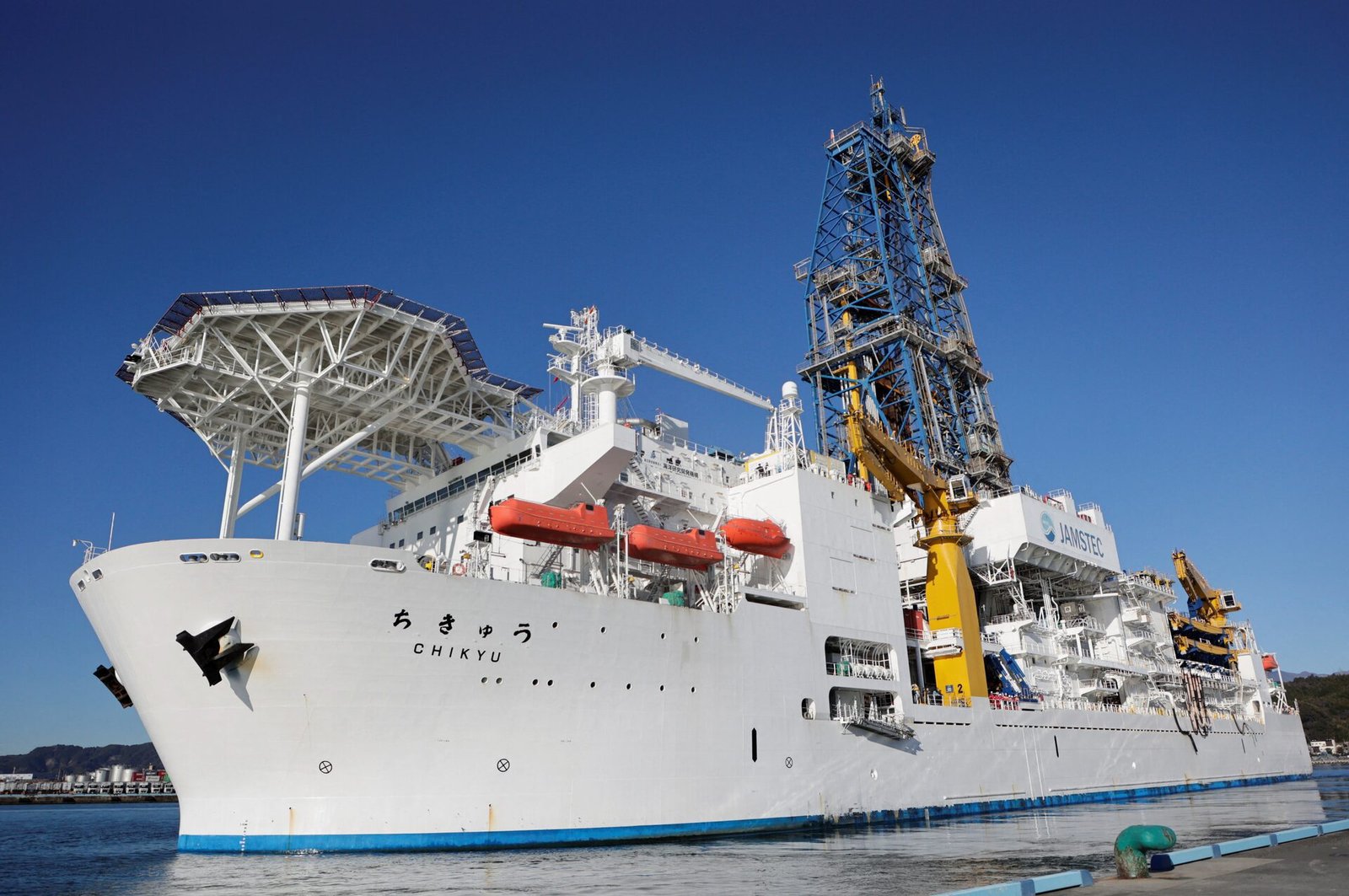
The deep-sea drilling vessel, named Chikyu, successfully retrieved mud samples containing rare earths while laying the equipment, stated Deputy Chief Cabinet Secretary Masanao Ozaki at a press conference. “This test aimed to confirm for the first time if we could continuously lift rare-earth mud,” he said.
Japan, motivated by global cobalt supply disruptions, began exploring the ocean for minerals in the late 1970s. The Japan Organization for Metals and Energy Security, or Jogmec, successfully tested excavation of a cobalt-rich crust on the seabed in 2020.
The rare-earth project started in 2014 and has progressed through various phases, with the ship operated by the Japan Agency for Marine Earth-Science and Technology departing from Shizuoka in January.
“This initiative seems to resurface whenever China raises concerns about rare-earth exports,” noted David Abraham, an affiliate professor at Boise State University. “Extracting mud from miles below the surface under high pressure is likely to involve significant operating costs, needing ongoing government support even if it is technically viable.”
Ishii, from the ocean development platform, does not see costs as a barrier. When asked about the commercial viability of seabed mining, he emphasized that the Japanese government is focused on creating a stable supply chain for its domestic industry. He compared this to the US government’s recent $400 million investment in MP Materials Corp., which revived a dormant rare-earth mine in California, aiming to secure supply.
Market conditions are “favorable for Japan as it seeks to advance the testing and development of this unconventional deposit,” stated James Tekune, a research associate at Adamas Intelligence. However, he expressed caution about the future of deep-sea mining as a significant source of rare earths. “At best, it will become a niche supply source,” he added.