
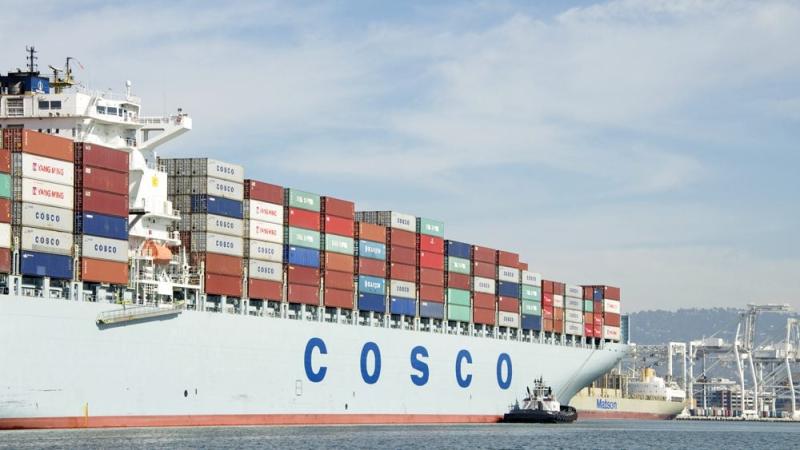
Iran has announced that it is enforcing new shipping controls in the Strait of Hormuz. The country claims it has blocked several container ships, including two from China's COSCO, under a "permission-to-transit" system that could change how vessels access this crucial maritime route.
Just hours after COSCO revealed plans to redesign its network in the Gulf and resume operations in the Strait, Iranian authorities stepped in to prevent ships from entering if they did not follow the new transit rules.
The Islamic Revolutionary Guard Corps (IRGC) of Iran stated that it had "blocked three container ships of different nationalities" for not complying with the new requirements.
Two ultra-large container vessels (ULCVs), CSCL Indian Ocean and CSCL Arctic Ocean, tried to pass through the Strait but turned back around 03:50 UTC, according to data from Kpler. These vessels had been waiting near the coast of the UAE off Dubai and are now heading back to those waters.
Rebecca Gerdes, a data analyst for Container Intelligence at Kpler, noted, "This marks the first major carrier's crossing attempt since the conflict began."
Iran previously declared a "safe" shipping corridor on March 18, offering a framework for approved—and possibly fee-based—transits through the area. The recent events suggest that passage may now depend on whether vessels follow Iranian procedures.
Both COSCO ships were headed for Port Klang in Malaysia.
During a regular press briefing on Friday, Lin Jian, the Director of the Foreign Ministry Information Department in China, said the country is closely watching the situation.
"The Strait of Hormuz is a key shipping route for global trade and energy security. The ongoing tension and military confrontations benefit no one," he remarked.
When asked if China would send escorts for its vessels to ensure safe passage, Lin emphasized, "China's stance on the Middle East conflict remains unchanged. We believe that force will only lead to a cycle of violence. Our top priority is to achieve a ceasefire and encourage a political solution."
This denial of passage highlights the increasing uncertainty for commercial shipping in the region, where operators must consider both security risks and the potential for selective access controls.
Currently, the waters in the Gulf appear more like a holding area than an active transit corridor. Kpler’s analysis shows that around 470,000 TEUs are stranded as operators are hesitant to send vessels without guarantees of safe passage.