
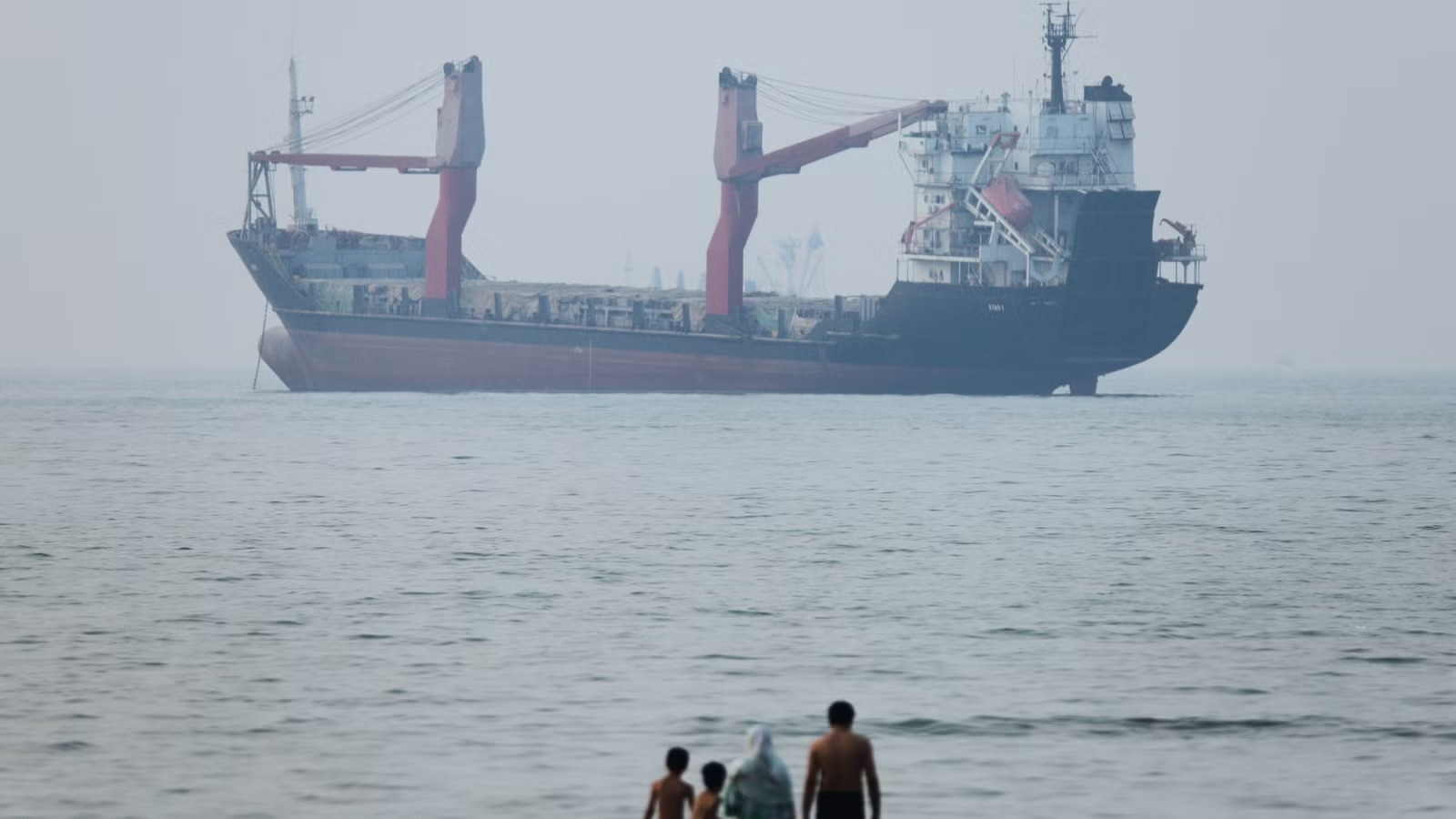
(Bloomberg) — Iranian lawmakers are currently discussing a proposed deal with Oman regarding the Strait of Hormuz, while US President Donald Trump states that an agreement is becoming more likely.
Trump mentioned that the talks are progressing, but did not provide further details when questioned by White House reporters on Thursday. Earlier this week, Iran's Deputy Foreign Minister Kazem Gharibabadi said they had reached an "in-principle" understanding with Oman, and a lawmaker indicated that the final details of the agreement with Muscat would be revealed “soon.”
Some Iranian politicians are advocating for provisions such as banning US and Israeli ships from the waterway, according to the semi-official Fars news agency. This condition would contradict Washington’s request for free passage, even though there are currently few, if any, US or Israeli commercial vessels operating globally.
Additional changes discussed by Fars include Iran's demand for compensation from “hostile countries,” a proposed ban on cargo linked to Israel, and a fee system covering services such as insurance and environmental costs.
It remains unclear whether Iran’s Supreme Leader Mojtaba Khamenei has given his approval for the proposal, which is necessary for it to move forward. Iranian officials have mentioned that reaching out to him can take time.
A deal concerning the strait is critical for expectations of an increase in energy flows, which have persisted despite recent conflicts, albeit at lower levels since the US and Israel targeted Iran in late February. Reopening this key chokepoint could also facilitate broader negotiations between the US and Iran to end ongoing hostilities.
Fars reported late Thursday that Iranian naval forces had targeted “hostile” positions near the strait, indicating that tensions remain elevated.
Brent crude oil prices remained steady at around $82 a barrel, following a nearly 4% increase in the previous session.
Arab mediators working on a deal with Iran for the Strait of Hormuz have expressed concerns that Iran's diplomats may struggle to ensure compliance with any agreement reached, as reported by the Wall Street Journal. Mediators cited in the article noted that Tehran's chief negotiators are facing growing pressure from hardline officials to push for more explicit acknowledgment of Iran's position in the strait and clearer benefits.
Only a few US- or Israeli-flagged commercial vessels have entered or exited the Persian Gulf since the onset of the conflict. It remains uncertain how broadly Iran might interpret a ban on these ships, as the complex structure of vessel ownership means some ships with US or Israeli connections might be seen as having ties to those nations.
For months, Trump has insisted that navigation through Hormuz must resume, warning of further actions against Iran if it does not reopen the waterway. A US official stated Thursday that any temporary routes through the strait would not require approvals, permissions, tolls, or charges, in response to speculation about the latest proposals.
Tehran has stated that full reopening of the strait would necessitate lifting the American maritime blockade, although the US has not indicated whether it is prepared to make that concession.
According to Fars, which cited an informed source in Iran’s Foreign Ministry, the draft agreement with Oman would grant Iran management over the entry of vessels into Hormuz, while both countries would oversee the exit. They plan to channel transit through a “central corridor,” halting traffic via two other currently limited routes within a “specified timeframe.”
Trump, who has recently backed off his earlier threats to launch military strikes against Iran, confirmed on Thursday that the US is engaged in negotiations but did not reveal whether any agreement has been finalized.
“We control it, but they can always attack,” said Trump, referring to the crucial waterway.
Many past claims of imminent deals have turned out to be false, and it is unclear if the proposals from Iran and Oman will be sufficient to restore traffic flow. On Thursday, Iran's chief negotiator with the US, Mohammad Bagher Ghalibaf, criticized the White House for its ongoing threats followed by retractions, labeling it “theater diplomacy on repeat.”
Several potential barriers to a lasting peace deal have arisen as the conflict escalates regionally.
These include attacks by the Houthis, an Iran-aligned militia in Yemen, against Saudi Arabia. The Yemeni group reported a “large-scale” attack against Saudi-aligned forces in central Yemen on Thursday, claiming hundreds were killed or injured.
The Associated Press noted that at least 30 troops from Yemen’s internationally recognized government were killed in these attacks, according to government officials. Additionally, the Saudi-led coalition in Yemen claimed the militia fired projectiles into Saudi Arabia’s Najran region, near Yemen’s northern boundary.
Although the Houthis and the Saudi-led coalition have maintained a ceasefire since 2022, fighting has resumed in recent weeks, including incidents in the Red Sea, which has been the primary route for Saudi oil exports since the closure of the Strait of Hormuz.
Visible traffic in the Strait of Hormuz remains limited, with only a small number of cargoes from Middle Eastern producers being transported through a shuttle program backed by US military assistance, as vessels turn off their transponders.