
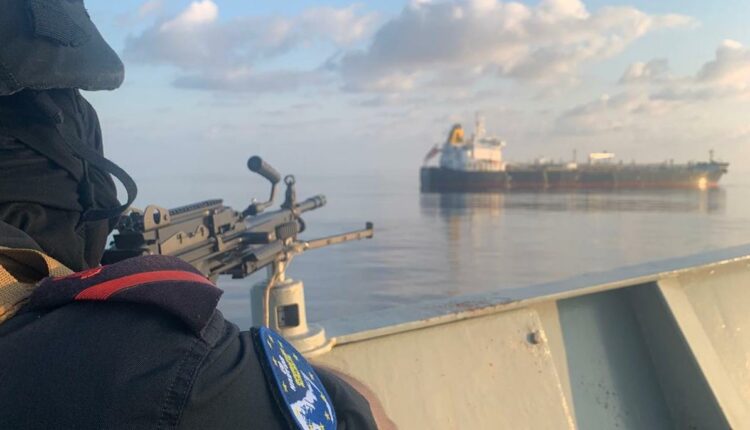
The Indian Navy and European Union naval forces have started a major maritime surveillance operation to track down a group of Somali pirates responsible for several attacks in the Indian Ocean, including the recent hijacking of the tanker HELLAS APHRODITE.
As reported by EUNAVFOR's Maritime Security Centre Indian Ocean, the “Pirate Action Group (PAG) connected to these incidents is under close observation by both the Indian Navy and EUNAVFOR Operation ATALANTA.” Authorities have claimed that there is currently no threat to merchant vessels from this group.
European naval forces successfully rescued the Maltese-flagged tanker HELLAS APHRODITE on Friday afternoon, after a tense 30-hour ordeal about 700 nautical miles off Mogadishu. All 24 crew members were unharmed after they took shelter in the ship's citadel during an attack by pirates armed with small weapons and rocket-propelled grenades on November 6.
This operation highlighted effective international cooperation, with the Spanish flagship ESPS VICTORIA utilizing helicopters, drones, maritime patrol planes, and a Special Operations Team. Support also came from Puntland authorities and various international maritime forces.
According to EUNAVFOR, “The merchant tanker was abandoned by the Pirate Action Group after a show of force.”
Pirates Still Active
Despite the successful rescue, there are still many worries. EUNAVFOR has warned, “The mother ship and the pirates are still in the area,” adding that a coordinated joint operation is in progress to intercept the dhow used for the attack.
Maritime authorities have conveyed that the threat level in the area remains critical and have urged vessels to be extremely cautious when passing through this region.
Investigations are underway to gather evidence for possible legal action against the suspected pirates, as ATALANTA and its partners continue their extensive search for the Pirate Action Group.
The hijacking of the HELLAS APHRODITE marks the peak of an eight-day spree by the same pirate group, which had previously targeted the Stolt Aphrodite on November 3 and the fishing vessel Intertuna Tres on November 2, according to Martin Kelly, Head of Advisory at EOS Risk Group.
On November 3, the chemical tanker MV Stolt Sagaland successfully defended itself against an attack approximately 330 nautical miles east of Mogadishu, when armed security personnel fired warning shots at four individuals trying to board.
On Friday, the Marshall Islands-flagged LNG carrier Al Thumama reported an encounter with a small boat carrying three people near the site of the Hellas Aphrodite incident. Fortunately, the tanker, traveling from Qatar to Poland via the Cape of Good Hope, was able to outpace the speedboat.
Rise of Maritime Piracy
These recent events indicate a worrying trend that began in November 2023, featuring a series of dhow hijackings, alongside attacks from Houthi groups in the Red Sea area. Pirates often use hijacked dhows as “mother ships” to conduct attacks far off the coasts in the Indian Ocean.
Operation ATALANTA recorded numerous incidents in the Somali Basin and the Gulf of Aden in 2024, which included four boardings of merchant vessels and two significant hijackings: the MV Ruen, held for three months before being rescued by the Indian Navy, and the MV Abdullah, which was released after a month reportedly in exchange for a large ransom. In January 2025, a Chinese fishing vessel was hijacked off Somalia's northeastern Puntland coast.
Operation ATALANTA strongly advises that merchant and other vulnerable vessels register with the Maritime Security Centre Indian Ocean's Voluntary Registration Scheme for the best monitoring and response from ATALANTA forces and their partners against maritime threats.
Authorities previously advised ships to steer clear of a 100-nautical-mile radius from locations of attacks where pirate groups are known to operate, emphasizing that “prompt and detailed reporting of incidents and suspicious activities is essential for quick responses.”
All assessments and recommendations are communicated through appropriate channels to shipping operators and updated on the Maritime Security Centre Indian Ocean website.