
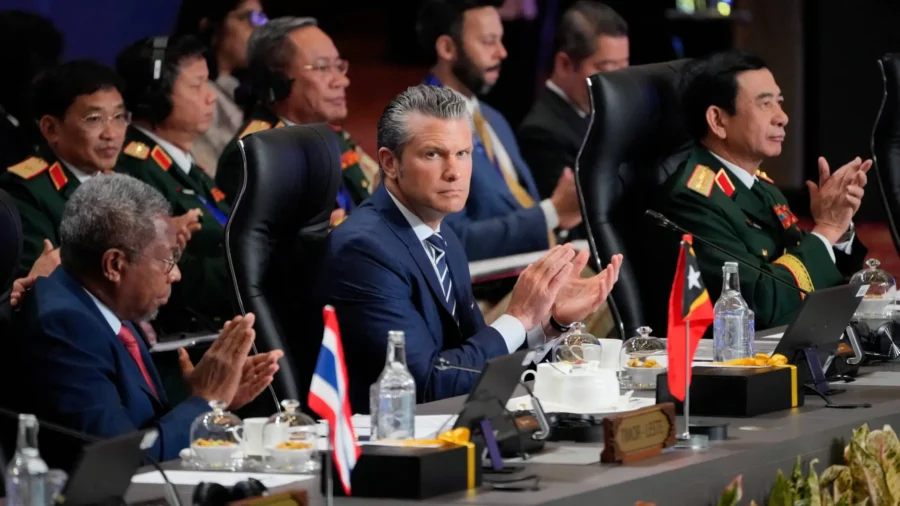
KUALA LUMPUR, Nov 1 – U.S. Defense Secretary Pete Hegseth criticized Beijing on Saturday for its increasing "destabilizing actions" in the South China Sea. He pledged to support Southeast Asian nations with technology to help them respond together to threats from China.
During his second day in Kuala Lumpur, which included meetings with allies like Australia, Japan, and the Philippines, he proposed to ASEAN defense ministers that they work on shared maritime awareness. He stated that China has shown disrespect and posed threats to their territorial sovereignty.
“You experience the threats we all face from China's aggression and actions in the South China Sea and beyond,” he remarked.
“We need to enhance our joint capabilities to respond, which includes monitoring maritime activities and developing the tools that allow us to act quickly. It’s crucial that no one facing aggression feels alone,” he added.
“No one can innovate and scale like the United States, and we’re eager to share our capabilities with allies and partners,” Hegseth emphasized.
CHINESE COAST GUARD ARMADA
His comments came a day after military forces from Australia, New Zealand, the Philippines, and the U.S. conducted drills in the South China Sea. A Chinese military spokesperson responded by saying this patrol “seriously undermined peace and stability.”
China claims nearly the entire South China Sea as its own, based on a line on its maps that overlaps with the exclusive economic zones of Brunei, Indonesia, Malaysia, the Philippines, and Vietnam.
Beijing has deployed numerous coast guard vessels hundreds of kilometers from its shores, which have repeatedly clashed with Filipino ships and disrupted the energy activities of Malaysia and Vietnam.
China denies being aggressive and states that its coast guard operates professionally to defend its territory from incursions.
On Friday, Chinese Defense Minister Dong Jun said it was essential for China and ASEAN to cooperate to "pool Eastern strength" and maintain peace in the South China Sea.
NUCLEAR WEAPONS TESTING
Hegseth’s visit to Southeast Asia followed U.S. President Donald Trump’s announcement on social media that he had instructed the U.S. military to “start testing our Nuclear Weapons” after a 33-year pause. This move seemed aimed at rival nuclear powers like China and Russia.
It was not clear if Trump meant to restart nuclear-explosive testing, which would be handled by the National Nuclear Security Administration, or to conduct flight tests of nuclear-capable missiles.
When reporters asked Hegseth about the type of testing Trump was referring to, he said his department would comment later, adding that, “We have very capable nuclear capabilities, and testing them is only prudent.”
Addressing the defense ministers at their forum, Hegseth highlighted Washington’s commitment to peace and stated that the U.S. aims to build a military “unmatched in global power,” while supporting allies in the Indo-Pacific.
He mentioned that dialogue with China is valuable, especially after talking with his Chinese counterpart on Friday, but stressed that Beijing’s actions need to be monitored closely.
“We seek peace and do not desire conflict, but we must ensure that China is not trying to dominate you or anyone else,” Hegseth told ASEAN colleagues.