
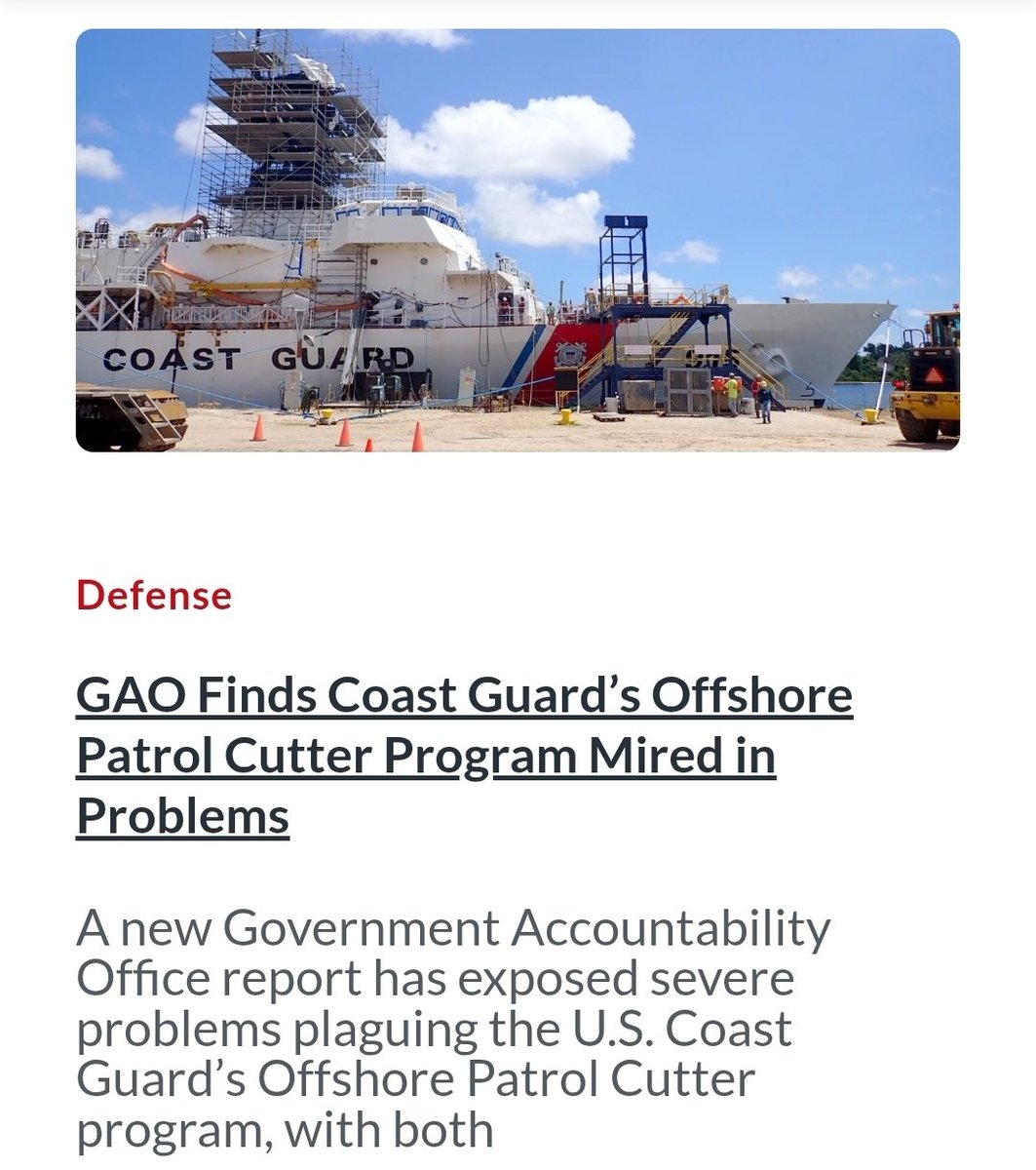
A new report from the Government Accountability Office has revealed serious issues in the U.S. Coast Guard's Offshore Patrol Cutter (OPC) program. Both shipbuilders have failed to deliver any vessels after years of work, with costs skyrocketing to $17.6 billion.
The GAO found that the Coast Guard's approach of starting ship construction before the designs were finalized has backfired. Eastern Shipbuilding Group, the contractor for the first stage, has shown little progress since the last GAO evaluation. As a result, the Coast Guard ended half of its original four-ship contract in July 2025. This month, Eastern announced it had to halt work on the remaining two vessels due to “severe financial strain.”
The report states, “Construction of OPCs 1-4 began without a stable design, going against established shipbuilding practices,” which resulted in rework and delays in ship deliveries. The delivery of OPC 1 has been postponed by more than five years, now expected to take place at least by late 2026 instead of June 2023.
Worryingly, Austal USA, the second-stage contractor, seems to be heading down the same troubled road. According to the GAO, “Construction of OPC 5 began in August 2024 without a stable design.” The report warns that continuing to build additional stage 2 vessels without a solid design increases the risk of facing costly rework and further delays.
The financial outlook for the program has worsened significantly, with costs rising from $12.5 billion to $17.6 billion. The GAO noted that “the OPC program is at risk of not meeting its cost goals because it relied on outdated cost information to set those targets.”
Additionally, the GAO found weaknesses in Austal's cost tracking systems, which “may be difficult to monitor,” complicating budget assessments as construction progresses.
The Coast Guard also faces challenges with its stage 3 procurement strategy. The report highlights that “it is unlikely that results from performance testing of any OPCs will be available before stage 3 procurement activities begin,” which means “the Coast Guard could purchase more ships without knowing if the OPCs meet necessary requirements.”
To address these issues, the GAO has made four recommendations for the Coast Guard and the Department of Homeland Security (DHS). These include stabilizing the stage 2 design before allowing more vessels to be built, improving the reporting of cost goals by stage, and creating a thorough plan for stage 3 procurement that includes testing results and best practices in shipbuilding. However, DHS only agreed with two of these recommendations.
The troubled program comes at a time when the Coast Guard urgently needs these vessels to replace old cutters that perform law enforcement and search and rescue missions. The initial plan aimed to acquire 25 OPCs over three stages: stage 1 for vessels 1-4, stage 2 for vessels 5-15, and stage 3 for vessels 16-25.
Despite Eastern Shipbuilding's difficulties with the OPC program, the company recently won a $714.5 million contract for hybrid-electric ferries in August, which suggests that their challenges may be more about the complexity of Coast Guard vessels rather than their overall shipbuilding capability.
Austal USA is currently working under a $3.3 billion contract for up to 11 OPCs and plans to lay the keel for its first vessel in December. The key question is whether the Coast Guard and its contractors can apply lessons from past errors and successfully deliver the much-needed cutters without repeating the mistakes that have hindered the program's first stage.