
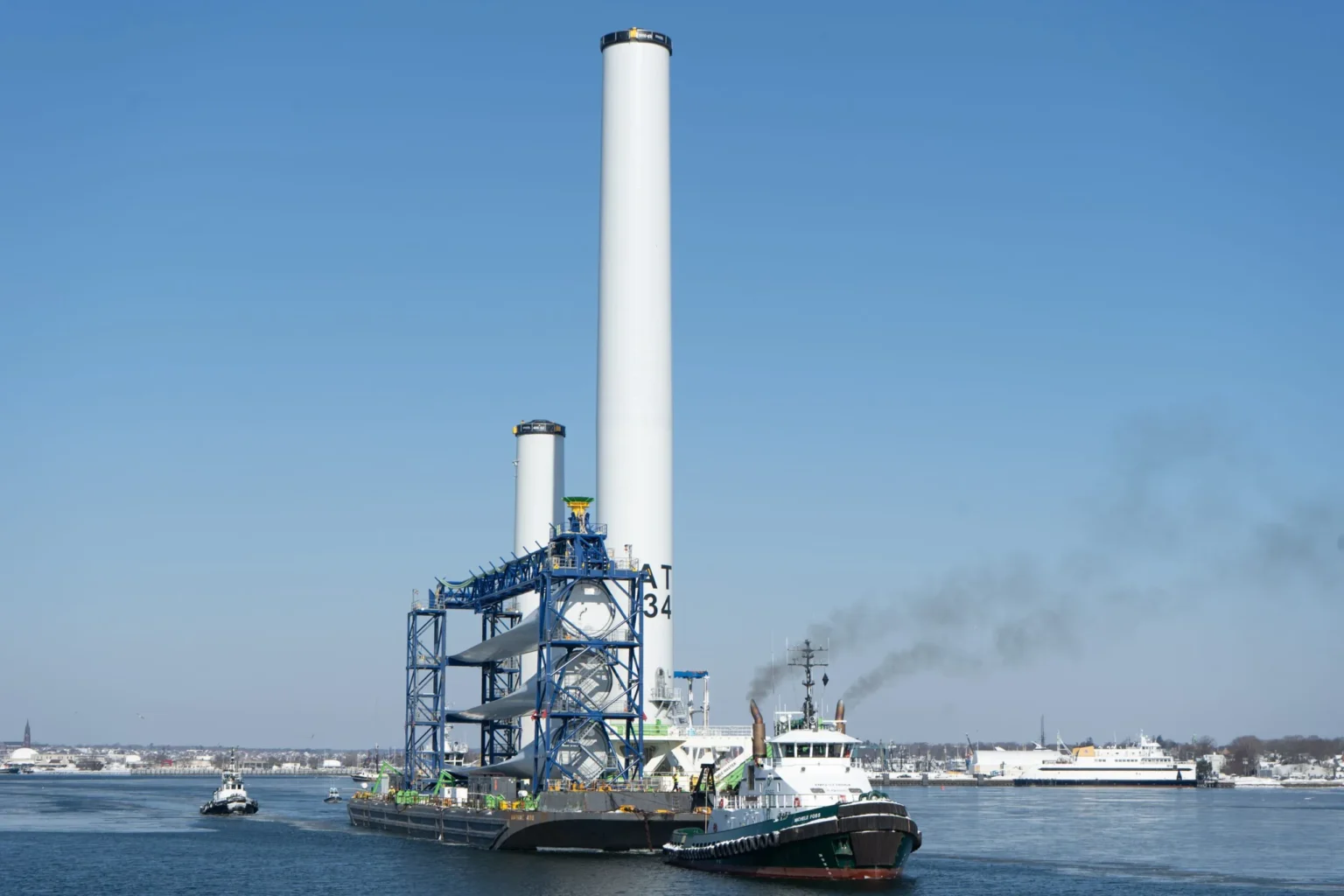
Recent federal court decisions have overturned the Trump administration’s efforts to stop offshore wind projects along the U.S. East Coast. The latest ruling allows Ørsted’s Sunrise Wind project to restart work immediately.
On Monday, the U.S. District Court for the District of Columbia granted a preliminary injunction requested by Sunrise Wind LLC, lifting a halt that the Bureau of Ocean Energy Management (BOEM) imposed on December 22, 2025. This ruling means that construction can continue while legal battles over BOEM’s decision are ongoing.
“We will resume construction as soon as possible, prioritizing safety to provide affordable and reliable energy for New York,” said Sunrise Wind in a statement following the ruling.
The Sunrise Wind decision is the fifth consecutive loss for Interior Secretary Doug Burgum, who based the suspension of East Coast offshore wind projects on national security issues. Federal judges in Massachusetts, the District of Columbia, and Virginia have now cleared all five projects affected—Sunrise Wind, Vineyard Wind, Dominion Energy’s Coastal Virginia Offshore Wind project, Equinor’s Empire Wind, and Ørsted’s Revolution Wind—to proceed with construction.
The administration claimed that large offshore wind turbines might interfere with radar systems, potentially causing issues in detecting real targets or generating false readings, especially near crowded coastal areas. Burgum cited “emerging national security risks” when announcing the suspension in December.
However, courts have not been swayed by these arguments. In a January 27 decision regarding Vineyard Wind, a federal judge in Massachusetts stated that BOEM’s decision likely “violates applicable law” and would create “immediate and irreparable harm” if allowed to remain. In the Empire Wind case, U.S. District Judge Jamar Walker concluded on January 15 that the suspension was too broad, pointing out that the government’s concerns were mostly tied to the wind farm operations and not the construction process.
The work stoppages have had a significant financial impact. Empire Wind alone faced up to $50 million in costs per week due to the halt, while Revolution Wind reported losses surpassing $15 million each week. Equinor warned that stopping Empire Wind could lead to over $4 billion in investments being stranded, incur $850 million in termination fees for construction contracts, and require an additional $355 million to dismantle assets.
Dominion Energy highlighted that delays in its Coastal Virginia Offshore Wind project cost about $5 million daily, leading to a $300 million increase in total project costs, bringing it to around $11.5 billion.
These legal wins come as the U.S. offshore wind project pipeline contracts sharply. From the third quarters of 2024 to 2025, the active projects dropped from 45 to 23, with planned capacity reducing from nearly 56 gigawatts to about 25 gigawatts. Tariffs on steel, aluminum, and European turbine components, along with the cancellation of $679 million in federal port grants, have also added pressure.
Burgum indicated in September that “there won’t be future offshore wind built in America” under current policies.
For now, the court decisions provide some relief for developers. Construction is set to resume on all five projects, even as the legal challenges to BOEM’s December 22 order continue—cases that may ultimately define the extent of executive authority in halting major energy projects under national security claims.