
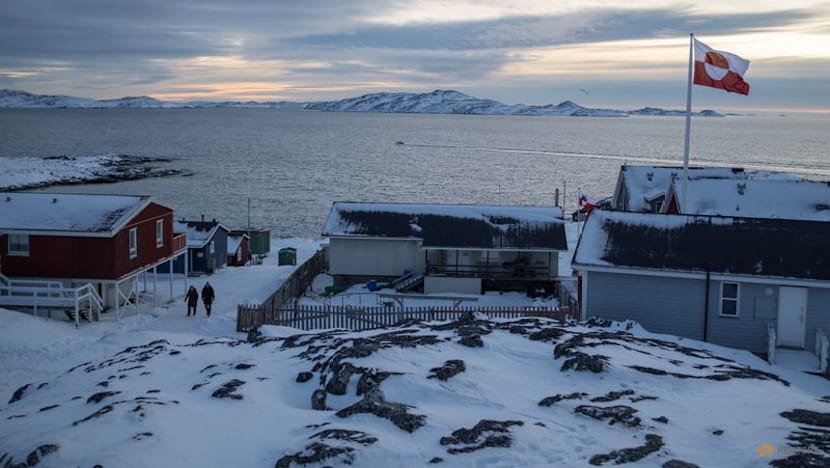
NUUK, Jan 15 (Reuters) - European nations began sending a small number of military personnel to Greenland on Thursday. This move comes as Denmark and its allies prepare for exercises aimed at reassuring U.S. President Donald Trump about the island's security, amid his interest in acquiring it.
A meeting on Wednesday involving officials from the U.S., Denmark, and Greenland did not lead to any swift resolutions but avoided the public embarrassment faced by Ukrainian President Volodymyr Zelenskiy last year.
“The American ambition to take over Greenland remains,” stated Danish Prime Minister Mette Frederiksen in a response to Reuters on Thursday, highlighting a "fundamental disagreement." She added, “This is indeed serious, and we continue to work to prevent this scenario from becoming reality.”
TRUMP CITES RUSSIAN AND CHINESE INTEREST
Trump has emphasized that the strategically positioned and resource-rich island is crucial for U.S. security, suggesting that it must be owned by the U.S. to prevent Russian or Chinese occupation. He believes Denmark is unable to fend off Russian and Chinese influence in the Arctic region.
In response, Russia criticized NATO's claims about Moscow and Beijing posing a threat to Greenland as unfounded, warning against escalating tensions in the area. They implied that ignoring Russia's interests in the Arctic would provoke a reaction.
Currently, there is minimal evidence of a substantial number of Chinese and Russian vessels operating near Greenland's shores.
Greenland and Denmark have made it clear that the island is not for sale, labeling threats of force as reckless, and asserting that security matters should be handled among allies.
Key EU nations have supported Denmark, warning that a military takeover of Greenland by the U.S. could effectively jeopardize NATO.
Before the meeting on Wednesday, Greenland and Denmark announced their plans to strengthen military presence in and around Greenland in collaboration with NATO allies. Germany, France, Sweden, Norway, and the Netherlands confirmed they would be sending military personnel to prepare for larger drills planned for later this year.
“The Danish Armed Forces, along with several Arctic and European partners, will investigate in the coming weeks how to practically implement an increased military presence and training activities in the Arctic,” said the Danish Ministry of Defence.
INITIAL DEPLOYMENT APPEARS SMALL
According to Danish Foreign Minister Lars Lokke Rasmussen, about 200 U.S. troops are already stationed in Greenland, which has a population of approximately 57,000.
Details about the size of the planned European military buildup remain undisclosed, but initial deployments appear modest. A German reconnaissance team of 13 personnel will first travel to Copenhagen, then proceed to Greenland alongside Danish troops. On Wednesday, a Danish Air Force plane landed at Nuuk airport, with personnel dressed in military uniforms disembarking.
Sweden is sending three officers, while Norway is contributing two. French Ambassador to the Poles, Olivier Poivre d'Arvor, mentioned that France will send around 15 mountain specialists.
“A first team of French military personnel is already in place and will be reinforced soon by land, air, and naval assets,” stated French President Emmanuel Macron. He emphasized that France and the EU must be “unyielding in upholding territorial sovereignty.”
A British officer is joining the reconnaissance group, while the Netherlands plans to send one naval officer. Poland has decided not to send any troops.
This European military deployment to Greenland conveys two key messages to the U.S. administration, according to Marc Jacobsen, an associate professor at the Royal Danish Defence College. “One message is deterrence, showing that ‘if you decide to take military action, we’re ready to protect Greenland.’ The other is to convey, ‘we take your concerns seriously, we are increasing our presence, protecting our sovereignty, and enhancing surveillance over Greenland.’”
After meeting with U.S. Secretary of State Marco Rubio and Vice President JD Vance on Wednesday, Rasmussen and Greenland's Foreign Minister Vivian Motzfeldt announced that the U.S. and Denmark will create a working group to address concerns about the island.
Greenland's Prime Minister Jens-Frederik Nielsen reiterated on Facebook that the island does not wish to be governed or owned by the United States and will remain part of Denmark and the NATO alliance. “Now is not the time for internal discussions. It is a time for unity, calm, and responsibility. I am closely monitoring the situation and stand with you to ensure the safety of Greenland,” he expressed.