
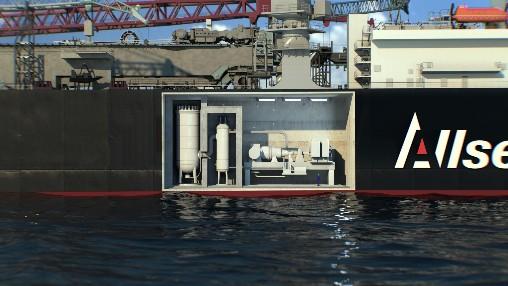
Allseas has published results from an independent impact study that suggests its Small Modular Reactor (SMR) technology could greatly benefit the Dutch economy while also helping to reduce carbon emissions in global shipping and heavy industry. The study was carried out by the strategic consultancy Roland Berger over seven weeks from September to October 2025. It estimates that Allseas' SMR technology could generate up to €130 billion for the Dutch economy by 2050 and create around 35,000 to 40,000 new jobs. This economic growth would stem from direct investments made by Allseas and its supply chain, as well as indirect expansions in Dutch industrial and maritime sectors.
Central to Allseas' plan is a reactor that produces 25 MWe / 70 MWt, which is based on high-temperature gas-cooled reactor (HTGR) technology. The company initiated a five-year development plan in June 2025, aiming for initial operations by 2030 in partnership with NRG PALLAS, TU Delft, and other collaborators. “This study proves that our small modular reactor is not only technologically advanced but also important for the Netherlands,” said Stephanie Heerema, Project Manager of Nuclear Developments at Allseas. “With this technology, we can meet the urgent need for stable, clean, and affordable energy while creating an export product that speeds up the global energy transition.”
The compact design of these reactors allows for use in various settings, from offshore vessels and commercial shipping to industrial locations like chemical clusters, steel plants, refineries, and data centers. Roland Berger estimates that there could be deployment of up to 110 units on land in the Netherlands and 700 in the global maritime sector.
In addition to economic gains, this technology helps solve key infrastructure issues. By producing power right where it's needed, SMRs could lessen the burden on the Netherlands’ electricity grid, potentially saving up to €12 billion in planned high-voltage grid investments by 2050.
Regarding emissions, Allseas predicts that its SMR technology could reduce up to 10 megatons of CO₂ annually from Dutch industry and 55 megatons from the global maritime industry by 2050—equivalent to the yearly emissions of 3.5 million Dutch homes. The reactor also offers competitive cost advantages, providing industrial heat up to 650°C at prices that are 30% lower than gas turbines and 80% cheaper than renewable options, according to the study.
Roland Berger confirmed its findings with prominent Dutch institutions including TNO, COVRA, Urenco, and the Port of Rotterdam. “As a responsible family-owned company, we always adopt a long-term perspective,” Heerema added. “The results of this study reveal exciting potential for our technology to tackle today's challenges and strengthen our commitment to implementing our five-year plan.”