
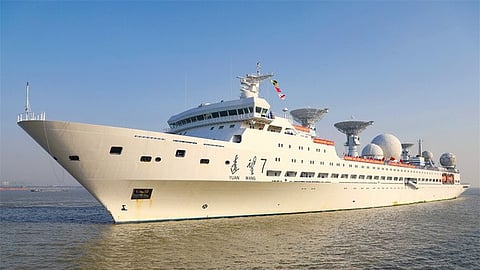
SYDNEY, Nov 20 (Reuters) – Last month, five Chinese research vessels operated in the northwest Pacific, including ships used for tracking space and missiles, and for underwater mapping. This activity coincided with increased military exercises by the United States, according to data from a group based in Guam.
The rapid buildup of military forces in the northern Pacific is not receiving enough attention, says the Pacific Center for Island Security. They warn that this situation could put island communities at risk in a potential conflict between major powers.
Leland Bettis, the director of the group, highlighted the significant number of U.S. and allied military exercises in the region, stating in an interview, “When you see how active the U.S. and its partners have been, it’s not surprising that China is sending research vessels to explore the underwater areas that could be used for military purposes.”
According to the center's Micronesia Security Monitor, three Chinese vessels, including the Yuanwang 7, which tracks space and missiles, were spotted near the small Pacific island of Kiribati last month. Kiribati, a Pacific neighbor of Hawaii with strong ties to Beijing, has an extensive exclusive economic zone covering around 3.6 million square kilometers (1.4 million square miles).
Last year, Kiribati expressed concern over a Chinese test of an intercontinental missile that landed close to its waters.
Additionally, two other Chinese research ships were located to the east of Guam, near U.S. territories such as the Federated States of Micronesia and the Marshall Islands, which have defense agreements with the U.S.
China's foreign ministry did not provide a comment regarding the purpose of these research vessels. Responses from Kiribati were also not received.
Between August and November, the United States conducted nine multilateral military exercises near Guam in collaboration with its allies. One of these, the Malabar exercise, involved Australia, India, Japan, and the U.S., focusing on anti-submarine warfare and air defense tactics. The Australian defense force emphasized the importance of this exercise in “deterring coercion in the Indo-Pacific.”
The U.S. maintains military bases in Guam and the Marshall Islands, as well as rights for overflight and maritime access to three freely associated states: Palau, the Federated States of Micronesia, and the Marshall Islands.
Bettis noted, “Thirty years ago, the U.S. presence in these regions would have been seen as a deterrent; today, due to advancements in technology, it makes us a potential target.” Bettis resides in Guam and made this statement shortly before the monitor's report was released.
Additionally, the visual data from the monitor illustrates the growing presence of U.S. military infrastructure across Micronesia, including enhanced wharves and airfields.
This project is supported by various commercial donors, including the Carnegie Corporation and the Sasakawa Peace Foundation.