
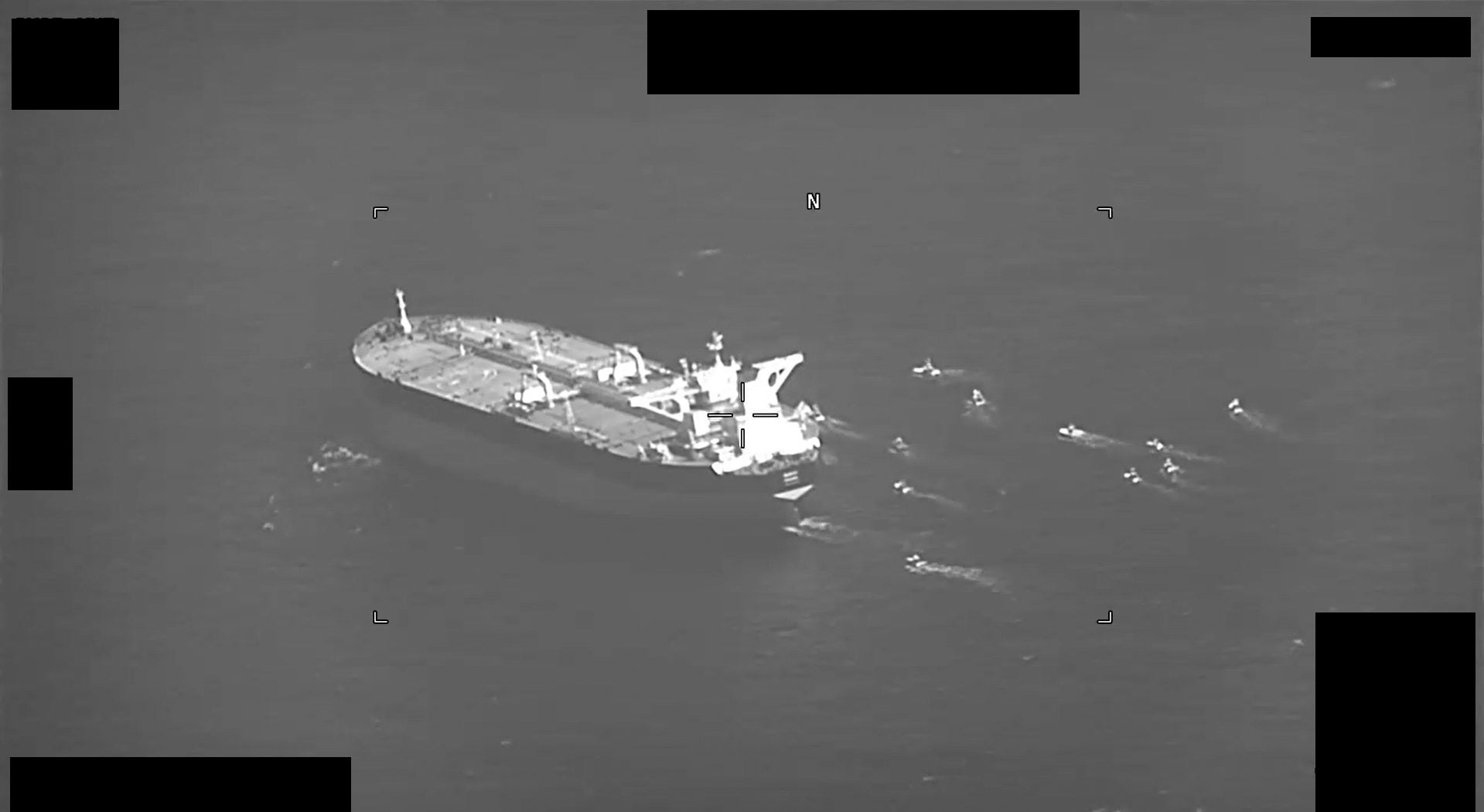
President Donald Trump’s recent comments on social media about Iranian “fast attack ships” may seem entertaining online, but experts in maritime security, along with evaluations from the U.S. military, indicate that the threat from Iran’s swarm tactics is much more serious than simple memes portray.
On Tuesday, the White House promoted an edited image shared by Trump showing U.S. forces destroying Iranian “fast boats” and aircraft with advanced laser weapons, captioned: “Bing, Bing, GONE!!!” However, for many years, the U.S. Navy has seen these boats as one of the most significant threats in the Strait of Hormuz.
The main issue is not whether the U.S. Navy can take out individual boats—it's evident that they can. The real challenge is that Iran’s Islamic Revolutionary Guard Corps Navy (IRGCN) was never meant to win a traditional naval battle against the U.S.
Trump has repeatedly claimed that Iran’s navy has been effectively eliminated. He once asserted that “all 32 are at the bottom of the ocean” and referred to it as the “largest destruction of a foreign navy” since World War II. In reality, the IRGCN's strength is not based on a few advanced warships but rather on hundreds of small, low-cost fast attack boats designed to swarm larger ships and disrupt their operations in the narrow waters of the Persian Gulf.
This force was developed to take advantage of its geographical setting, overwhelm defenses with swarm tactics, and create ongoing uncertainty in a crucial maritime chokepoint.
An earlier assessment by the Defense Intelligence Agency (DIA) highlights that the IRGC Navy's strategy focuses on “speed, mobility, large numbers, surprise, and survivability,” leveraging the shallow waters of the Persian Gulf and the Strait of Hormuz.
The report reveals that IRGCN units train for hit-and-run attacks on larger naval vessels by using swarms of small boats along with coastal missiles, naval mines, and special operations teams.
Additionally, the IRGC Navy is primarily responsible for operating Iran’s hundreds of fast attack crafts and fast inshore attack crafts, which have been central to its naval strategy since the 1980s.
This strategy has influenced U.S. naval planning in the region for decades.
Iranian fast attack boats are inexpensive, hard to track in busy shipping lanes, and can quickly surround commercial or military vessels. Even lightly armed boats can cause problems by forcing warships to maneuver, triggering defensive responses, or raising uncertainties for shipping companies and insurers.
This distinction is important because Iran’s goal is not simply to sink a U.S. destroyer. Instead, it aims to complicate maritime traffic, pressure shipping routes, increase insurance costs, and create enough instability to undermine confidence in free navigation.
Despite frequent claims from Washington that Iran’s naval power has been significantly weakened, patterns in commercial shipping suggest that operators are not convinced that the threat has faded.
Trump's recent social media posts echo earlier comments on Truth Social in April, where he seemed to downplay the threat posed by Iran’s fast attack capabilities. In a post from April 13, Trump stated, “What we have not hit are their small number of, what they call, ‘fast attack ships,’ because we did not consider them much of a threat.”
Importantly, the threat goes beyond just small boats. Iran and its regional allies are increasingly using swarm tactics combined with drones, missiles, and unmanned surface vessels. This approach has been evident during crises in the Red Sea, where Iranian-backed Houthi forces employed one-way attack drones and anti-ship missiles to disrupt commercial shipping, forcing major carriers to reroute around Africa.
Analysts suggest that these operations illustrate how relatively low-cost systems can pressure global trade routes without needing to defeat a superior navy directly.
Traffic through the Strait of Hormuz remains significantly below pre-war levels, and concerns about war risks and security continue to affect shipping in the region.
Trump’s meme about lasers also oversimplifies the actual state of directed-energy weapons.
The U.S. Navy has been working for years to develop onboard laser systems like HELIOS to counter drones and fast attack craft. However, various reports from Congress and the Navy point out that these technologies still encounter operational challenges.
A Congressional Research Service report from January states that lasers typically engage only one target at a time and are susceptible to saturation attacks—exactly the kind of swarm tactics that Iran’s naval doctrine aims to exploit.
Senior Navy officials have also cautioned against overstating the capabilities of laser technology. Earlier this year, Acting Chief of Naval Operations Adm. James Kilby stated he was “not ready to go all in yet” on shipboard lasers, while Fleet Forces Commander Adm. Daryl Caudle mentioned that the Navy should be “embarrassed” about the lack of maturity in directed-energy weapon systems as operational capabilities.
This doesn’t imply that lasers are ineffective; rather, the Pentagon considers them to be an evolving technology rather than a game-changing one.
A broader concern for Washington may be the growing gap between political rhetoric and actual military reality. Trump’s social media posts portray Iran’s fast attack craft as almost laughably unimportant, but the U.S. military assessments still view them as a credible threat capable of disrupting crucial shipping lanes, even if they cannot win a traditional naval battle.
Ultimately, the Hormuz crisis has illustrated that even disruption alone can significantly impact global shipping.